
At a time when AI trading is declining, the Nvidia crisis is adding another spark! Japanese AI stocks face double scrutiny of valuation and profit
The Zhitong Finance App learned that investors said that Japanese stocks that once enjoyed valuation premiums due to artificial intelligence (AI) business exposure now seem too risky. The sudden departure of Nvidia (NVDA.US) CEO Wong In-hoon has further heightened market concerns about the future of the entire industry.
After the US midterm elections, global AI stocks were sold off. As Nvidia's leadership changed, market sentiment towards this sector deteriorated further, and the sell-off momentum intensified. Japan's AI concept stocks were also impacted by this round of retracement. Since Hwang In-hoon's resignation, the shares of chip-related companies Kioxia Holdings and Edwin Test have both fallen by more than 9%, while Japan's Eastern Stock Price Index (Topix) fell only 2.9% during the same period.
Market concerns are increasingly turning to corporate profits. The profit forecasts of many Japanese chip and AI-related companies are still based on the assumption that investment in data centers and other AI infrastructure will continue to grow strongly. If related spending slows down, these companies will be vulnerable to the risk of lower profit expectations.
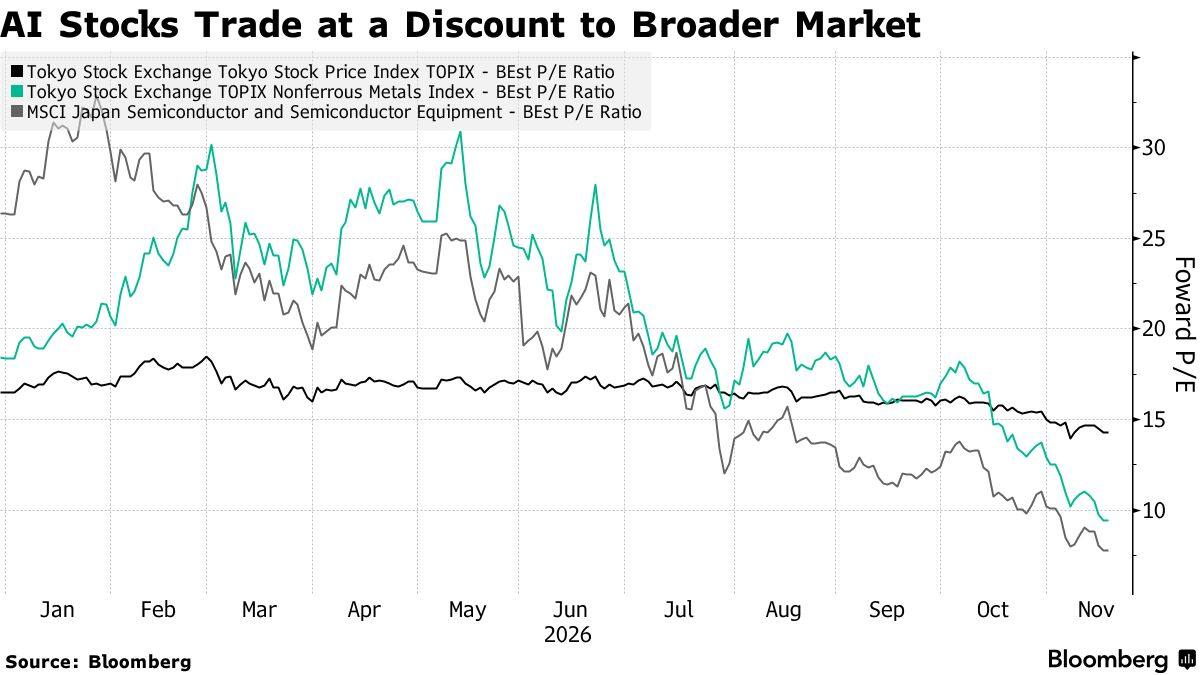
Yoshitaka Suda, cross-asset strategist at Nomura Singapore, said that AI-related stocks are facing a “triple blow”, including concerns about deteriorating profitability, market expectations of tighter regulations after the US midterm elections, and the impact of Nvidia's internal turmoil. He said that in this context, investors may be increasingly inclined to require AI stocks to provide valuation discounts rather than be willing to pay a premium for them.
Hiroaki Tomori, executive fund manager of Mitsubishi UFJ Asset Management, said, “Some AI-related stocks used to enjoy AI premiums, but now they have entered the AI discount stage. Just because they are associated with AI, it may lead to valuation discounts.” He added that some large AI stocks are still trading at premium valuations, so they may be vulnerable to further sell-off. In contrast, those stocks whose prices have been adjusted may be nearing the bottom.
Currently, analysts are still betting that AI investment will not slow down. According to compiled data, the capital expenditure of the six largest US technology companies is expected to reach 885 billion US dollars this year, and will further increase by 64% next year to reach 1.45 trillion US dollars. This week, Nvidia gave higher quarterly revenue guidance than Wall Street expectations, in an attempt to reassure investors that market demand will remain strong even after Hwang In-hoon leaves office. +
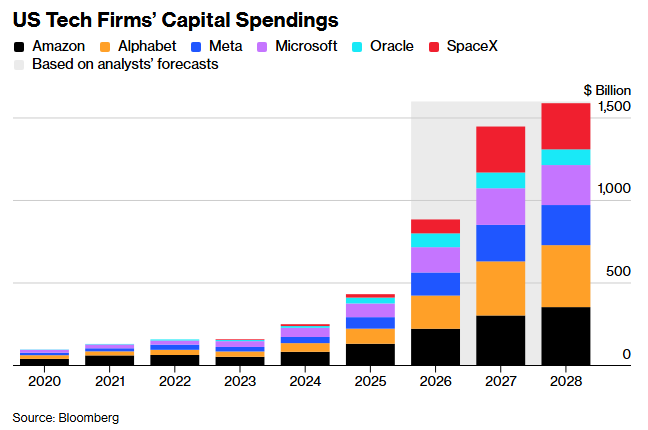
Capital expenditure for US tech companies
However, changes in the valuation of the Japanese market are already evident. The expected price-earnings ratio of the Tokyo Stock Exchange Non-Ferrous Metals Index (which includes cable manufacturers) for the next 12 months and the expected price-earnings ratio of the MSCI Japan Semiconductor Index for the next 12 months have all fallen below the level of the end of March — the AI market had not accelerated at that time. Currently, the valuation multiples of both indices are lower than the broader TSE stock price index.
This makes future profit expectations critical. Hiroaki Tomori said that data center investment could drop by 20% to 30% cannot be ruled out.
As the Kioxia situation shows, it is not easy to determine whether this sell-off has gone too far. The chipmaker currently expects less than 2 times the price-earnings ratio for the next 12 months. Fund managers generally believe that this level means that valuations are cheap. But this valuation is based on still optimistic earnings forecasts. If the AI investment boom slows down and corporate profit expectations are lowered, then Kioxia's valuation may be far less cheap than it seems on the surface.