
Nvidia Crushes Q3 With $115.8 Billion in Revenue, But Its Delayed 10-Q May Matter More
Nvidia (NVDA) last night delivered a commanding beat in its first earnings report without Jensen Huang, with fiscal third-quarter revenue soaring 103% to $115.8 billion against consensus near $109 billion. Even so, the company's decision to postpone its Form 10-Q by several weeks may matter more to investors than any headline figure.
The delay marks a notable break from precedent, as Nvidia filed the quarterly report alongside its earnings releases throughout 2025 and 2026, while every Magnificent Seven peer and Advanced Micro Devices (AMD) filed within a day of reporting.
The filing is not technically late, because the 40-day window from the Oct. 25 quarter-end remains open – yet Nvidia's last prolonged departure from its usual practice came in 2006 during a stock-option restatement whose audit review lasted nearly five months. For a company whose results routinely move the entire AI trade, that historical parallel is an uncomfortable one.
Nvidia Just Crushed Q3 Earnings
Data center sales climbed 110% to $107.6 billion, and adjusted earnings of $2.68 per share topped estimates by roughly 8%, while the new Vera Rubin platform contributed nearly $20 billion in its very first quarter of shipments.
Management also raised its fiscal 2028 growth outlook to 75% from 70%, and that revision is arguably a more telling signal than the $130 billion fourth-quarter guide, which benefits from an extra week estimated to be worth $9 billion to $10 billion.
Why the 10-Q Delay Matters for NVDA
Context sharpens the concern, with an independent board committee investigation ongoing, federal authorities probing partner Megaspeed over export controls, and the SEC reportedly examining Nvidia's shareholder disclosures.
A 10-Q contains risk factors, legal proceedings, and internal control evaluations, which makes it exactly where investigation-related disclosures would surface. That helps explain why prominent skeptics, including Michael Burry, have highlighted comparisons to companies with past accounting troubles.
Ballooning Receivables and Guarantees
The supplemental figures already released give those skeptics more to examine, starting with receivables that reached $81 billion, or 64 days of sales — the highest since the 2022 downturn — which the company attributed to extended payment terms for large customers.
Guarantees total $118 billion, including $105 billion of credit support for a single Ohio campus serving privately held OpenAI, while supply commitments jumped to $390 billion from $279 billion.
Meanwhile, gross margin guidance is falling to 71%–72% from 74.8%, and interim CEO Colette Kress signaled more selective customer financing ahead, suggesting the balance-sheet support behind recent demand may tighten.
Shares Bounce, But Resistance Holds
Shares are up roughly 3% premarket to near $160 after a bruising 39% five-week slide, but the after-hours rally stalled at technical resistance around $163. The options market was pricing in a 7% swing for NVDA today after earnings, so the reaction appears somewhat muted compared to expectations.
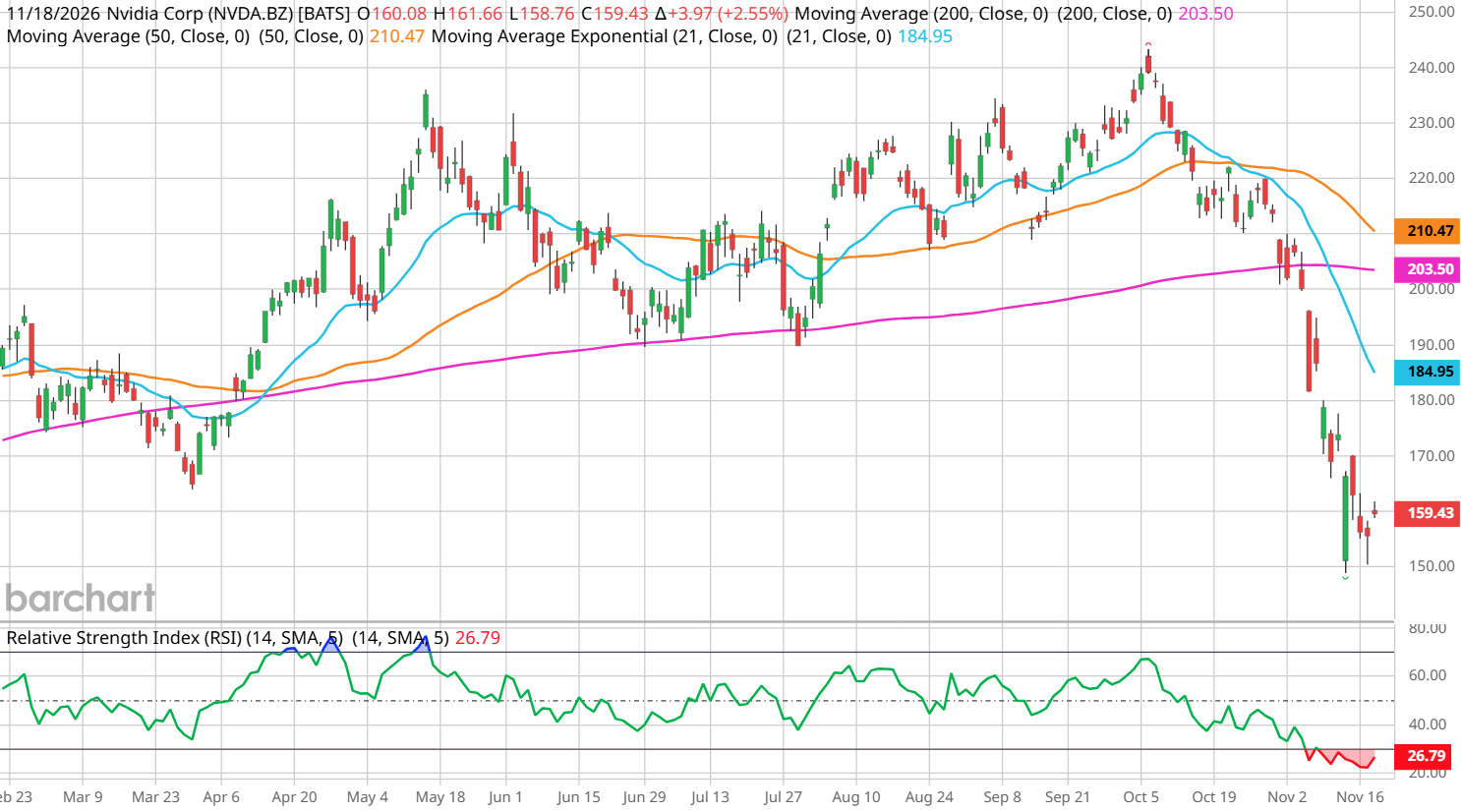
Macro conditions add pressure, with the 10-year Treasury yield ($TNX) above 5% and a December rate hike fully priced in, both of which weigh on long-duration growth names.
Still, a forward multiple in the low-to-mid teens and $227 billion in remaining buyback capacity provide some valuation support for a stock that has already absorbed significant damage.
A Governance Question Without an Answer
However, governance remains unsettled, because the board has ruled out reinstating Huang despite reports of a dissenting faction, while a permanent CEO search is underway.
Huang is also set to testify before Congress in December, adding another high-profile event to a calendar already crowded with regulatory scrutiny.
What’s Next for Nvidia
Until a clean 10-Q is filed, a governance and disclosure discount is likely to persist on NVDA shares, regardless of how strong the underlying demand for its chips appears.
The key signal will be whether the filing reveals a material weakness, a restatement, or expanded legal disclosures, any of which could overshadow a quarter that otherwise beat expectations by a wide margin. For now, Nvidia's numbers are the easy part — the paperwork is what investors are waiting on.
This article was created with the support of automated content tools from our partners at Sigma.AI. Together, our financial data and AI solutions help us to deliver more informed market headline analysis to readers faster than ever.
On the date of publication, Sarah Holzmann did not directly have a position in any of the securities mentioned in this article. All information and data in this article is solely for informational purposes. For more information please view the Barchart Disclosure Policy here.