
Store Expansion Plans Might Change The Case For Investing In Casey's (CASY)
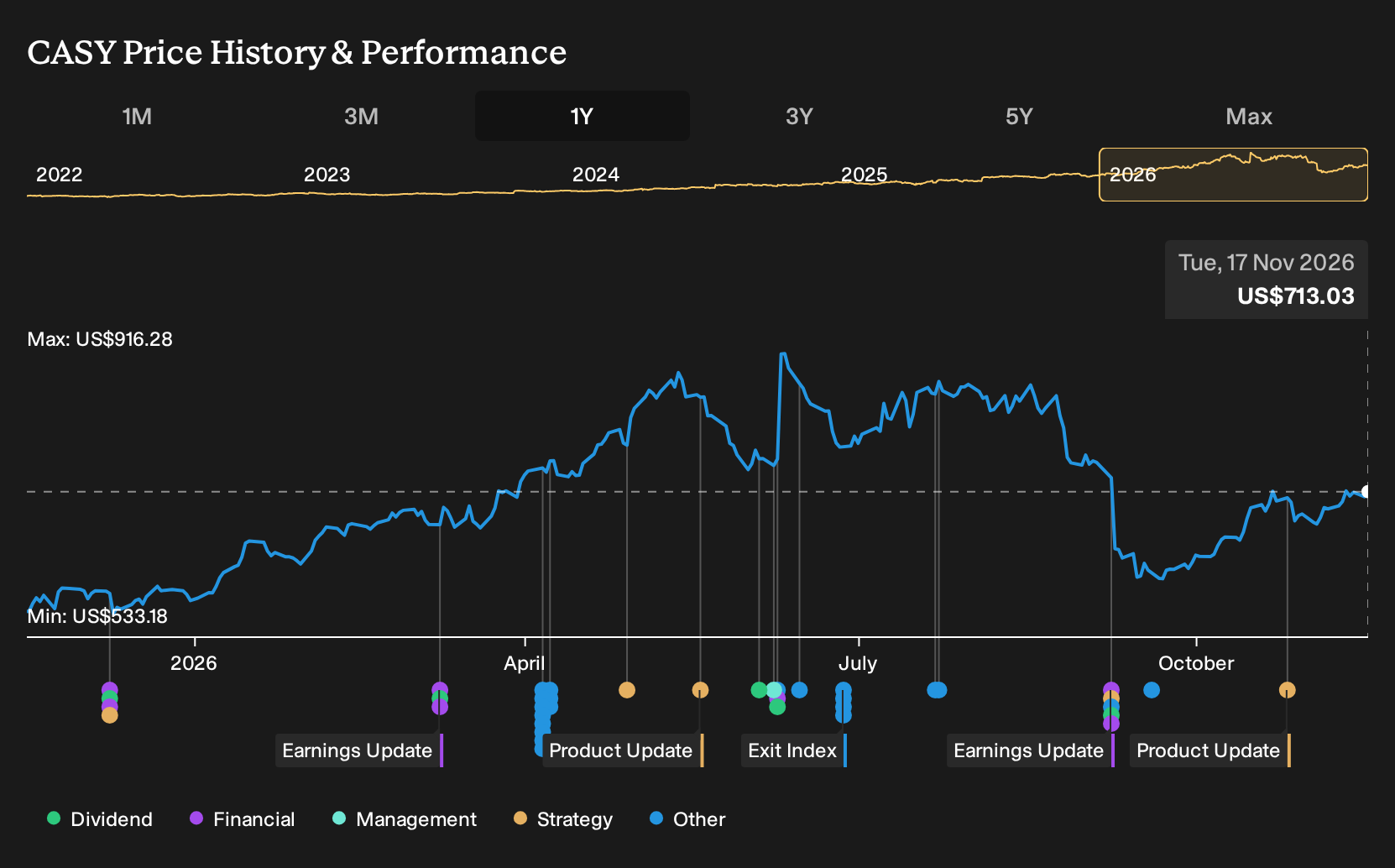
- Casey's General Stores has delivered five consecutive years of S&P 500 outperformance with profit up 160.8% over that stretch, supported by consistent annual profit gains.
- The chain plans 120 new stores in fiscal 2027 and targets at least 400 net new units through 2029, building on net income growth of 27% in Q1 FY27 and a 15 year track record of market outperformance.
- We will look at how Casey's multi year profit growth and the planned 120 store expansion reshape the broader investment narrative.
See how Casey's General Stores compares with other resilient compounders by reviewing our hand picked list of 29 resilient stocks with low risk scores.
Casey's General Stores Investment Narrative Recap
For Casey's General Stores, the core belief is that rural convenience formats and prepared food keep driving steady traffic, while new locations and remodels support higher earnings over time. The analyst consensus narrative on Simply Wall St leans on that mix shift toward higher margin categories. Recent outperformance versus the S&P 500 does not materially change that thesis.
The short term swing factor is whether inside sales and fuel margins hold up as 120 new stores in fiscal 2027 and CEFCO conversions roll through the P&L. The biggest risk is cost inflation and elevated capex keeping expenses and free cash flow tight, which could squeeze margins if inside trends soften.
The upcoming Q2 FY27 earnings release and conference call on 8 and 9 December 2026 is the next clear checkpoint for this story. Management will be updating investors after a Q1 where total operating expenses moved 8% higher year over year against 5.6% inside sales growth, and free cash flow was US$190m versus US$262m a year earlier.
For anyone tracking catalysts, this update matters because it should show how the 120 store build, the CEFCO integration and ongoing remodel program are flowing through fuel cents per gallon and prepared food margins. It is also a chance to hear how Casey's General Stores is using its reported US$1.4b of available liquidity and 1.5x debt to EBITDA leverage while still managing high debt and funding future growth.
Casey's General Stores' current analyst narrative points to revenues of US$22.2b and earnings of US$979.7m by 2029. These figures are built on 5.9% yearly revenue growth and an earnings increase of about US$206.9m from US$772.8m today.
Uncover why Casey's General Stores' fair value indicates a 12% potential upside to its current price, which could narrow quickly.
Exploring Other Perspectives
One alternate take on Casey's General Stores leans hard into fuel margin risk. The most cautious analysts were only penciling in revenues of about US$19.8b and earnings near US$917.0m by 2029, well below consensus. Your own view might shift after this latest outperformance streak and store build update; explore both narratives.
Explore 3 other Casey's General Stores fair value estimates, including one that suggests it could be worth just $715.93.
Decide For Yourself
Don't just follow the ticker; dig into the data and build a conviction that's truly your own.
- A great starting point for your Casey's General Stores research is our analysis highlighting 3 key rewards and 1 important warning sign that could impact your investment decision.
- See our latest analysis for Casey's General Stores. The report includes a comprehensive fundamental analysis summarized in a single visual, the Snowflake, making it easy to evaluate Casey's General Stores' overall financial health at a glance.
Looking for more investment ideas beyond Casey's General Stores?
Once you have a handle on Casey's General Stores, it can help to broaden your watchlist and compare it with other businesses that match your risk profile, income needs, and return expectations.
- If you want to focus on financial strength first and performance second, start with this list of solid balance sheet and fundamentals (24 results) to find candidates with sturdier foundations.
- For investors hunting for potential mispriced opportunities, use the 37 high quality undervalued stocks to see which companies the Simply Wall St model currently flags as looking cheap.
- If income is your priority and you care about cash coming back to shareholders, filter ideas with the 7 dividend fortresses and see which payers meet your yield and quality thresholds.
Have feedback on this article? Concerned about the content? Get in touch with us directly. Alternatively, email editorial-team@simplywallst.com