
Consumer discretionary - wireless, cable and satellite stocks Q3 teardown: Optimum Communications vs the rest

Earnings results often indicate what direction a company will take in the months ahead. With Q3 behind us, let’s have a look at Optimum Communications NYSE:OPTU and its peers.
The Consumer Discretionary sector, by definition, is made up of companies selling non-essential goods and services. When economic conditions deteriorate or tastes shift, consumers can easily cut back or eliminate these purchases. For long-term investors with five-year holding periods, this creates a structural challenge: the sector is inherently hit-driven, with low switching costs and fickle customers. As a result, only a handful of companies can reliably grow demand and compound earnings over long periods, which is why our bar is high and High Quality ratings are rare. Wireless, cable, and satellite companies provide pay-TV, broadband internet, and mobile connectivity through large fixed-infrastructure networks. Tailwinds include growing bandwidth consumption, bundling opportunities across video, internet, and wireless services, and rural broadband subsidies from government programs. However, headwinds are pronounced: cord-cutting continues to erode traditional video subscriber bases, capital expenditure requirements for network upgrades (such as fiber overbuilds and 5G rollouts) are substantial, and aggressive promotional pricing among competitors compresses margins. Regulatory oversight on pricing and net neutrality adds uncertainty, while streaming platforms increasingly bypass traditional distributors, reducing the value of the legacy pay-TV bundle.
The 7 consumer discretionary - wireless, cable and satellite stocks we track reported a mixed Q3. As a group, revenues beat analysts’ consensus estimates by 2.9%.
In light of this news, share prices of the companies have held steady as they are up 1.5% on average since the latest earnings results.
Optimum Communications NYSE:OPTU
Based in Long Island City, Optimum Communications (NYSE:OPTU) is a telecommunications company offering cable, internet, telephone, and television services across the United States.
Optimum Communications reported revenues of $2 billion, down 5.1% year on year. This print was in line with analysts’ expectations, but overall, it was a sluggish quarter for the company with a significant miss of analysts’ EPS estimates and a miss of analysts’ EBITDA estimates.
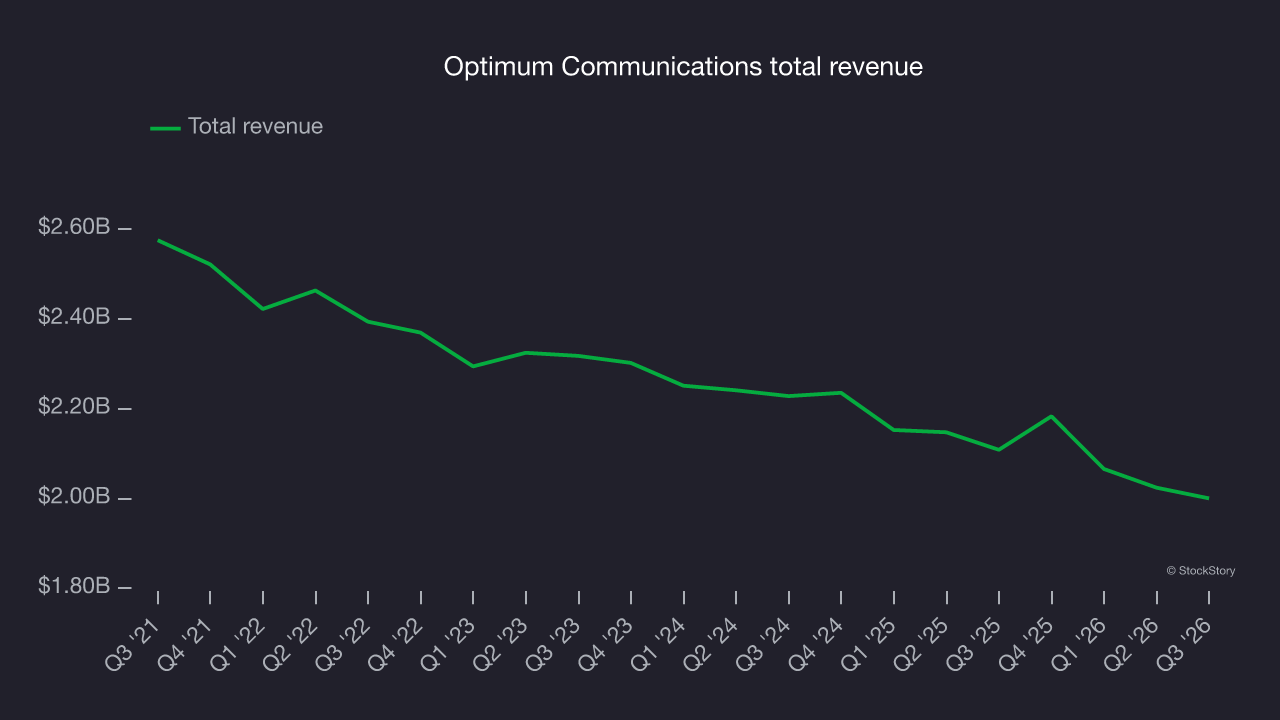
Interestingly, the stock is up 15.9% since reporting and currently trades at $0.66.
Read our full report on Optimum Communications here, it’s free.
Best Q3: Charter (NASDAQ:CHTR)
Operating as Spectrum, Charter (NASDAQ:CHTR) is a leading telecommunications company offering cable television, high-speed internet, and voice services across the United States.
Charter reported revenues of $16.51 billion, down 1.5% year on year, outperforming analysts’ expectations by 21.9%. The business had a very strong quarter with a beat of analysts’ EPS estimates and a decent beat of analysts’ EBITDA estimates.
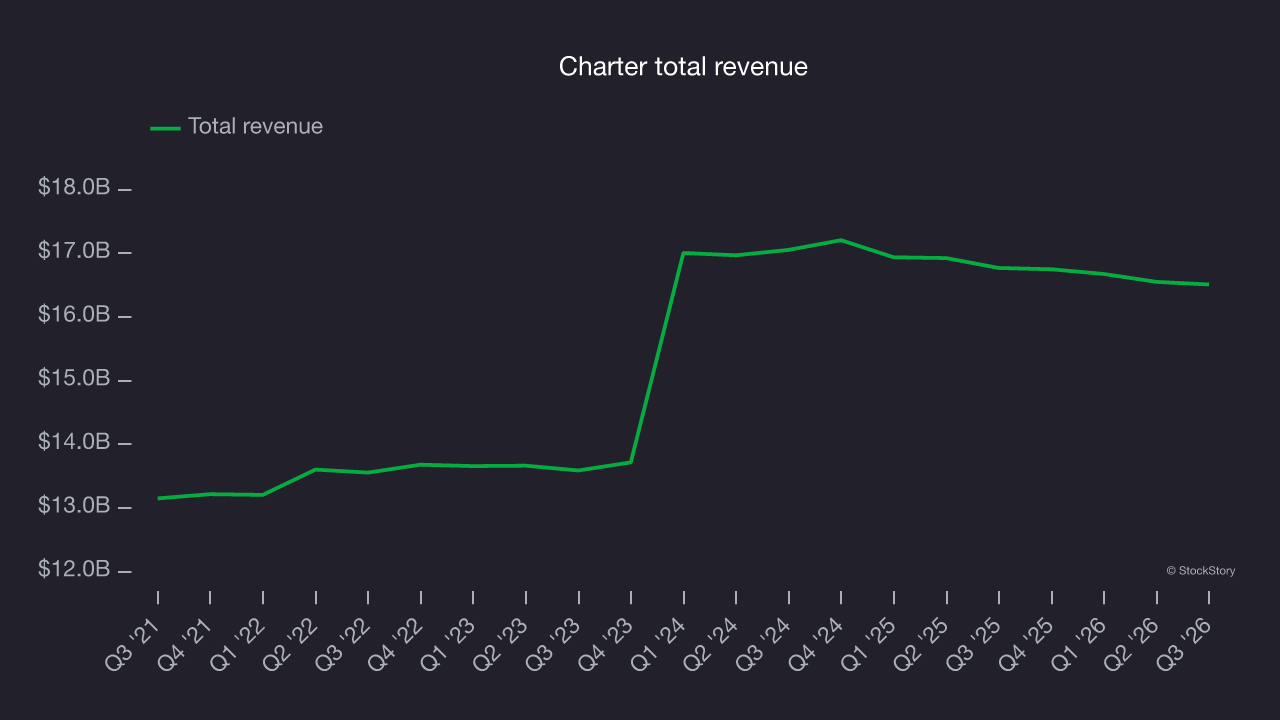
Charter achieved the biggest analyst estimate beat among its peers. The market seems happy with the results as the stock is up 9.2% since reporting. It currently trades at $137.44.
Is now the time to buy Charter? Access our full analysis of the earnings results here, it’s free.
Weakest Q3: Cable One (NYSE:CABO)
Founded in 1986, Cable One (NYSE:CABO) provides high-speed internet, cable television, and telephone services, primarily in smaller markets across the United States.
Cable One reported revenues of $332.2 million, down 11.7% year on year, falling short of analysts’ expectations by 3%. It was a sluggish quarter as it posted a significant miss of analysts’ EPS estimates and a miss of analysts’ EBITDA estimates.
Cable One delivered the weakest performance against analyst estimates and slowest revenue growth of the whole group. As expected, the stock is down 41.9% since the results and currently trades at $3.
Read our full analysis of Cable One’s results here.
Comcast (NASDAQ:CMCSA)
Formerly known as American Cable Systems, Comcast (NASDAQ:CMCSA) is a multinational telecommunications company offering a wide range of services.
Comcast reported revenues of $29.3 billion, flat year on year. This print met analysts’ expectations. Overall, it was a satisfactory quarter as it also put up a beat of analysts’ EPS estimates.
The stock is up 13.8% since reporting and currently trades at $25.14.
Read our full, actionable report on Comcast here, it’s free.
AT&T (NYSE:T)
Founded by Alexander Graham Bell, AT&T (NYSE:T) is a multinational telecomm conglomerate providing a range of communications and internet services.
AT&T reported revenues of $32.32 billion, up 5.3% year on year. This number topped analysts’ expectations by 2.1%. It was a solid quarter as it also recorded a beat of analysts’ EPS estimates.
AT&T pulled off the fastest revenue growth in the group. The stock is down 5.3% since reporting and currently trades at $22.18.
Read our full, actionable report on AT&T here, it’s free.
Market update
Over the past year, investors have been forced to repeatedly answer the same question: What is the market’s biggest risk? The answer has changed several times, and each shift has reshaped market leadership.
Late in 2025 and early 2026, artificial intelligence became the market’s primary uncertainty. Investors questioned whether AI would erode software pricing power and weaken competitive moats as AI made it easier to replicate once-differentiated products.
By the spring, technology took a back seat to geopolitics. The U.S. conflict with Iran briefly became the market’s dominant narrative, raising concerns about oil prices, inflation, and global growth. But as energy markets remained orderly and fears of a prolonged supply disruption faded, investors quickly turned their focus back to fundamentals.
Want to invest in winners with rock-solid fundamentals? Check out our Top 5 Growth Stocks and add them to your watchlist. These companies are poised for growth regardless of the political or macroeconomic climate.