
Is global funding betting back on Europe? Technology stocks experienced the most severe allotment cuts in nearly 20 years, but the bullish sentiment in European stocks hit a nine-month high
The Zhitong Finance App learned that just as Wall Street financial giant Bank of America's latest fund manager survey showed that the net overallocation ratio of global technology stocks fell from 37% in October to 12% in November, down 25 percentage points in a single month, the biggest decline since June 2006, the European stock market has quietly outperformed the global market, and the latest capital flow data shows that in the week ending November 11, the net inflow of European equity funds was 35.13 billion US dollars, a new high since June 2021.
Since this year, investors have rarely been as optimistic about the future of the European stock market as now; they even expect that European stocks will have room to rise further.
The European stock market has outperformed the global market. Since the beginning of 2026, the Stoxx Europe 600 Index has risen strongly by 9.88%, leading the global stock market. As a comparison, the MSCI All Country Index (MSCI All-Country Index) has risen 6.3% during the same period. This quarter, AI trading pulled back sharply, shaking the global market, and the European stock market generally withstood this round of shock.
European companies have performed better than expected in dealing with oil price shocks, and are now expected to benefit from falling crude oil prices. The low weight of the technology sector, moderate economic growth, and the government's introduction of large-scale spending plans are attracting investors.
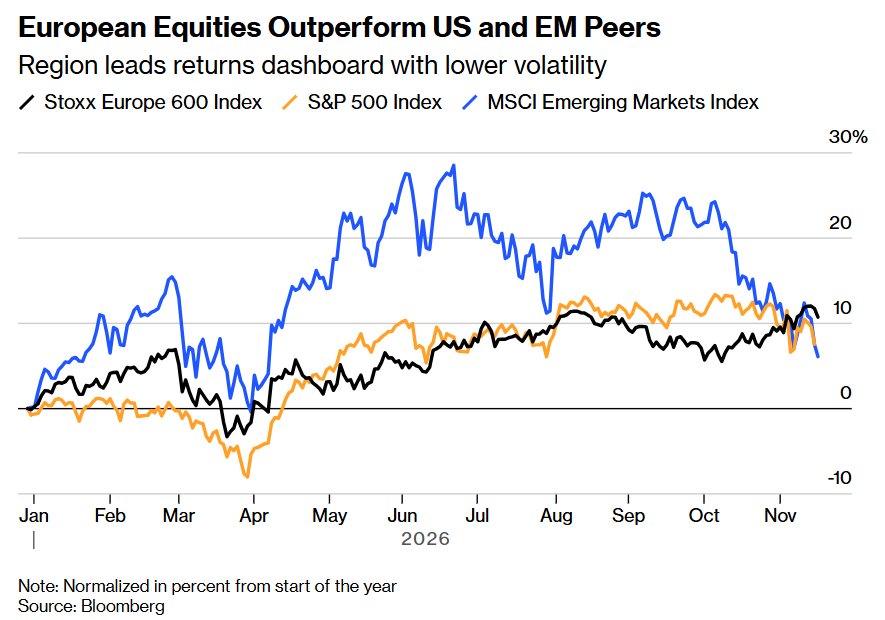
As shown in the chart above, the European stock market significantly outperformed the US and emerging markets. Europe is at the top of the regional returns ranking with low volatility. Note: The cumulative performance is shown as a percentage based on the beginning of the year.
Bank of America strategists, including Paulina Strzelinska, said while interpreting this month's European fund manager survey: “Looking ahead to 2027, investors are becoming more optimistic about the European market. The net share of respondents who expect the European stock market to rise in the next one to three months reached 67%, the highest since February.”
Position data from the survey also showed that European stock markets still have the potential to rise further. Global investors' allocations to Eurozone stocks are still 0.8 standard deviations below the long-term average. In November, the net underallocation ratio of investors to Eurozone stocks narrowed to 5% from 8% last month. The net underallocation ratio for UK stocks narrowed to 21% from 26% in October.
Earnings are expected to be the main driver of the rise in the stock market. Europe is going hand in hand with the US in this regard. According to the current financial report schedule, the earnings per share of MSCI European Index components are expected to increase 33% year-on-year in the current quarter, which is similar to the growth rate of S&P 500 index constituent stocks, and far higher than the 23% expected by the market before the start of the earnings season.
Since this year, European companies' profits have grown faster than stock prices, and the valuation multiplier for European stocks has declined by about 6% as a result. As long as corporate profits remain strong, the European stock market is expected to remain attractive compared to other markets.
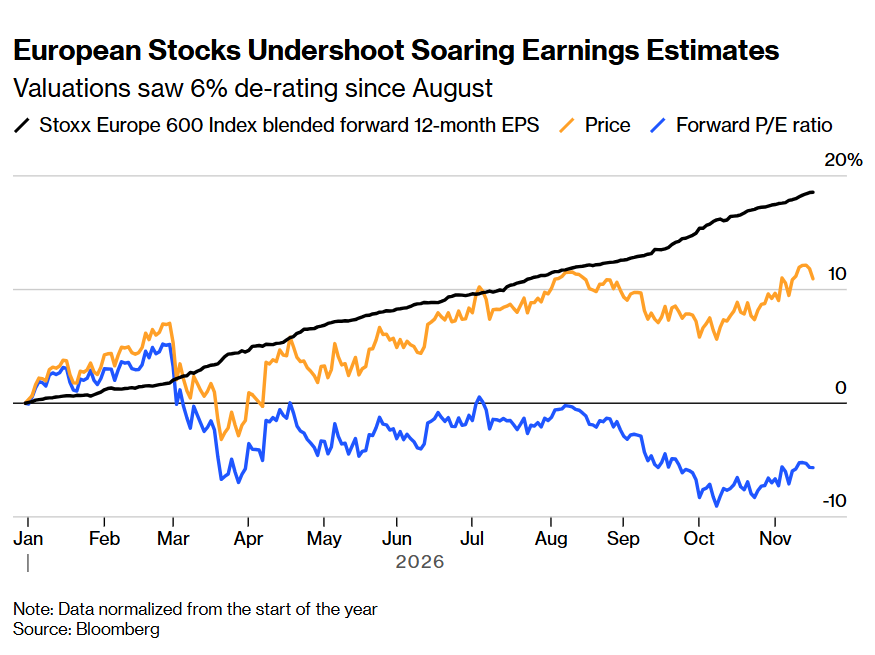
As shown in the chart above, the increase in European stock prices lagged behind the rapidly rising market's consensus profit expectations. Since August, the valuation multiplier has dropped 6%. Note: The data is standardized based on the beginning of the year.
Bank of America strategists pointed out that enthusiasm for the European market has left investors in a dilemma: 33% of respondents ranked excessive concentration of positions on popular trades as the biggest risk faced by their portfolios, while another 30% were worried that their positions were too light and missed the upward trend.
Some market forecasters believe that European stock market gains may soon lose momentum. The challenges they listed include higher valuations of European stocks compared to US stocks, political instability in parts of Europe, and the risk of slowing profit growth.
In terms of earnings, about half of this quarter's profit increase came from energy stocks. Oil prices have fallen by about 20% this month, and the energy industry's boosting effect on profit growth is likely to gradually weaken. If the US and Iran reach a peace agreement, this impact will be even more obvious.
European corporate profits are expected to grow 20% this year, and the growth rate is expected to slow to 9% in 2027. For Europe, this is still a pretty strong performance. Furthermore, falling energy prices will reduce operating costs in most other industries, which is expected to largely offset the impact of the energy industry's weakening profit contribution.
The main benefits facing the European stock market include government spending commitments on defense and infrastructure, particularly in Germany. The forecast shows that Europe's economic growth rate will accelerate from 1.2% this year to 1.5% in 2027. At the same time, applying AI and controlling costs have helped companies improve profit margins, and this trend is expected to continue until next year.
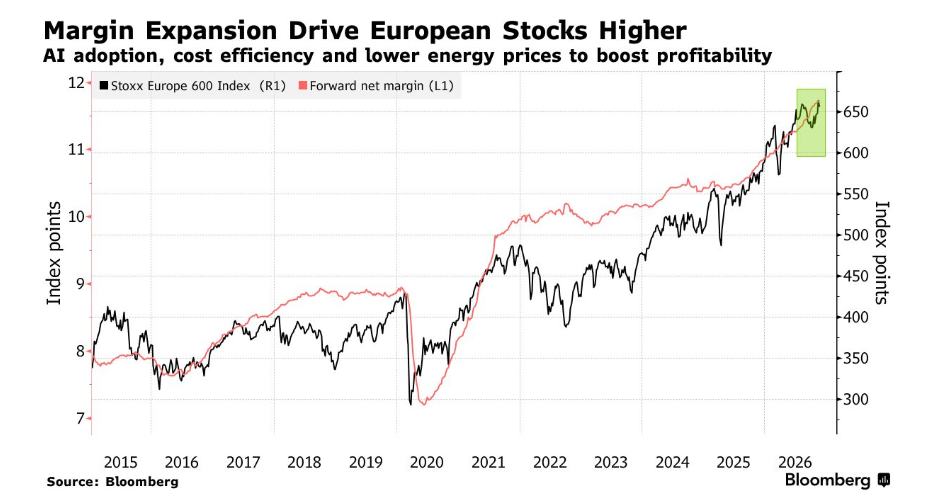
As shown in the chart above, the expansion of profit margins is driving up the European stock market — the penetration of AI applications into more industries will drive profit expansion, cost and operating efficiency improvements, and falling energy prices are expected to improve corporate profitability.
Earlier this month, Citigroup's strategy team, led by Beata Mante, raised European stocks other than the UK to “overvalued.” They believe that various policy adjustments in Europe are expected to drive long-term earnings per share growth. The team said, “We believe that stock market valuations have yet to fully reflect the impact of policy shifts. Over a longer period of time, the valuation multiplier may increase by 10% as a result.”
The global semiconductor rebound was sold off again. Where did the relative resilience of European stocks come from?
The Philadelphia Semiconductor Index rebounded 17.2% from November 5 to 11, but when Nvidia CEO Hwang In-hoon resigned and the US further restricted China's access to advanced AI chips, the rise was reversed again. On Monday, November 16, Fee Half fell 5.28%. On Tuesday, it only rebounded 0.34%. It is still about 34% below the high in late June, and is in a technical bear market. The Nasdaq 100 index fell 2.67% and 0.72% on Monday and Tuesday, respectively.
In the Asian market, the weighted index of Taiwan, which has a higher chip weight, fell 6.03% and 2.31% respectively on the two days, with a cumulative retracement of 8.20%; the Korea Composite Index fell 3.59% and 2.59% respectively, with a cumulative retracement of 6.09%. Since the Democratic Party's victory in the midterm elections led to a sharp slowdown in the market, and after the Nvidia CEO crisis continued to unfold, investors, from US chip designers to Asian foundry and storage vendors, are also re-evaluating the dependence of this AI computing power industry chain on AI computing power procurement from a few major customers.
According to the Bank of America Global Fund Managers Survey, the net overallocation ratio of technology stocks fell from 37% in October to 12% in November, down 25 percentage points in a single month, the biggest decline since June 2006. The Bank of America fund managers survey was conducted from November 6 to 12. The global portion covered 169 fund management agency participants, with a total assets under management of US$461 billion. Regional questions in the European market were answered by 94 participants, with assets under management totaling US$241 billion.
In contrast, LSEG capital flow data shows that Europe has attracted huge amounts of actual capital — in the week ending November 11, the net inflow of European equity funds was US$35.13 billion, a record high since June 2021.
However, the Stoxx Europe 600 Index also fell 1.75% on Tuesday, lithography maker Asmack fell 5.3%, and power equipment company Siemens Energy fell 3.1%. This shows exactly where Europe's allocation value is — that is, semiconductor equipment and data center power supply companies closely surrounding the global AI infrastructure frenzy are still sensitive to AI capital expenditure, and the overall European market index also has a number of companies whose profits depend more on public investment, energy costs, and their own operating efficiency.
The bulls are increasing, and positions are still low. The next round of growth depends on who can continue to contribute strong profits
As of November 17, the Stoxx Europe 600 Index rose 9.88% during the year, leading the MSCI Global National Index by about 3.58 percentage points according to statistics compiled by the agency.
In the Bank of America European Fund Managers Survey, the net share of respondents who expect European stocks to rise in the next one to three months rose from 44% to 67%, a nine-month high, yet global investors are still net under-valued by 5% for Eurozone stocks.
The distance between looking long and holding positions leaves room for subsequent increases. Half of the European survey respondents listed an increase in profit forecasts as the most likely driving force for further growth, and the current financial reporting season has already given the basis: the profit per share growth rate of MSCI European Index is expected to reach 33% year-on-year, 10 percentage points higher than the forecast before the start of the earnings season, which is similar to the S&P 500 index; in addition, statistics show that since August, the valuation multiplier for European stocks has shrunk by about 6%.
What determines how far this round of market can go is whether profit growth can expand from energy companies to more industries. Energy stocks contributed about half of this quarter's profit increase. Oil prices fell by about 20% in November, and this contribution may have weakened. For other companies, how much profit a reduction in costs can leave depends on when the purchase contract is repriced, and how much of the savings will be passed on to the customer through price reduction.
German defense and infrastructure budgets are converted into orders, and companies use AI to reduce processing costs for each transaction, which is expected to provide new support for profits in 2027. Citi has raised European stocks other than the UK to overallocation, and believes that policy changes are expected to increase the valuation multiplier by about 10% in the long term. As Europe's overall profit growth rate is expected to slow from 20% this year to 9% next year, what is most worth tracking is whether orders, profit margins, and profit forecasts in the non-energy sector can improve simultaneously.