
The 6% yield isn't “extremely cheap” either! Fidelity throws cold water: long-term inflation and debt risk are key, and it may be difficult for US debt to become a “safe haven” for the stock market
The Zhitong Finance App learned that the recent resale of US Treasury bonds has sparked extensive discussions on buying opportunities in the market. According to Salman Ahmed, head of global macro and strategic asset allocation at Fidelity International, even if the 10-year US Treasury yield rises to 6%, it will not be enough to make it “extremely cheap.”
Fidelity said this judgment is based on its valuation framework, which takes into account factors such as steeper yield curves, rising real interest rates, and high long-term inflation. Ahmed added that Fidelity has a “neutral” stance on the long-term term of US Treasury bonds and believes that the effectiveness of US Treasury bonds as a tool to hedge against stock market fluctuations is declining.
In an interview in Singapore this week, Ahmed said: “The overall correlation between stocks and bonds is positive. This situation will not change due to various factors. The size of the fiscal deficit has widened dramatically, debt continues to rise, and inflation is more sustainable.”
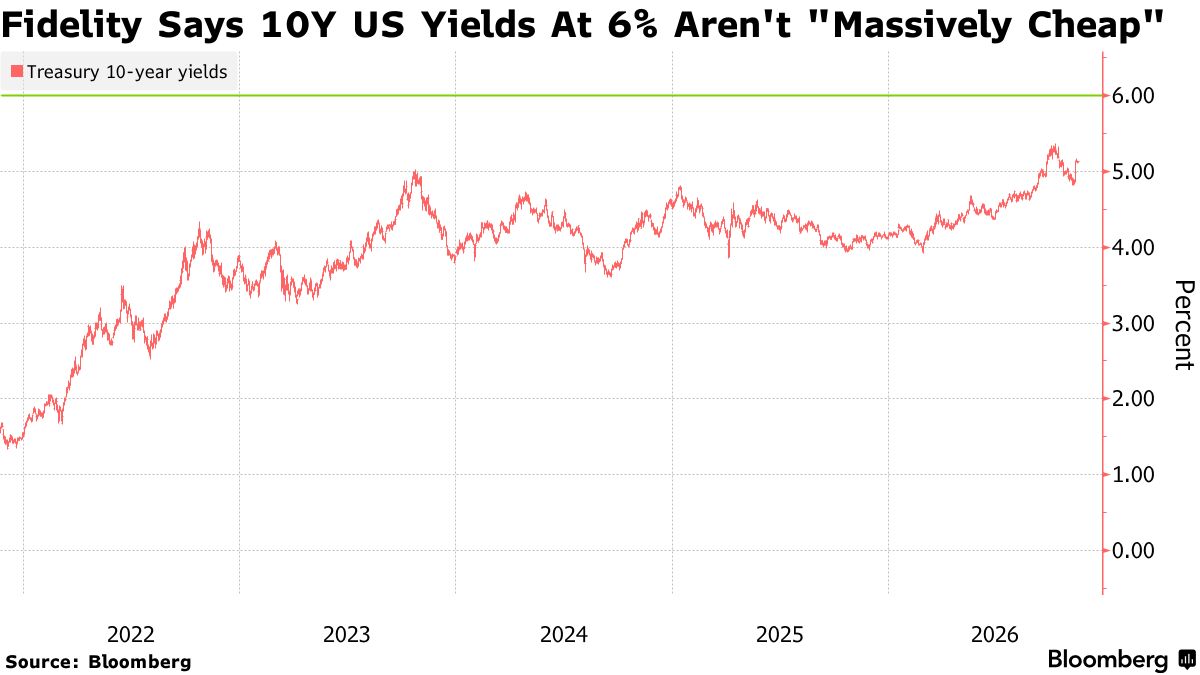
The sharp drop in the price of US Treasury bonds last week has once again sparked discussions in the market about the top position of yield, as well as debates about whether current bond valuations are attractive enough to re-attract investors. Some market observers, such as Prudential Group, have warned that bond yields may not peak until the US economy falls into recession; other institutions, such as Goldman Sachs Group, believe that US Treasury bonds can provide attractive yields, and that current valuations are already at a “cheap” level.
As bond traders re-established bearish positions, short positions on US bonds have accumulated significantly. If concerns surrounding artificial intelligence (AI) stock trading heat up again and cause capital to shift to safe-haven assets, then the US bond market may be squeezed by bears as a result.
Ahmed warned that if the yield on US Treasury bonds quickly approaches 6%, the US government may intervene because rising borrowing costs may further increase the burden on the government to repay its debts. He added that if yields fluctuate sharply and could jeopardize financial stability, the possibility that the US government would intervene would be particularly high.
However, this is not Fidelity's basic scenario. According to Ahmed, the probability of this tail risk occurring is closer to 25% to 30%. He said that potential intervention measures may take the form of yield curve control, etc.
In August of this year, US Treasury Secretary Bessent tried to reduce long-term borrowing costs by expanding government debt buyback operations. Although this move drove bond yields lower, as the dollar was impacted, the market was once again reminded of the so-called “Debasement Trade” (Debasement Trade). Ahmed said, “If the yield on long-term treasury bonds gets out of control, the subject of currency depreciation transactions will actually heat up,” and this may prompt the US government to take intervention measures. However, he added that this is still a tail risk scenario, and the probability of occurrence is about 20% to 25%.