
Qunzhi Consulting: Total smartphone panel shipments in the third quarter of 2026 increased by 1.8% year-on-year, and the growth rate was significantly narrower than in the first half of the year
The Zhitong Finance App learned that Qunzhi Consulting published an article stating that total smartphone panel shipments in the third quarter of 2026 were about 600 million units, an increase of 1.8% over the previous year, and the growth rate was significantly narrower than in the first half of the year. The growth engine was supported by “two-wheel drive” convergence to a single point of a-Si LCD in the South China market, and the market showed slight growth characteristics.
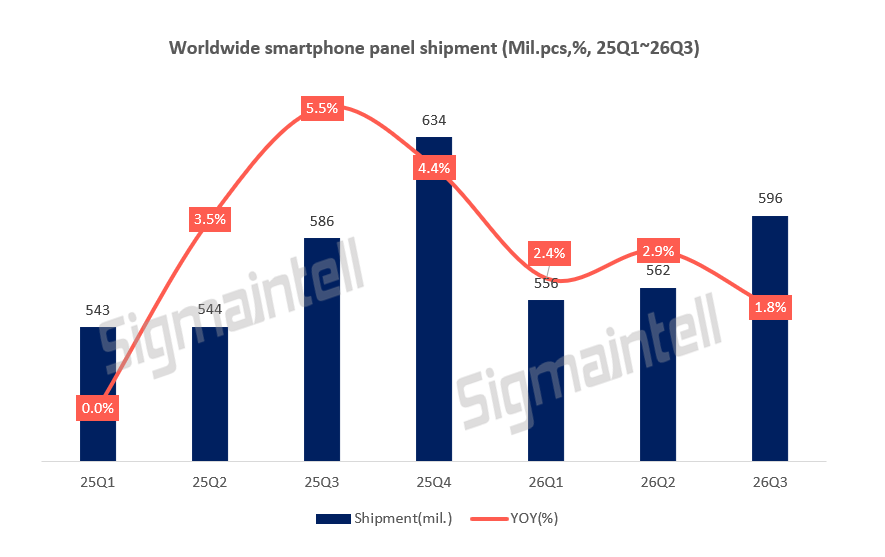
In the third quarter of 2026, there was only a single point of support from demand for a-Si LCD in South China. The final total shipment volume was about 600 million pieces, up 1.8% year on year, against strong demand in the maintenance market and weakening brand demand. The incremental structure was concentrated in the lower unit price range. For panel manufacturers, behind the “slight increase” is a decline in revenue quality; judging from the general market, if inventory in the South China maintenance market is high and delivery momentum weakens, the overall shipment growth rate may rapidly come under pressure.
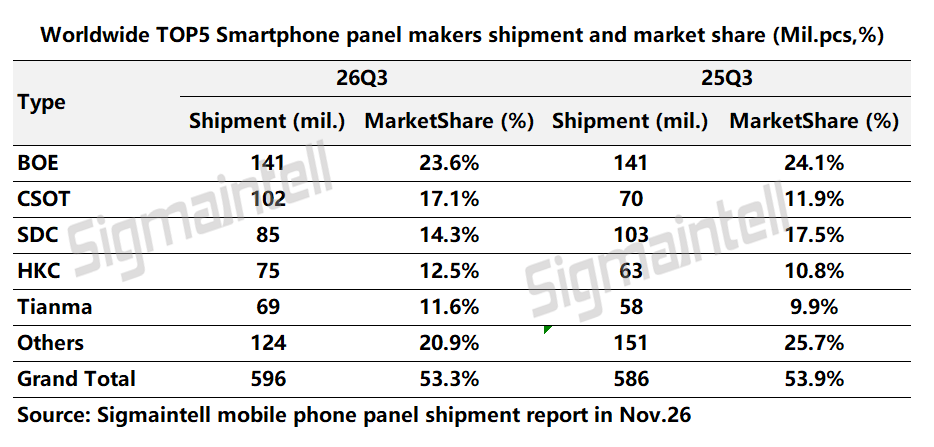
Competitive landscape: Total shipments from the top 5 manufacturers increased by 8.5% year on year, and Huaxing Optoelectronics (CSOT) rose to second place in the world
Looking at the overall pattern, the total shipments of the top 5 panel manufacturers increased by 8.5% year on year, with a total market share of about 79%, a further increase from 77% in the first half of the year, maintaining a stable competitive structure of the “top five + small and medium-sized manufacturers” for many consecutive quarters. However, the concentration of shares does not mean that the pattern has stood still: an obvious structural rearrangement was completed within the top five this season, and Huaxing Optoelectronics (CSOT) rose to second place, while small and medium-sized manufacturers continued to be squeezed:
BOE (BOE): It held the top position in the world with a 23.6% share, and shipped about 140 million tablets in the third quarter. By category, a-Si LCD shipped about 100 million pieces, up 4.8% year on year, and flexible OLED about 38.5 million pieces, which is basically the same as the previous year. Its 8.6-generation flexible OLED production line continues to climb. The medium size has been mass-produced and delivered at a rapid pace, and the small size will proceed according to the plan.
Huaxing Optoelectronics (CSOT): It rose to second place in the world with a share of 17.1%. Shipments in the third quarter were about 100 million pieces, an increase of 46% over the previous year, the highest growth rate among the top 5. The main increase was due to a-Si LCD, which shipped more than 80 million pieces, a year-on-year increase of 78.4%. Flexible OLEDs shipped about 18 million pieces in the third quarter. In the future, flexible OLEDs will continue to reduce costs and improve as the core goal, seize opportunities for low-end flexible OLEDs and maintenance demand; accelerate the commercialization of printed OLEDs; and explore structural growth opportunities in the downturn cycle of the whole machine.
Samsung Display (SDC): Shipments in the third quarter were about 85 million tablets, down 16.7% year on year. Among them, flexible OLEDs were about 56 million, down 9.1% year on year, and rigid OLEDs were about 30 million, down 28% year on year. The flexible and rigid business is under simultaneous pressure: Flexible OLEDs are facing competition from Chinese panel manufacturers. The rigid end is affected by the flexible penetration of mid-range models, and its share has declined to third place.
Technical pattern: Flexible OLED shipments have changed from increase to negative, and a-Si LCD continues to expand against the trend.
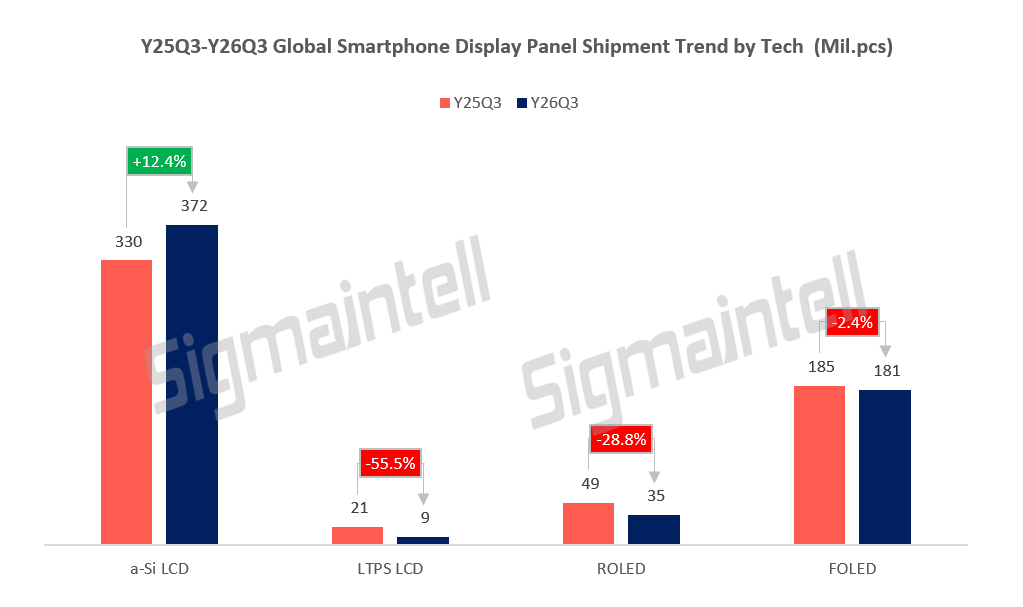
Demand for smartphone terminals weakened further in the third quarter of 2026 due to rising costs driven by rising storage prices, but panel shipments depended on demand for a-Si LCDs in South China to achieve a slight increase. Flexible OLEDs shipped about 180 million pieces in the third quarter, down 2.4% year on year. The overall structure is “strong at the low end and weak at the high end”.
a-Si LCD:
Total smartphone a-Si LCD panel shipments in the third quarter of 2026 were about 370 million, up 12.4% year on year, and the overall market share reached 62.3%, a further increase from 60.7% in the first half of the year. The core growth driver continues to be driven by strong demand in the South China maintenance market. Huaxing Optoelectronics (CSOT) increased 78.4% year-on-year, Tianma (Tianma) grew 69.9%, and Huike (HKC) grew 17.9%; small and medium-sized panel manufacturers continued to shrink under the double squeeze of prices and orders.
FLEXIBLE OLED:
Total flexible OLED shipments in the third quarter of 2026 were 180 million, down 2.4% year on year. This is the first negative turn in the past two years, which is an important inflection point. The direct reason for the year-on-year negative change in this quarter was that the increase in storage prices boosted overall machine costs and suppressed terminal sales, and brand panel orders contracted; rising demand in the South China market hedged, which reduced the decline to a slight range. Structurally, only LGD (25.8% year-on-year increase) and BOE (basically the same level) remained resilient. Other panel manufacturers declined in the same overall trend, and subsequent growth will depend more on the decline in flexible OLEDs in low-end models.
Rigid OLED:
The total number of rigid OLED shipments in the third quarter of 2026 was 35 million, a year-on-year decline of 28.8%. Mid-range models are becoming more flexible, and the stock maintenance market is also moving closer to flexible OLEDs. The demand for rigid OLEDs is gradually unifying, and most of the demand comes from Samsung.
LTPS LCD:
In the third quarter of 2026, LTPS LCD shipped a total of about 9 million pieces, a sharp drop of 55.5% from the previous year, accounting for less than 2% of the overall market. The life cycle as a transition technology is coming to an end at an accelerated pace.
Short-term maintenance demand is underpinned, medium- to low-end FOLED brings growth, and there are still challenges in price and profit; looking ahead to 2027, the machine market continues to decline, and panels still have opportunities for structural growth
Sigmaintell (Sigmaintell) believes that rising machine costs are compressing brand promotion space, switching cycles are further lengthening, short-term terminal phone market demand continues to weaken, brand panel orders are shrinking, and overall panel shipments are under pressure. Although the fourth quarter was the traditional peak season, the peak season clearly weakened, and growth depended more on the high demand for maintenance and replacement and the relative stability of Apple's high-end model orders.
In the medium to long term, the incremental path of terminal brands is focused on the two main lines of “technological sinking+form innovation”: on the one hand, low-end flexibility has become the main focus of panel manufacturers to replace LCDs. However, there is still a lot of cost optimization pressure on this route, and it is difficult to improve profit levels in the short term. The short-term core value is to drive production line operation. At this stage, the focus of panel factory operations has shifted from capacity expansion to stock capacity revitalization and utilization rate management.
On the other hand, innovative forms such as wide folding and wide straight boards are important structural growth opportunities in 2027. In addition to flexible OLEDs, panel solutions with a wide and straight panel ratio have also been launched and planned; most terminal brands have an active layout, and product plans cover the full price range, and wide-panel models will usher in significant growth in 2027.