
Accelerate the spread of “AI dividends” to the application side! British companies use AI to improve efficiency and increase Wall Street's profits and begin to “overfit” the British stock market
The Zhitong Finance App learned that the sharp differentiation of the global AI trading theme is extending from within the AI industry chain in a broad sense to different stock markets around the world. At a time when the US stock market and the Asian stock market plummeted, the British stock market can be described as showing strong resilience, significantly outperforming the global benchmark stock index and the MSCI North American and Asian benchmark stock index. The revaluation logic of the UK stock market is that the market is beginning to combine the productivity dividends brought by AI with the long-term profit cashout of mature businesses and lower valuation starting points — whoever can continue to efficiently transform cutting-edge AI technology into profit and cash flow will have a better chance of getting market repricing.
After the Democratic Party won the midterm elections and Hwang In-hoon resigned as CEO of Nvidia, the market began to re-examine the capital requirements and return cycle of computing power expansion, and at the same time began to focus on mature companies that can use AI technology to drive profit growth. Bank of England, financial data, consumer goods and education companies embed AI in customer service, information retrieval, R&D, and content production. As a result, the investment value falls on reducing unit operating costs, expanding service capabilities, and improving profits after deducting deployment and operating costs.
Morgan Stanley emphasized the leading performance of British companies in quantifying the benefits of AI adoption, providing an operational-level basis for this main line; the valuation discounts, high dividends, and active mergers and acquisitions of British stocks further enhanced the attractiveness of allocations. On this basis, Barclays overtook the UK and preferred FTSE 250. Goldman Sachs is optimistic that energy prices and treasury bond yields will fall in 2027 to support domestic stocks.
From November 9 to 13, the Philadelphia Semiconductor Index and the Nasdaq 100 Index rebounded by about 8.05% and 3.53%, respectively, but fell 5.28% and 2.67% respectively on November 16; compared with their respective historical closing highs, the cumulative retracement was about 34.33% and 12.90%. Nvidia announced the resignation of Hwang In-hoon as CEO on November 12. The leadership transition further increased market anxiety about the continuity of AI computing power strategies and large-scale AI financing projects. The Asian market closed on the same day, and the Taiwan Weighted Index, South Korea's KOSPI, and Nikkei 225 fell 6.03%, 3.59%, and 2.42% respectively; in contrast, the UK FTSE 100 and FTSE 250 fell by about 0.2% and 0.4%, respectively, showing relative resilience.
The investment appeal of the UK stock market comes from the combination of corporate growth benefits, local economic resilience, and valuation discounts brought about by AI applications. Morgan Stanley believes that British companies are leading Europe in quantifying the benefits of AI adoption, and are optimistic about Lloyds Bank, National Westminster Bank, London Stock Exchange Group, Liquitex, and Pearson.
At the same time, the British FTSE 250 index, which is more biased towards the local economy, has outperformed FTSE 100, which accounts for a relatively high share of international business since the end of the first quarter, indicating that investors are beginning to re-evaluate UK growth and corporate profits, and investors are generally beginning to measure the quantification of AI earnings and a new round of valuation expansion of mid-cap stocks. The room for revaluation brought about by interest rates linked to the Bank of England's policy path is still expected, and efficiency improvements brought about by cutting-edge AI technology are already supported by some corporate data.
Wall Street's institutional allocation ideas also generally follow this direction — J.P. Morgan emphasizes discounted valuation of British stocks, high dividends, and relatively low risk of AI trading recession; Barclays overallocated the UK in the 2027 allocation and favors FTSE 250. For local British companies, falling oil prices are expected to reduce transportation and production costs and ease the pressure on residents' spending; for energy companies in FTSE 100, it may significantly weaken profit contributions.
On November 16, Brent crude oil fell 3.6% to 92.44 US dollars per barrel. Expectations for the recovery of Middle Eastern exports and oversupply became the main source of pressure for the day. This is also the important logic of Goldman Sachs's preference for domestic stocks in the UK: if energy prices and UK Treasury yields continue to decline in 2027, sectors such as consumption, residential construction, and real estate may simultaneously receive operational and valuation support.
AI boosts growth prospects in the UK, and the UK stock market is beginning to attract investors
British investors are gradually re-acknowledging the resilience of the local economy. AI adoption is becoming an important factor driving local stock performance and helping the economy stay strong in an unfavorable environment.
Since the end of the first quarter, the FTSE 250 index's performance has surpassed the FTSE 100 index, which is more biased towards the global market, and economic growth that has exceeded expectations has supported it. If monetary policy stabilizes, this trend will be further promoted.
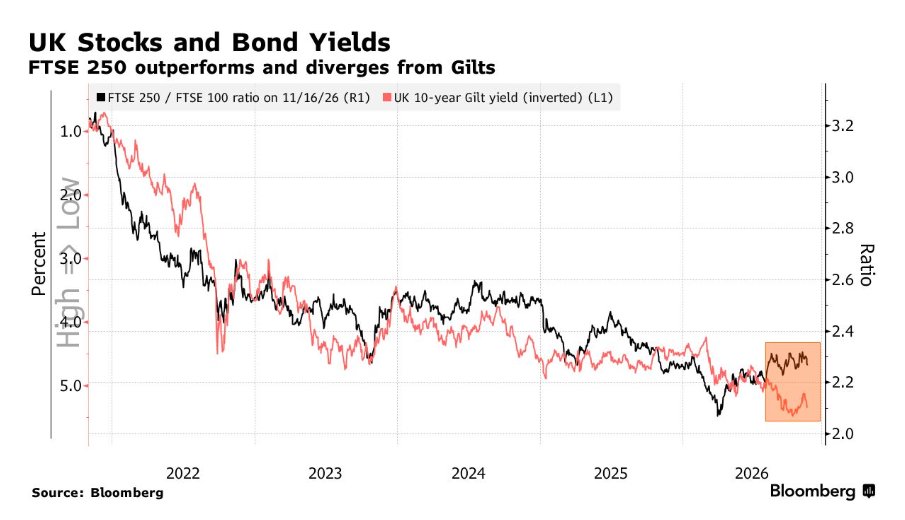
The picture above shows a comparison between the UK stock market and treasury bond yields — the FTSE 250 Index is leading the way and is different from the trend of British treasury bonds.
Morgan Stanley strategist led by Marina Zavolock (Marina Zavolock) said, “The UK has the most companies that quantify the benefits of AI adoption, and the number of British stocks is also the largest in our 'Europe's Leading AI Adoption Companies Quantifying Return on Investment' list. This is in line with our British economists' research on rising productivity.”
According to the statistics of these strategists, in the past 12 months, 22% of British companies have given quantitative figures on the benefits of adopting AI, which is higher than in other European countries. Stocks that are in line with this trend include Lloyds Bank Group, National Westminster Bank Group, London Stock Exchange Group, Regent's Group, and Pearson Group.
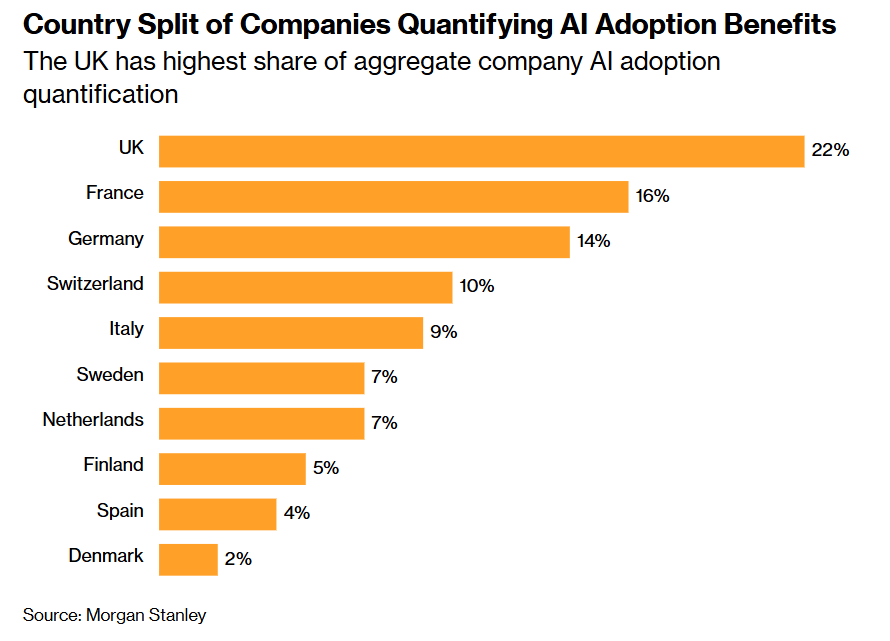
The above chart shows how Morgan Stanley uses AI technology to quantify the operating efficiency and growth benefits of enterprises — the UK accounts for the highest share of total quantitative disclosure of corporate AI adoption revenue
The fall in oil prices gave British stocks an advantage because the profits and returns of the FTSE 100 Index are highly sensitive to crude oil prices. Benchmark Brent crude oil has fallen 20% this month. The market expects the Democratic Party to win a big victory in the US midterm elections, increasing the possibility of an early end to the Iranian conflict.
Domestic stocks also reacted more quickly and optimistically to positive economic data.
A J.P. Morgan strategist led by Mislav Matejka (Mislav Matejka) said, “Within the UK market, FTSE 250 still has relative room for growth compared to the situation reflected in the Purchasing Managers' Index (PMI). UK stocks have significant valuation discounts compared to other regions, have the highest dividend rate in the world, and are largely unaffected by AI eroding existing businesses and the risk of AI transactions falling back.”
The Barclays team, led by Emmanuel Cau (Emmanuel Cau), said that in the 2027 configuration, they are overrated with UK stocks and prefer FTSE 250 over FTSE 100. The strategist said, “As AI boosts manufacturing and market focus shifts to long-term structural growth drivers, UK economic activity remains resilient, while fiscal credibility and the relationship between the UK and the EU are improving.”
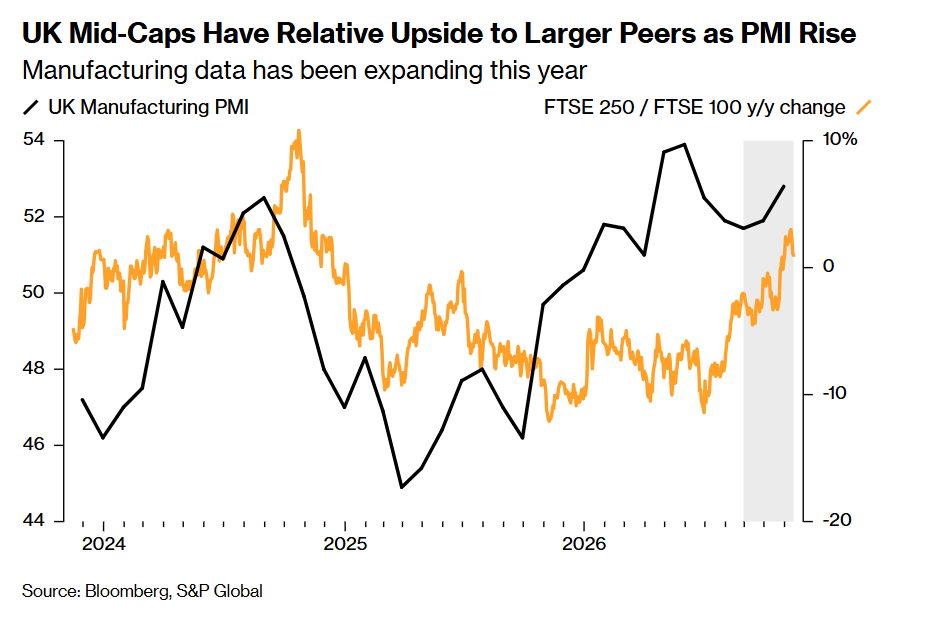
As shown in the chart above, as the PMI index rises, UK mid-cap stocks still have room to rise compared to large-cap stocks — manufacturing data is expanding this year.
Domestic British stocks withstood the pressure of rising interest rates during the rise, while falling oil prices made investors expect the Bank of England to soon shift to a less hawkish position. The inflation data released on Wednesday will provide clues to the central bank's next steps.
Currently, however, the swap market is reflecting a less positive picture. After this month's rate hike, the probability of another rate hike at the December meeting has reached 80%. The market's pricing up to the end of June next year reflects two more interest rate hikes. Economists expect the year-on-year increase in CPI to rise to 3.6% in October due to rising car fuel costs and rising household energy bills.
Matthew Gilman (Matthew Gilman), wealth management strategist at UBS, said, “We expect that the current round of global interest rate hikes will be relatively short and will not substantially change the outlook for the stock market. In particular, the underlying profit trend continues to be better than expected, and is supported by resilient structured investment trends.”
The UK stock market remains one of the lowest-valued markets in the world. Even though it has gone through obvious revaluation in recent months, the valuation of local stocks is only comparable to that of larger peers. This year's particularly strong mergers and acquisitions have supported the outlook for local stocks; sectors such as real estate, residential construction, and consumer-related stocks may benefit from a more stable monetary policy and interest rate environment, leading to a rebound after the pressure has eased.
Barclays's test indicates that interest in mergers and acquisitions will support the valuation of British small and medium capitalization stocks. “The significant recovery in mergers and acquisitions has also highlighted the strategic value of UK assets,” he wrote in the report.
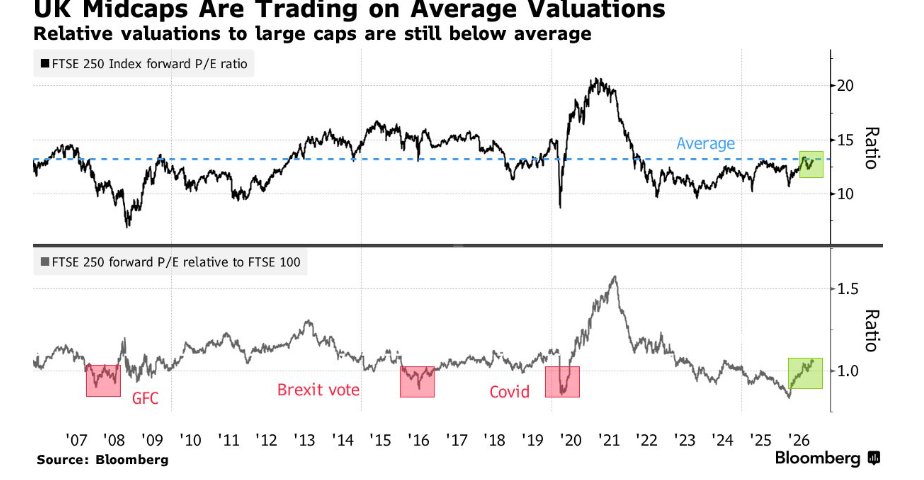
As shown in the chart above, UK mid-cap valuations are near average — meaning that valuations are still below average relative to the large-cap benchmark.
A Goldman Sachs strategist led by Sharon Bell (Sharon Bell) said, “Specifically in the UK market, considering that we expect energy prices and UK Treasury yields to drop further in 2027, compared to FTSE 100, we prefer local British stocks. We are also optimistic about the UK real estate sector because of its high dividend ratio and UK Treasury yields are expected to decline.”
The topic of AI computing power infrastructure in the US and Asia is under repeated pressure, and the British market has begun to trade the operating returns brought by AI technology
The fragmentation of global AI transactions can be described as extending from within the industrial chain to different stock markets. From November 9 to 13, the Philadelphia Semiconductor Index and the Nasdaq 100 Index rebounded by about 8.05% and 3.53%, respectively, but fell 5.28% and 2.67% respectively on November 16; compared with their respective historical closing highs, the cumulative retracement was about 34.33% and 12.90%.
Nvidia announced the resignation of Hwang In-hoon as CEO on November 12. The leadership transition further increased the market's focus on strategic continuity. The Asian market closed on the same day, and the Taiwan Weighted Index, South Korea's KOSPI, and Nikkei 225 fell 6.03%, 3.59%, and 2.42% respectively; in contrast, the two major benchmark stock indexes of the UK stock market — the UK FTSE 100 and FTSE 250, fell by about 0.2% and 0.4%, respectively, showing relative resilience.
This difference corresponds to two different profit transmission mechanisms: chip and computing power suppliers are more directly dependent on customer capital expenses, financing capabilities, and project delivery; banks, consumer goods, and professional service companies can embed AI into existing customer relationships and business processes to reap benefits by reducing repetitive labor and improving service capabilities and R&D efficiency.
When the market re-examines the return on computing power construction, companies that can quantify the effectiveness of AI use provide another path to participate in AI growth. Compared to leaders in the AI computing power industry chain, which are facing heavy pressure from the slowdown in the AI data center construction process, the overall investment value of enterprises that have increasingly focused on AI application topics in recent years depends on saved resources and additional revenue. After deducting software, reasoning, data governance, and system transformation costs, they can achieve continuous profit and cash flow improvements.
British companies already have verifiable cases. As shown in the Lloyds Bank disclosure, generative AI will generate about 50 million pounds in value in 2025, and it was reiterated during the latest three-quarter conference call that the goal of achieving AI revenue of more than 100 million pounds in 2026 is still progressing according to plan; its internal knowledge assistants helped about 20,000 employees reduce average information search time by 66%.
These “value” and “profit” indicators are not directly equal to net profit after tax, but they are closer to operating results than simply investing in technology. Li Jie Shi revealed that the digital R&D plan, which combines AI, predictive science, and simulation technology, reduces the R&D department's time consumption of low value-added tasks by up to 70%. The underlying economic mechanism is undoubtedly to reduce repeated searches and testing, speed up product screening and listing, and increase the efficiency of mature companies' existing businesses.