
Can Arm (ARM.US), which has plummeted 60% from its all-time high, usher in a valuation turnaround? Demand for AI smart reshaping CPUs is still cautiously bullish
The Zhitong Finance App learned that just as the stock price of ARM (ARM.US), the owner of the ARM instruction set architecture, plummeted for two consecutive trading days after experiencing a brief rebound, Wall Street financial giant Morgan Stanley raised the chip giant's mid-term profit forecast trajectory, but the analyst team maintained an “equal balance” neutral rating position and a target price of $212. Compared to the November 13 closing price of $190.53 used in the report, the potential upside was 11.3%; based on $175.05 after a sharp drop on November 16, the space expanded to 21.1%.
Morgan Stanley (hereinafter referred to as “Damo”)'s latest outlook assessment of Arm can be summarized as follows: the AI data center construction process is in full swing and royalty growth is being accelerated, and self-developed CPUs are beginning to be tested for production capacity, actual deployment capacity, and return on capital; this means that ARM's specific investment opportunities depend not only on the Nvidia Vera CPU market expansion trajectory using the ARM architecture, but also on the cloud AI business growth trajectory of large-scale cloud computing giants that use ARM architectures to build cloud factory self-developed data center CPUs What kind of valuation will be paid for Arm to move from IP licensing to direct data center CPU chip sales.
Arm's stock price recently showed a high fluctuation trajectory of “a strong rebound after a sharp drop, then a rapid rebound”. The elasticity of rise and fall was significantly higher than that of the semiconductor sector. On November 5, Arm's stock price fell sharply by 13.08% to close at $166.72; it then recovered to $203.36 on November 11, with a cumulative rebound of about 22%. Among them, it surged 12.05% in a single day on the 11th, clearly exceeding the 5.66% increase in the Philadelphia Semiconductor Index during the same period. However, this counterattack did not continue: on November 12, 13, and 16, it fell for three consecutive trading days, with a cumulative retreat of 13.92%, and the fee half fell by about 9.03% during the same period; in particular, on November 16, Arm fell 8.12% to $175.05, once again significantly exceeding Fee's 5.28%.
Against the backdrop that Fei Ban is still about 34.3% below the record closing high, a series of recent stock price trends show that the market's expectations for the growth prospects of its AI data center business are not enough to offset the sharp contraction pressure driven by a series of negative events, such as the slowdown in data center construction expectations due to the Democratic Party's big victory in the midterm elections, and Wong In-hoon being forced to leave the Nvidia CEO position. The short-term rebound has not translated into a continuous strong competitive run.
At a time when Fei Ban is mired in a bear market, Wall Street's focus on ARM's growth seems to be shifting to whether the increase in CPU demand brought about by AI agents can support profit and valuation recovery. Damo's latest research report covering Arm has the most investment significance: data center AI cloud royalties are providing quantifiable growth support, and whether self-developed CPUs can turn the scale of revenue into continuous profit will determine how much valuation premium Arm can get.
After a rebound, it was violently sold off, and the market re-examined the growth curve of AI computing power demand
From November 9 to 13, the Philadelphia Semiconductor Index and NASDAQ 100, which has the title of “global technology stock weather vane,” rebounded by about 8.05% and 3.53% respectively; however, the US stock market closed this Monday, November 16, and both fell 5.28% and 2.67%. As a result, the semiconductor sector of the US stock market is still in a technical bear market, and NASDAQ is still in a technical correction zone. Last week's rebound has not changed the market's cautious position.
At a time when the Philadelphia Semiconductor Index was falling into a bear market, as shown above, the stock price of ARM, the leader in chip design, the owner of the ARM instruction set architecture, clearly showed a high fluctuation trajectory of “a strong rebound after a sharp decline, then a rapid rebound”. The elasticity of rise and fall was significantly higher than that of the semiconductor benchmark sector in the US stock market.
As of the close of the US stock market on November 16, EST, Arm reported a cumulative decrease of about 61.33%, or more than 60%, from the historical intraday high of $452.70 set on June 18, 2026. Fee Half recently closed at 9610.65 points, which is 34.3% lower than the record closing high of 14634.72 points on June 22. Previously, the retracement on November 5 reached 38.4%. On the same day (US stocks closed on November 16), the Dow, S&P 500, and Nasdaq Composite fell 1.41%, 1.92%, and 2.49%, respectively, indicating that the sell-off had spread from chips to a wider range of risky assets.
The Asian market, on the other hand, continues this wave of intense pressure on chip stocks. On November 16, the Taiwan Stock Market Weighted Index, Korea's KOSPI Index, and Nikkei 225 fell 6.03%, 3.59%, and 2.42% respectively; on the 17th, the Taiwan Weighted Index fell another 2.31% to close at 40092.11 points, with a cumulative decline of 8.20% over the two trading days. The Korean stock market benchmark index, the KOSPI Index, fell more than 2% intraday. The combination of Nvidia leadership handover, export restrictions, and the uncertainty of huge project financing associated with large-scale AI data centers has placed the Asian market, which is highly focused on the foundry, storage, and server supply chain, under greater pressure to adjust profit expectations.
The Asian stock market has huge chip design, wafer manufacturing, and memory chip leaders, as well as cutting-edge 3D advanced packaging systems and chip testing systems, which are divided into different semiconductor market segments, yet they share the procurement budgets and guaranteed financing conditions of Nvidia and many large AI cloud computing-related customers. When the market simultaneously re-evaluates customer expenses, management continuity, and capital costs, geographical fragmentation makes it difficult to fully offset the impact of common sources of demand.
Nvidia's leadership changes have further increased the risk compensation required by the market. The company disclosed that the board of directors accepted the resignation of Hwang In-hoon on November 11, and that Chief Financial Officer Colette Kress also served as interim CEO.
The repricing of Nvidia's future target price trajectory by Wall Street financial institutions reflects the typical characteristics of “approving the long-term growth rate of AI infrastructure orders and reducing the forward valuation premium”: Goldman Sachs lowered the target price from $300 to $220, Citibank from $285 to $225, and UBS from $300 to $240, respectively. The reductions were about 26.7%, 21.1%, and 20%, respectively, while retaining the “buy” rating.
The cautious bullish sentiment of Wall Street agencies described above is also reflected in Morgan Stanley's latest assessment of Arm's outlook and valuation. The bank raised data center royalties and medium-term profit forecasts, but reduced the target EV/EBIT ratio for the IP business from 49 times to 41 times, and ultimately maintained a target price of 212 US dollars and an “equal share” rating. For investors, the key change is that AI data center related business growth needs to be tested by both valuation and profit quality; whether Arm can be continuously revalued depends on the implementation of royalty increases and whether self-developed CPU expansion can maintain sufficient profitability.
Cloud royalties have taken over the growth baton, and Arm's AI revenue is becoming specific
As of November 16, the Philadelphia Semiconductor Index and Arm have retracted by about 34% and 60%, respectively, from their all-time high closing prices; at the same time, tool call, code execution, data processing, and task scheduling in intelligent workflows are expanding the application space of CPUs.
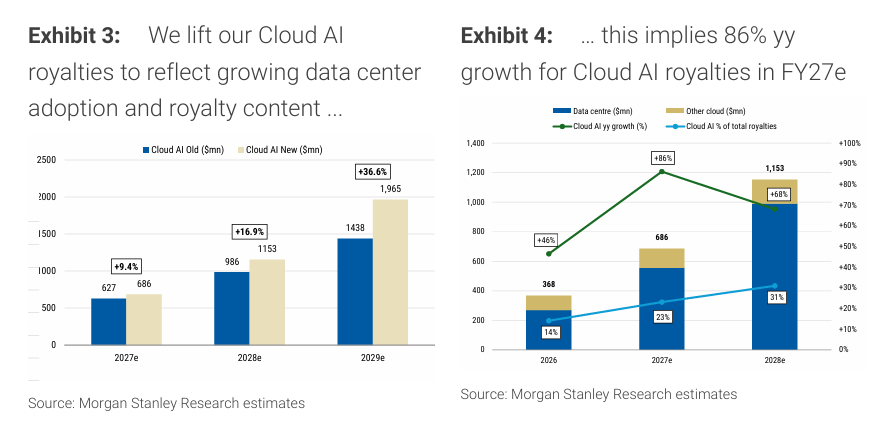
Morgan Stanley expects royalties associated with cloud AI (AI cloud business), which is dominated by data centers, will increase by about 86% and 68% in the 2027 and 2028 fiscal years, respectively, driving up Arm's mid-term profit forecast; however, direct sales of CPUs require manufacturing costs, deployment constraints, and competitive pricing. As a result, the bank reduced the CPU revenue forecast for fiscal year 2031 to close to 10 billion US dollars, below management's target of about 15 billion US dollars, and lowered the IP business valuation ratio to maintain an “flat balance” and a target price of 212 US dollars compared to the closing price on November 16 There is implied room for an increase of about 21.1%.
Arm's latest financial report shows that data center royalties are growing significantly faster than the overall royalty business, and cloud computing is becoming a more important source of revenue growth. For the second quarter of fiscal year 2027 at the end of September 2026, the company's revenue reached US$1,443 million, up 27% year on year; licensing and other revenue increased 50% to US$773 million, and royalty revenue increased 8% to US$670 million. Among them, data center royalties doubled year on year, showing that Arm's technology adoption in the cloud computing field is being converted into actual revenue. In addition, adjusted operating profit increased 37% to US$638 million, with a profit margin of 44.2%; licensing revenue reflects customers' investment in initiating design and purchase technology, while royalty revenue further verifies that chips using Arm technology are being shipped.
As a result, Damo raised the data center-led Cloud AI royalty forecast to US$686 million in FY2027 and US$1.153 billion in FY2028, corresponding to a year-on-year increase of about 86% and 68%; the share of total royalty revenue rose from 14% in FY2026 to 31% in FY2028. The “increase of 9% and 17%” in the report indicates the magnitude of the forecast correction compared to the old model. Sources of growth include Amazon Graviton, Google Axion, and Nvidia Vera's adoption in integrated systems and potentially independent inference deployments; more cores, Armv9 architectures, and computational subsystems (CSS) increase the IP value contained in each chip, and also support unit royalty growth.
Judging from the technical mechanism, the expansion of AI agents is the workload of the entire computing system, and the tasks carried out by the CPU are also increasing. GPUs and ASICs are responsible for intensive model computation, while CPUs handle tool calls, code execution, data access, task scheduling, and general business logic. As agent concurrency increases, it is not only the number of accelerators that the cluster produces, but also whether the CPU, memory, and network can supply data and complete serial tasks in a timely manner. In power-limited computer rooms, customers pay more attention to per-watt throughput and overall cost under actual workloads, which has created conditions for increased adoption of ARM server CPUs.
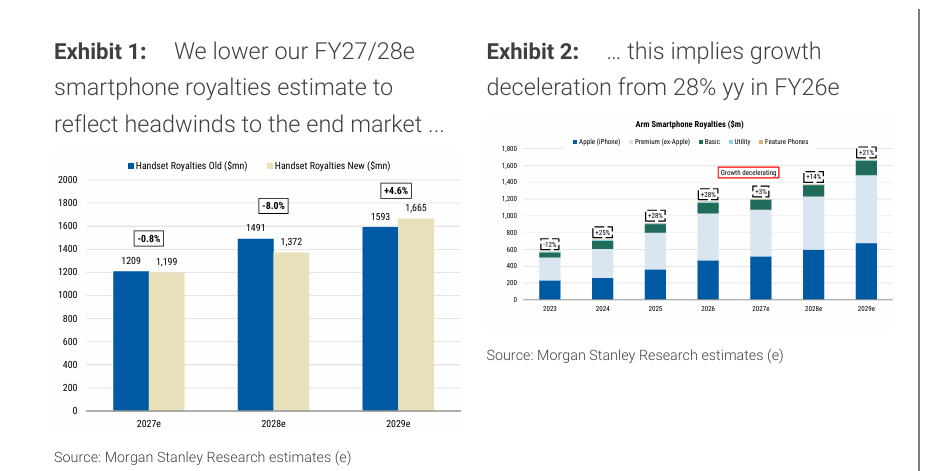
The mobile phone business is still an important pillar, but the pace of growth is clearly slow. Damo estimates that in fiscal year 2027, mobile phone royalties will be approximately US$1,199 million, up 3% year on year, and will rise back to US$1,372 billion in fiscal year 2028, an increase of 14%, mainly due to the stabilization of Apple production, the share of high-end products and the increase in authorized content, rather than a sharp expansion in global mobile phone sales. AI-related CSS and architecture licensing agreements continue to support new design projects; the report also lists unconfirmed v10 early access licenses as potential catalysts. As a result, Arm's revenue structure gradually upgraded from relying on mobile phones to cloud computing to provide higher growth.
Direct sales of data center CPUs have opened up revenue space and changed Arm's profit structure
According to the Damo research report, AGI CPU, a data center CPU product developed by Arm and sold exclusively to the outside world, has enabled Arm to move further from providing design technology to selling chips. As a result, the scale of revenue has expanded, and the cost structure has changed accordingly.
The company expects the first commercial deliveries to occur in the fourth quarter of fiscal year 2027, that is, January to March 2027. Compared with high-margin IP licensing, chip sales require wafer manufacturing, package testing, supply assurance, and inventory capital expenditure; even with outsourced manufacturing, Arm is still responsible for the entire product delivery process and actual commercial return.
Damo basically kept the 2028 CPU revenue forecast, but cut the FY2031 forecast by about 38% to close to $10 billion, which is lower than the management target of about 15 billion US dollars. Constraints include deployable electricity, competitive pricing, and product costs: the model assumes that the gross margin of first-generation products is about 35%, and the unit core revenue for each generation of products falls by about 5%.
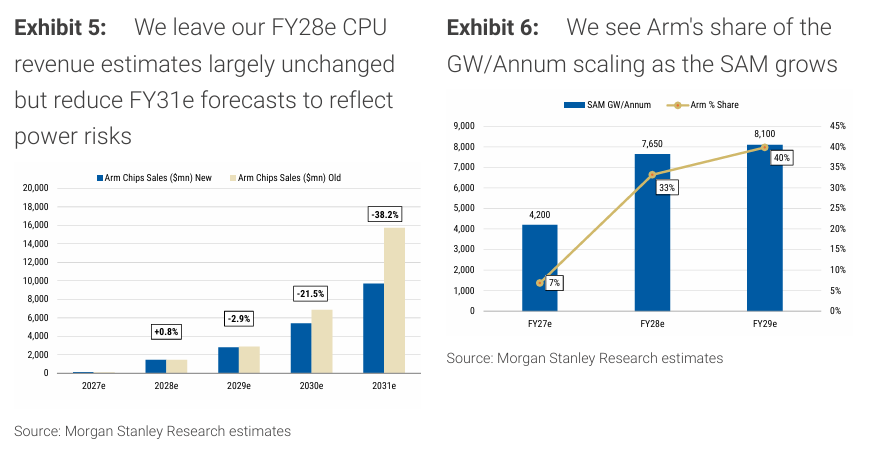
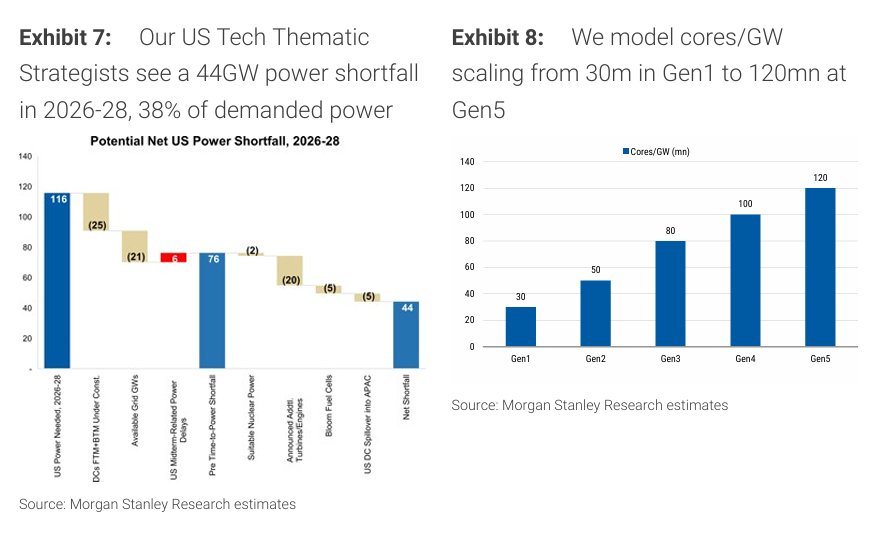
Even so, Damo still assumes that by 2030, the number of deployed cores corresponding to each gigawatt of fifth-generation products will reach four times that of the first generation. The $10 billion vision already includes significant product progress and market expansion, and whether it can be implemented on schedule is still an important variable in valuation.
In Morgan Stanley's overall financial model, Arm's revenue for the 2027-2029 fiscal year is expected to be $6.082 billion, $8.840 billion, and $12.450 billion, respectively, with adjusted earnings per share of $2.23, 3.95, and $5.66, respectively. Among them, the 2028 earnings per share forecast was raised by about 13.8% from the old model, and about 28.2% higher than the market's consensus forecast of $3.08. However, as the share of chip sales increases, the Group's gross margin is expected to drop from 97.5% in FY2026 to 86.9% in FY2028; the operating profit margin can still rise to 57.2% after the same period adjustments, relying on revenue growth to dilute R&D expenses. What Damo continues to focus on in terms of Arm's long-term basic outlook is whether this operating leverage can continue during the product expansion process.
The valuation process was therefore restrained. Using segmented total valuation, Damo reduced the corporate value/operating profit (EV/EBIT) ratio of the IP business from 49 times to 41 times, maintained the chip business 20 times, and discounted the 2029 fiscal year value with an 11% weighted average capital cost. The increase in profit offset the decline in the valuation multiplier, and the target price of $212 was maintained; based on static estimates of the share capital on the cover of the report, the corresponding market value was about US$217.8 billion. The $370 bull market scenario and the $65 bear market scenario show that the degree of implementation of the forward chip business has a huge impact on valuation. Damo has acknowledged stronger profit growth, but has yet to give the chip business a fully realized valuation.