
Kevin O’Leary Calls AI ‘the Number One Use of Capital in Our Economy.’ Voters Disagree. Here’s Why PWR Stock Doesn’t Need to Pick a Side.
On Nov. 8, Shark Tank's Kevin O'Leary said AI is "the number one use of capital in our economy right now," creating millions of jobs. Most of that money goes into building the data centers AI runs on. Just a few days before this, he also said that data centers could help "make hundreds of millions of Americans millionaires," pointing to the electricians, plumbers, and union workers who build them. But voters seem to disagree. On Nov. 3, 40 of 41 local measures against data centers passed across the country, according to the Deseret News. Also, O'Leary's own Utah data center project has stalled after local backlash.
The Company Hiring Mr Wonderful's Electricians
Quanta Services (PWR) is the company that actually hires the workers O'Leary was talking about, hiring roughly 26,000 employees this year. It builds the power lines, grid connections, and electrical systems that data centers and utilities need. But Quanta's growth isn't limited to data centers. CEO Duke Austin said its backlog growth came from across the business, including utilities, power lines, and renewable energy. Quanta also works for some of the biggest tech companies in the world, which makes its data center work less likely to get cancelled.
So O'Leary says data centers will keep getting built, and voters are trying to block them. If O'Leary ends up being right, and data centers keep getting built, each one needs a huge amount of electricity. For that electricity, Quanta gets the business to build the power lines and connect them to the grid. If the voters win and fewer data centers get built, America's power grid is old and needs upgrading anyway. And electricity demand keeps rising from homes, factories, and electric cars, not just data centers. Also, utilities still need Quanta to build and fix power lines. So even without new data centers, Quanta still has plenty of work. On top of that, Austin said on the earnings call that when it comes to data center customers, "we can't even get to 25% to 30% of what they have in front of us." So even if things slow down, it would still have more work than it can handle. This is why I believe investors shouldn't worry too much, since Quanta is well positioned to win either way.
About Quanta Services Stock
Quanta Services builds and maintains the infrastructure that keeps the power flowing, including power lines, substations, and the electrical systems behind power plants and data centers. It's also the company putting O'Leary's electricians to work as demand keeps climbing. Founded in 1997, Quanta is headquartered in Houston, Texas, and is led by President and CEO Austin.
Year-to-date, Quanta’s stock is up 39%, well ahead of the Global X U.S. Infrastructure Development ETF’s (PAVE) 9% gain. In the last month, though, the stock is down 12%. Most of that came on Nov. 4, when the stock dropped roughly 12% in a single day without any company-specific news. Data center stocks sank across the board after Democrats' midterm wins raised fears that new rules could slow construction.
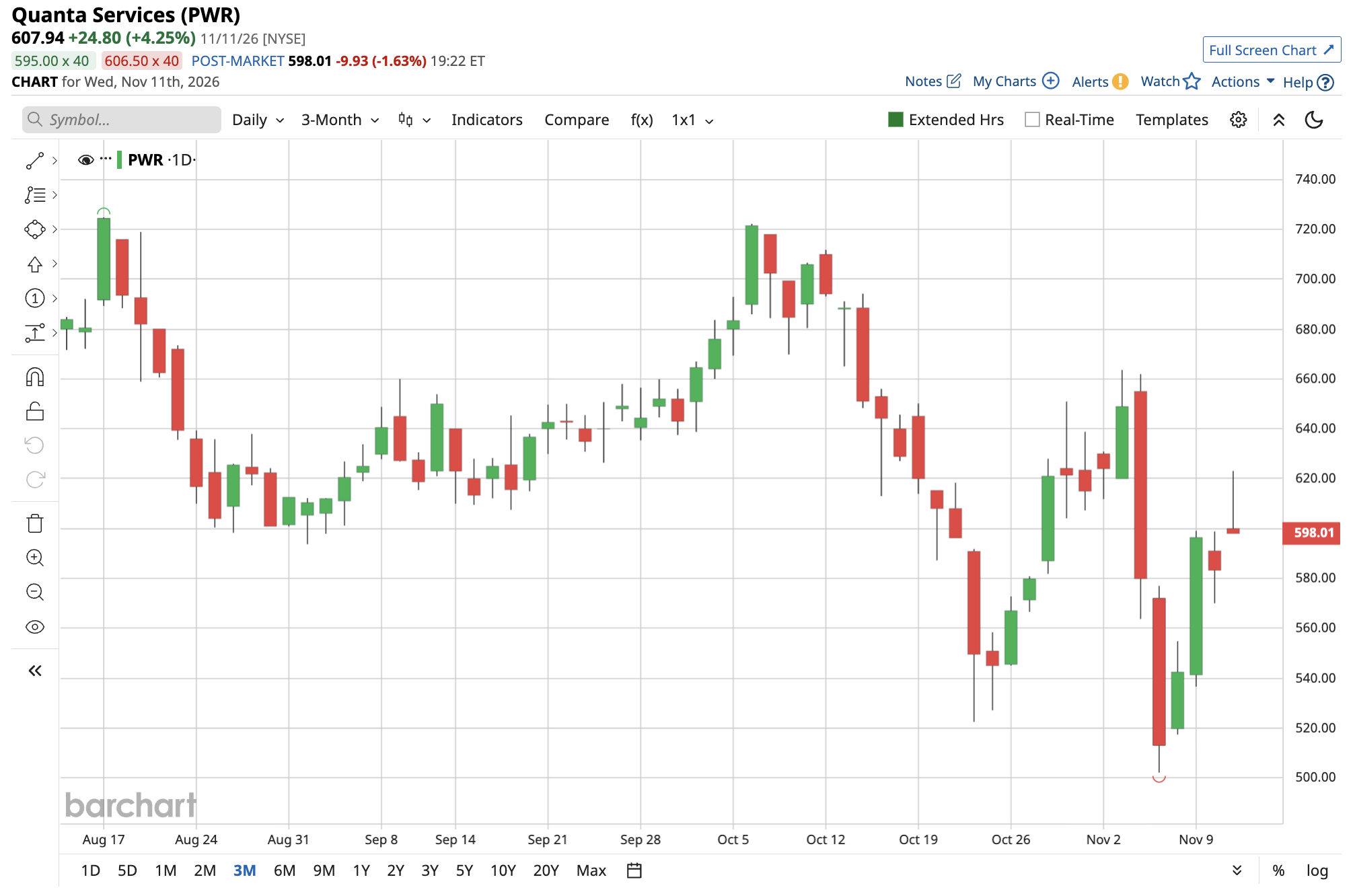
Quanta's stock isn't cheap on earnings, trading at about 32x forward profits, but that's close to its own five-year average. The forward price-to-sales ratio of 2.12x sits about 22% above its average. The EPS outlook helps justify the premium. Earnings are expected to jump about 69% this year and then grow 15% to 19% a year after that, bringing the P/E down to about 20x by 2029. The balance sheet looks manageable, with about $7.5 billion in debt against $2.3 billion in cash. After the recent selloff, I think investors are getting a growing business at a fair price, especially with the backlog still hitting records.
Quanta Beats Big and Raises Its Outlook Again
Quanta reported its third-quarter results on Oct. 29 and easily beat expectations. Revenue jumped 57% to a record $12 billion, well above the roughly $10.9 billion analysts expected. Adjusted EPS of $6.06 also crushed the $4.95 estimate, up 82% from a year ago. Austin called it "another exceptional quarter," and the backlog hit a record $63.7 billion, up $10 billion from the previous quarter.
Looking ahead, Quanta raised its full-year guidance across the board. It now expects revenue of $41.3 billion to $41.6 billion, adjusted EPS of $17.90 to $18.30, and free cash flow of $2.5 billion to $3 billion. Austin also said that some major long-distance power line projects haven't even been added to the backlog yet, which means more work is still on the way.
What Do Analysts Expect for Quanta Stock?
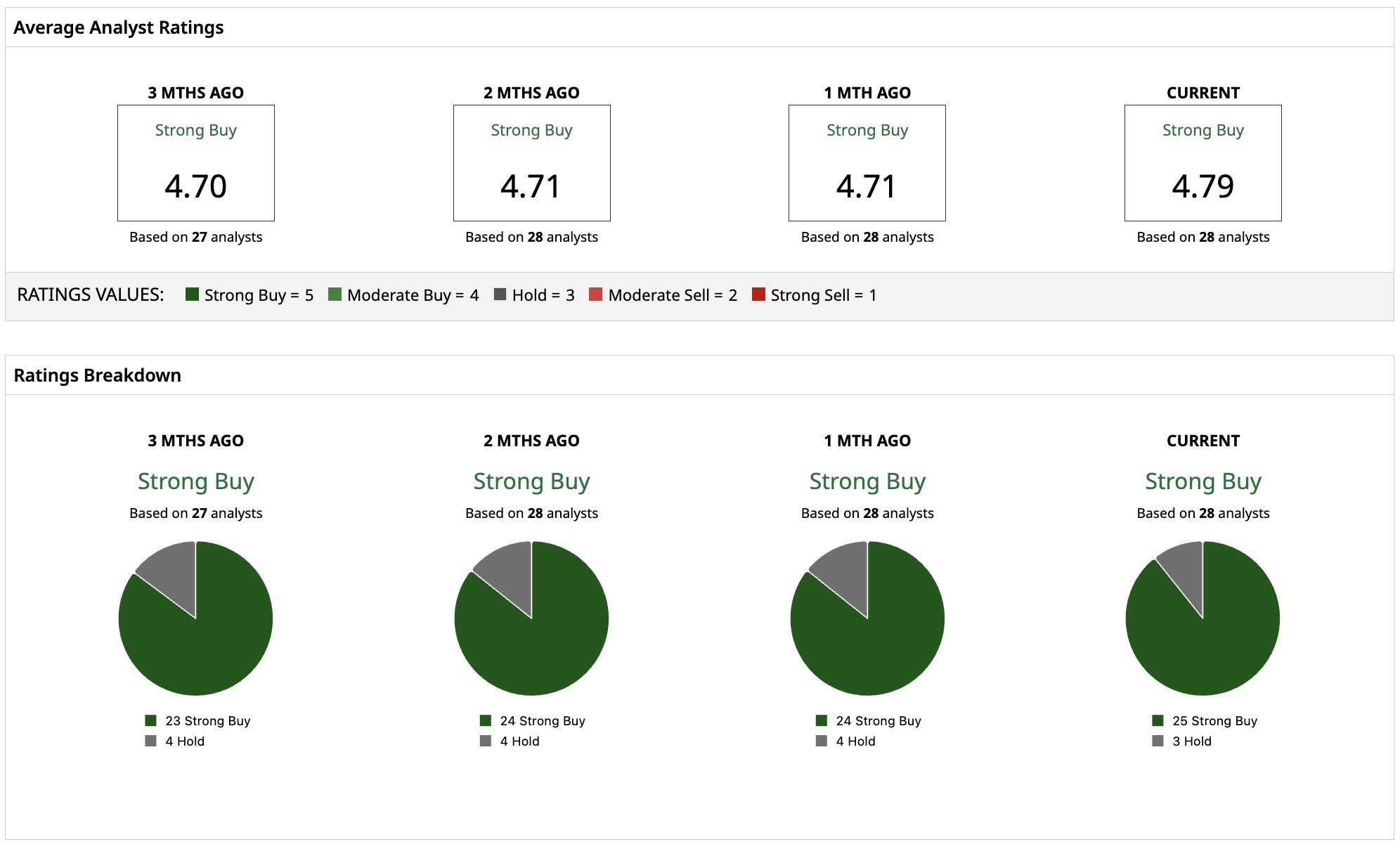
Based on 28 Wall Street analysts, Quanta holds a “Strong Buy” rating with a mean price target of $803.93, indicating 30% upside. The lowest price target of $701 is well above the current share price. This shows that analysts remain bullish on the stock.
On the date of publication, Jabran Kundi did not directly have a position in any of the securities mentioned in this article. All information and data in this article is solely for informational purposes. For more information please view the Barchart Disclosure Policy here.