
Risk aversion has swept through cryptocurrencies, Bitcoin is mired in a pullback, and the options market is already priced at $60,000
The Zhitong Finance App learned that after a sharp sell-off last Monday, Bitcoin options traders are hedging against further downside risks. Interest rate expectations turned hawkish and risk aversion in the market heated up, making the cryptocurrency market climate even more sluggish.
On Monday, on the derivatives platform Deribit, full-term put option open positions were concentrated at an exercise price of $60,000, which is about 8% lower than the current price of Bitcoin of about $65,000. Put options give holders the right to sell Bitcoin at the agreed price. Traders usually use it to hedge downside risks when predicting a continued decline in the market.
This position layout stemmed from Bitcoin's sharp decline last week — the biggest cryptocurrency fell by 12% in a single week. The currency price once fell to nearly $6.2 million over the weekend, hitting a four-month low, then slightly recovering some of its losses. However, in the options market, traders' vigilance has not subsided.
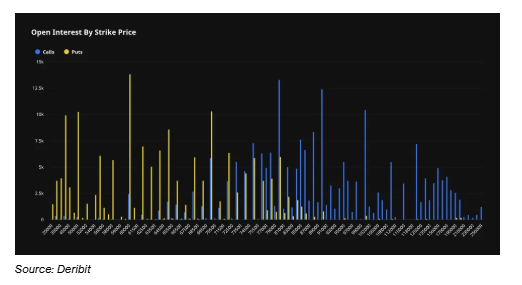
“Market participants are using options to hedge against short-term downside risks in the current situation where market liquidity is very thin,” said Caroline Mauron, co-founder of Orbit Markets.
Mauron said that during the sell-off period, an indicator that measures the difference in pricing between bearish and bullish options due on Friday, the put option premium once reached 25 points, reflecting strong demand for downside protection in the market.
“$60,000 has formed a strong support level, and it has held this mark twice this year and 2024,” Mauron added. If Bitcoin effectively falls below this position, the market will bear huge selling pressure, and the next clear support will be around $40,000.
Bitcoin briefly fell below $60,000 on July 1, hitting a low of $57,742 during the year, but it has been running above that price since July 2.
ETF capital outflows continue
Behind Bitcoin's latest round of decline, the multiple favorable factors that once boosted Bitcoin's rise have been reversed.
Compiled data shows that since Binance was hacked at $6 billion on October 29, the cumulative net outflow of US-listed Bitcoin spot ETFs is nearly $3 billion. Continued capital flight has taken away important buying power that previously supported cryptocurrency prices.
Meanwhile, US interest rate expectations turned bearish. After inflation data once again surpassed expectations, traders increased their bets that the Federal Reserve may continue to raise interest rates in 2027, or even begin pricing the possibility of a 50 basis point rate hike in December.
The turbulent market on the artificial intelligence (AI) circuit has led to a collective retreat of global risk assets, and the crypto market is also being held hostage.
Robin Singh, CEO of Koinly, said, “The current macro environment is complex, and Bitcoin is competing with many assets for financial attention. The Nvidia (NVDA.US) crisis, economic uncertainty compounded geographical tension, and investors had too many other risks to consider.”
In his view, Bitcoin currently lacks a clear catalyst that can attract the return of capital, making it difficult for the market to regain momentum.
However, ViaBtc's chief analyst Jeff Ko has a different opinion; he believes that Bitcoin may be nearing an inflection point.
“The recent decline was largely due to capital freeing up to participate in the Anthropic (ANT.US) IPO. Investors sold highly liquid assets to subscribe for new shares,” he also mentioned that on the eve of the SpaceX (SPCX.US) IPO, Bitcoin also experienced a similar round of sell-off, and then rebounded rapidly.
“The weekend drop to $62,000 also cleared a large number of leveraged speculative positions,” Jeff Ko said, which instead built a healthier bottom for the subsequent rebound.
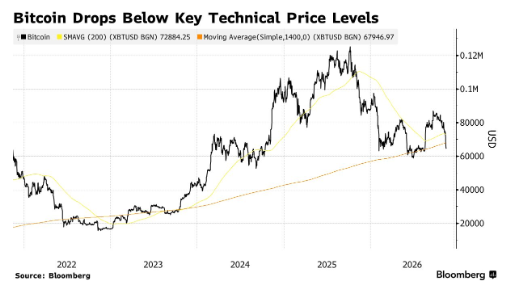
However, as of now, the technical indicators are not positive.
This round of decline brought Bitcoin back below the 200-day EMA and 200-week EMA. These two moving averages are recognized by the market as long-term key indicators. Apollo Crypto fund manager Pratik Kala commented that this pattern “favors bears in the short term.”
Currently, options traders can only hope to withstand the $60,000 support level twice this year, and expect it to hold the line of defense for the third time and drive a rebound in currency prices.