
Forget Former Nvidia CEO Jensen Huang -- This Is the Real Question Investors Need to Ask About Nvidia Stock
Key Points
Huang's resignation, which came after multiple alleged extramarital affairs, is going to be a big story for a while.
But for Nvidia investors, there is an even more important question, one about the company's customers.
Jensen Huang, who co-founded Nvidia (NASDAQ:NVDA) over three decades ago at a Denny's restaurant, is officially out as CEO of the artificial intelligence (AI) chip giant.
Multiple reports about multiple alleged extramarital affairs Huang had, one with a woman who may have been a Chinese spy and others with as many as two Nvidia employees, quickly led the torchbearer of AI to resign.
Missed AI’s "Act 1"? Act 2 Could Be 15x Bigger. Most investors think they missed the AI boat because they didn't buy Nvidia in 2005. But according to our analysts, we’re only at the end of "Act 1"—the R&D phase. "Act 2" is the global rollout. Continue »
CFO Colette Kress has been named interim CEO. Nvidia stock has sunk over 28% in the past month.
While Huang is undoubtedly the most important CEO in AI, his departure is unlikely to slow down the sector, and Nvidia is likely to press on as the dominant chip player. But that doesn't mean Nvidia is in the clear. Forget Huang -- this is the real question investors need to ask about Nvidia stock.
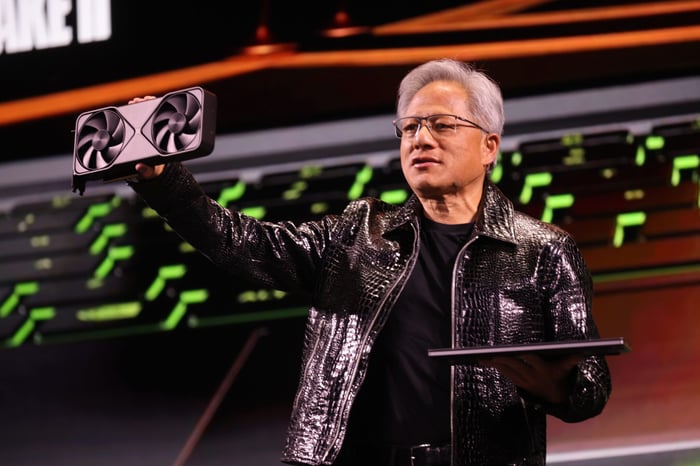
Jensen Huang. Image source: Nvidia.
Has Nvidia's revenue included illegal chip sales to China all along?
There's no denying Huang's importance to Nvidia -- his leadership may have even commanded a premium for the stock.
But at the end of the day, Nvidia will still have the same graphics processing units (GPUs) that have significantly outperformed their competition. I guess one could argue that future innovation might not be as secure as it was, but I don't think anyone can say that definitively.
Nvidia has maintained a moat since 2006 through its CUDA programming platform, on which most software developers have been trained, which makes switching to a new system difficult. That advantage won't go away.
When it comes to the stock and the financials driving it, the real question investors need to ask concerns Nvidia's relationship with the Singaporean data center Megaspeed, which reportedly led to illegal chip sales. The alleged Chinese spy with whom Huang reportedly had an affair, Alice Huang (no relation to Jensen), was a top executive at Megaspeed.
Tech news site The Information reported this week that over $7 billion of chip sales from Nvidia to Megaspeed eventually made their way to China illegally.
Nvidia has not been able to sell chips to China since April 2025, when the U.S. government said it would require the company to obtain an export license. Since then, Chinese sales have been virtually zero, according to the company. Nvidia and Huang have lobbied President Donald Trump's administration to restart sales in the region. But even before then, Nvidia could sell only older-generation chips due to national security concerns.
What investors are likely wondering is whether Nvidia's relationship with Megaspeed is a one-off, or whether more of Nvidia's previous revenue has derived from similar relationships.
Interestingly, the independent short-seller Culper Research went short Nvidia in May of this year, betting that more of Nvidia's sales have a similar dynamic.
"We believe that in reality, over 20% of Nvidia's FY 2026 compute revenues remained driven by China via illegal GPU diversion and Southeast Asian intermediaries," Culper wrote on X in May.
More incredibly, Culper specifically called out Megaspeed and said it had uncovered documents showing the company had been financed by the Chinese tech giant Alibaba through a Singaporean shell company.
There are real financial implications, if true
If Culper's thesis, which looks a lot more plausible now, is true, that could mean real trouble for Nvidia's revenue and earnings.
While it looked like Nvidia was about to sell chips to China again in the near future, this whole matter could prompt the Trump administration to revisit export restrictions and potentially make them even stricter. Nvidia may also face tougher standards when selling chips abroad to prove they are not being illegally diverted. This could prove costly.
Now, it's also possible that Culper is wrong and the chip giant is still allowed to resume sales of chips to Chinese companies.
Ultimately, while Huang is the big headline, the bigger questions are whether a material amount of Nvidia's current and prior chip sales is being illegally diverted to China and whether Nvidia can resume sales to Chinese companies in the future.
Bram Berkowitz has no position in any of the stocks mentioned. The Motley Fool has positions in and recommends Nvidia. The Motley Fool recommends Alibaba Group. The Motley Fool has a disclosure policy.