
3 Stocks Retail Investors Are Watching After Nvidia Shock Hit Trading Platforms
Nvidia’s leadership crisis, from Jensen Huang’s resignation to fresh questions over governance and China links, has wiped more than $1.8 trillion in value from the stock and jolted AI-related trading. Shocks of this scale often pull trading volumes, hedging activity, and short-term pricing dislocations toward listed exchanges and derivatives venues. This piece walks through three stocks from our AI sector volatility screener that could matter for your portfolio right now.
The three stocks covered below are only a starting sample from this theme, as the full screen surfaced 34 more listed exchanges and trading venues with equally compelling narratives around AI-fuelled volatility that are not covered here. To see the wider field and identify which platforms best fit your approach, head straight into the Listed Exchanges and Derivatives Platforms Leveraging AI-Sector Volatility screener.
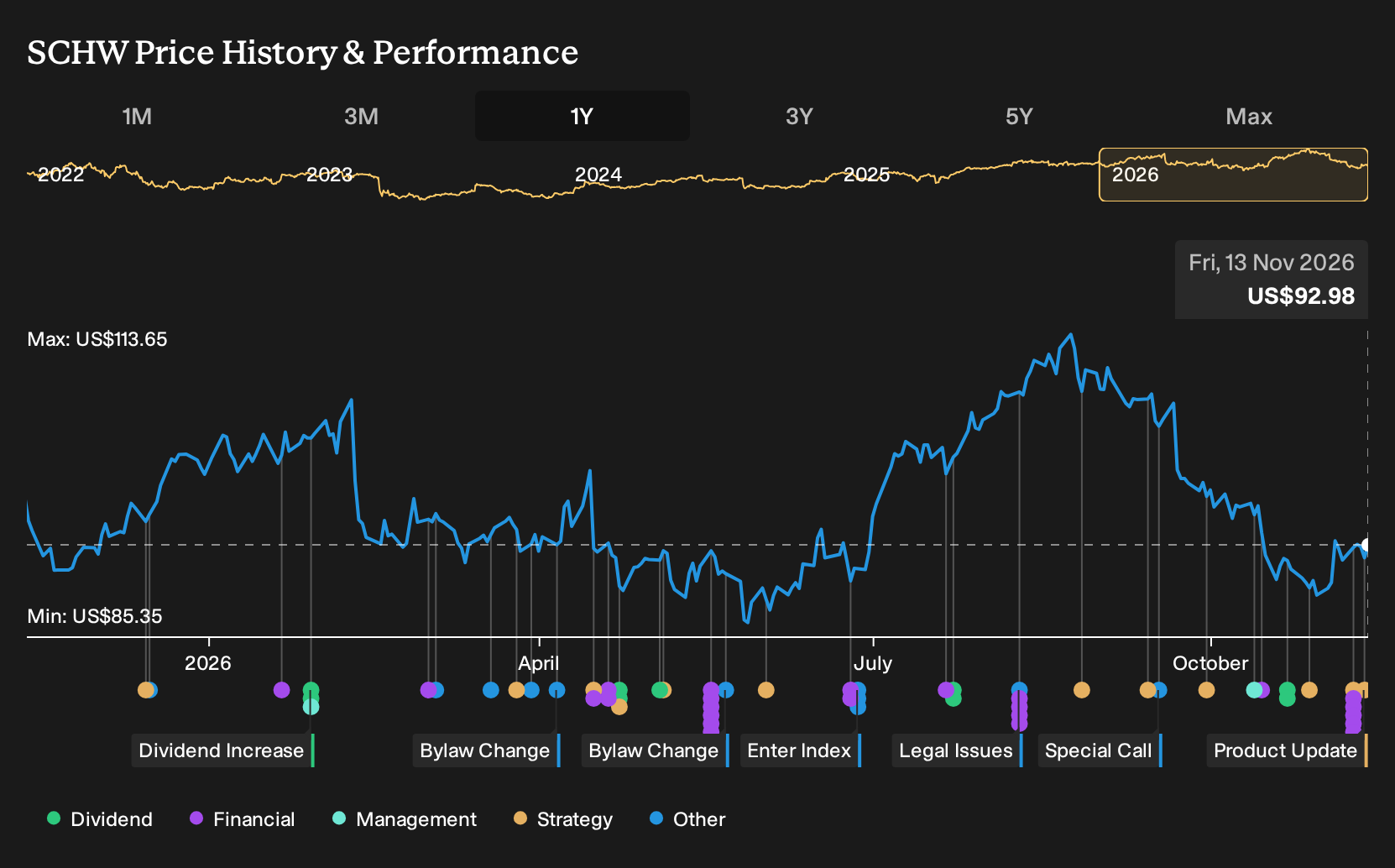
Charles Schwab (SCHW)
Overview: Charles Schwab is a large US wealth manager and brokerage platform that provides trading, banking, and advisory services for retail and institutional clients.
Operations: Charles Schwab generates about US$21.3b from Investor Services and US$5.8b from Advisor Services, with all reported revenue from the United States.
Market Cap: US$158.3b
For investors tracking how AI-fuelled volatility in Nvidia and other chip stocks ripples through trading venues, Charles Schwab matters because it channels that turbulence into higher engagement across brokerage, derivatives, and advisory activity. According to yiannisz, an investor in the Simply Wall St Community, this is why the long-term set-up deserves a closer look.
"As interest rates stabilize after a historically aggressive tightening cycle, the pressure on Schwab’s interest margins begins to ease."
What really moves the needle for Charles Schwab is how one quiet shift in client trading behavior interacts with that easing pressure.
That quiet shift is the crux of the story, and the full narrative for Charles Schwab unpacks how it could reshape Charles Schwab’s earnings mix and risk profile.
UP Fintech Holding (TIGR)
Overview: UP Fintech Holding runs the Tiger Trade online brokerage and wealth platform, letting primarily Chinese investors trade global stocks and derivatives.
Operations: UP Fintech Holding reports about US$607 million in revenue from its brokerage segment, centered on transaction and related service income.
Market Cap: US$698 million
What gives UP Fintech Holding real punch in this AI volatility theme, according to the analyst consensus Narrative on Simply Wall St, is how a Chinese client base increasingly trades around global tech swings through a single digital platform.
"Expansion of UP Fintech Holding’s user base and client assets in Singapore, Hong Kong, Australia, New Zealand and the U.S., with these markets contributing the majority of recent net asset inflows and new funded accounts, could gradually rebalance revenue and earnings away from onshore Mainland China."
Everything now hinges on how one unseen pressure shapes the trade off between fresh international inflows and the cost of keeping them engaged.
That hidden pressure is exactly where the full narrative for UP Fintech Holding shows how accelerating cross border demand, regulation, and pricing power could reshape UP Fintech Holding’s earnings mix.

XP (XP)
Overview: XP runs a Brazil-focused investment and trading platform that lets clients buy securities, funds, derivatives, credit products, and insurance. This positions it to harness bursts of AI-driven market volatility through higher client activity.
Operations: XP generates about R$18.6b from brokerage services, with most revenue from Brazil and a smaller contribution from other countries.
Market Cap: US$7.6b
XP matters for this AI-volatility theme because its broad brokerage and derivatives platform can turn global Nvidia-driven price swings into higher client trading. The analyst consensus Narrative on Simply Wall St argues the real story sits with how its customer base is evolving.
"The ongoing expansion of Brazil's middle class and gradual increase in personal savings rates are set to grow XP's addressable market, supporting long term AUM and retail client growth, which should support revenue and earnings power as the company penetrates deeper into emerging segments."
What really counts now is whether one quiet shift in how Brazilian households allocate savings supports richer fees even when market volatility calms.
That hinges on whether XP’s emerging saver class accelerates into risk assets, and the full narrative for XP shows how that shift could reshape fees and volatility exposure.

Seeking Alternatives Before The Crowd?
Nvidia’s shock has markets swinging and fresh breakouts rarely wait. Momentum shifts fast, and today’s under the radar opportunities can be tomorrow’s crowded trades, so it can help to prepare in advance.
- Target income ideas that aim to hold up when prices whip around by scanning a curated pool of 6 dividend fortresses before yields get picked over.
- Hunt for resilient balance sheets that can stay on the front foot when volatility spikes using a hand filtered list of solid balance sheet and fundamentals (24 results) while the field is still thin.
- Track the hardware backbone of AI momentum and look for potential beneficiaries of sustained demand with a focused sweep across 53 AI infrastructure stocks before money chases the obvious tickers.
Have feedback on this article? Concerned about the content? Get in touch with us directly. Alternatively, email editorial-team@simplywallst.com