
Fannie Mae (FNMA) Stock Still Looks Expensive Despite Its Huge Three Year Run
Federal National Mortgage Association, better known as Fannie Mae, has delivered a very large three year return that now sits alongside sharp swings in shorter timeframes. With headlines ranging from high profile forecasts of potential privatization to policy moves in housing finance, the key question is whether the current share price is adequately supported by the earnings the business is generating.
- Over the past three years, Federal National Mortgage Association has produced a very large gain for shareholders, which raises the issue of how much of its earnings power is already reflected in the valuation.
- Recent commentary on possible changes to conservatorship, lending practices and targeted mortgage programs may influence expectations for how Fannie Mae converts housing market policy into sustainable profits and cash flows over time.
- The analysts covering Federal National Mortgage Association have run their own numbers. See what analysts think Federal National Mortgage Association's shares could be worth.
For investors, the debate is whether Federal National Mortgage Association's current market value is justified by its earnings when set against the Fair Ratio benchmark.
If you want a broader watchlist while you weigh Federal National Mortgage Association's earnings against its share price, a focused screen of 32 high quality undervalued stocks can be a useful next step.
Has Federal National Mortgage Association Run Too Far on Earnings?
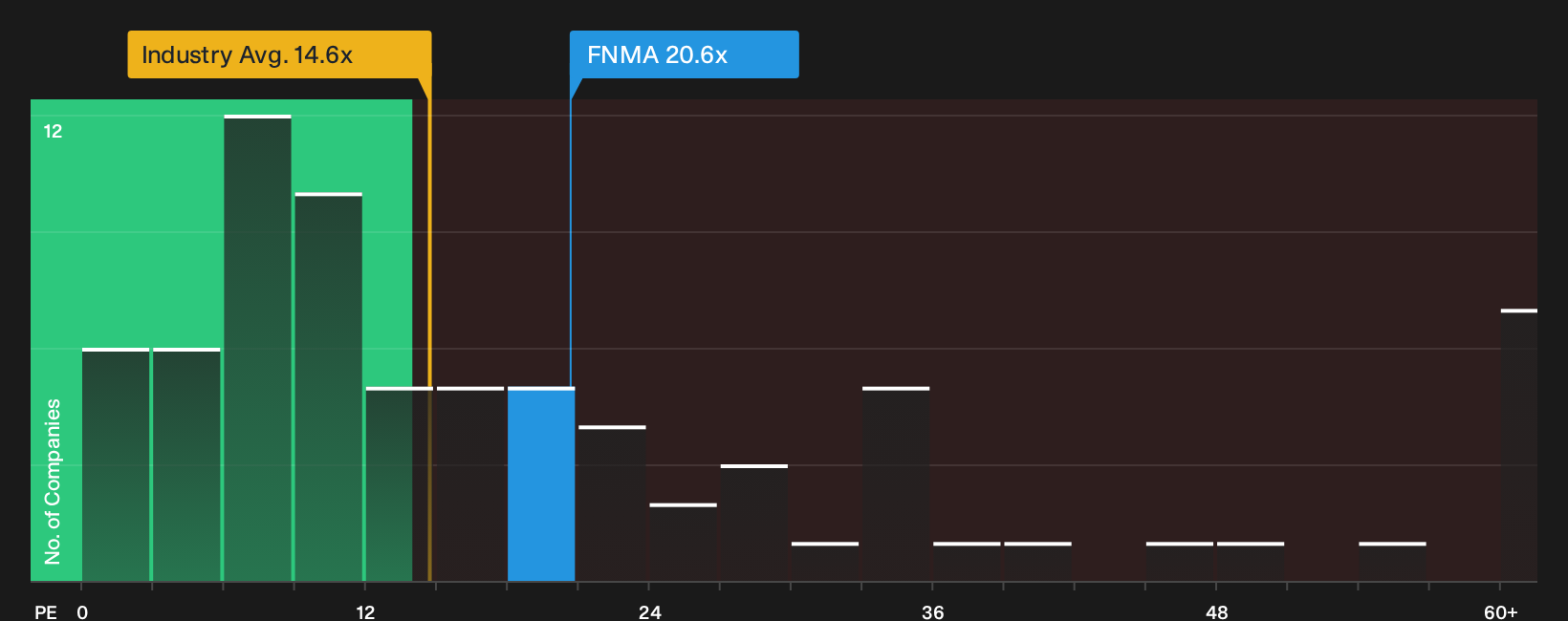
The P/E ratio fits Federal National Mortgage Association because earnings are the main way equity investors get paid in this kind of financing platform. On the latest figures, Fannie Mae trades at about 20.6x earnings, compared with roughly 14.6x for the wider Diversified Financial group and around 13.8x for peers. That is a clear premium in simple multiple terms and means you are paying more per dollar of profit than for many comparable stocks in the sector.
Despite high profile talk about a potential exit from conservatorship lifting interest in the story, the current P/E still prices Federal National Mortgage Association well above what the Fair Ratio model implies for a business with its risk profile. Because the model heavily penalises the uncertainty around regulation, housing policy and capital structure, the gap is better read as a warning signal that the shares screen expensive on this framework rather than a precise target multiple. If you are weighing whether that premium makes sense, the next step is to look at how resilient you think those earnings are under different housing and policy outcomes. Explore the numbers behind Federal National Mortgage Association's P/E valuation.
The Federal National Mortgage Association Narrative: What Would Justify Today's Price?
Simply Wall St Narratives for Federal National Mortgage Association pick up where the valuation puzzle leaves off and explain which growth, margin and earnings paths would need to occur for the stock to be worth materially more or less than today’s price on the Community page. Each scenario links its implied number to a specific view on how Federal National Mortgage Association's growth, profitability and risk profile could change, which you can revisit as new information becomes available.
The gap between optimism and caution on Federal National Mortgage Association is all about how durable its earnings look under heavy policy and capital constraints.
Bull case: 28% undervalued
According to the bearish analyst Narrative on Simply Wall St, the more optimistic view sees value in the current earnings power despite the headwinds.
"Federal National Mortgage Association reports that its $4.1t guaranty book and large guaranty fee revenue base provide a durable earnings source, the shift toward higher capital requirements from new acquisitions and weaker multifamily property valuations can limit the ability to convert this scale into higher net income growth over time..."
Discover why this Narrative puts Federal National Mortgage Association at 28% undervalued.
Bear case: 9% overvalued
The analyst consensus Narrative on Simply Wall St leans more guarded and puts greater weight on structural and policy risks.
"Reduced capital relief from credit risk transfer transactions, combined with higher risk weighted assets and risk density, points to structurally higher regulatory capital requirements that could constrain balance sheet flexibility and slow net worth growth relative to the scale of the guaranty book and earnings..."
Explore why this Narrative puts Federal National Mortgage Association at 9% overvalued.
Before acting on Fannie Mae's valuation, there is one more piece to check
The figures only tell part of the story, because the real test is how the people steering Federal National Mortgage Association are chosen, rewarded and kept aligned with your interests over time. See who runs Federal National Mortgage Association and how they are paid.
Have feedback on this article? Concerned about the content? Get in touch with us directly. Alternatively, email editorial-team@simplywallst.com