
Bitcoin has fallen to a three-month low, and the cryptocurrency market now has large-scale bursts, AI stocks have pulled back or further diverted speculative capital
The Zhitong Finance App learned that as the price of Bitcoin continues to fall, the cryptocurrency market is facing more and more frequent large-scale liquidations. In the past year, there have been 13 cases where Bitcoin has liquidated more than 500 million US dollars in a single day, 3 of which have exceeded 1 billion US dollars. Meanwhile, the cryptocurrency market is facing multiple pressures due to continued high inflation, rising expectations for further interest rate hikes by the Federal Reserve, outflows of funds from Bitcoin ETFs, and the diversion of funds that may be caused by a correction in the artificial intelligence (AI) sector.
According to statistics from the cryptocurrency data platform Coinglass on 28 futures exchanges, in the past 12 months, the Bitcoin market has repeatedly sold out more than 500 million US dollars in a single 24-hour period. Drastic price fluctuations continue to force leveraged traders to close their positions, further increasing the selling pressure on the market. This situation repeated on Friday. As the price of Bitcoin fell, approximately $1.3 billion of long positions in the cryptocurrency market were forcibly closed in the past 24 hours, with Bitcoin positions accounting for the majority.
On Friday, the price of Bitcoin fell 5.4% to about $67,600, the lowest level since August this year. Since last Sunday, Bitcoin has accumulated a decline of about 9%, and is likely to record its sixth consecutive week of decline.
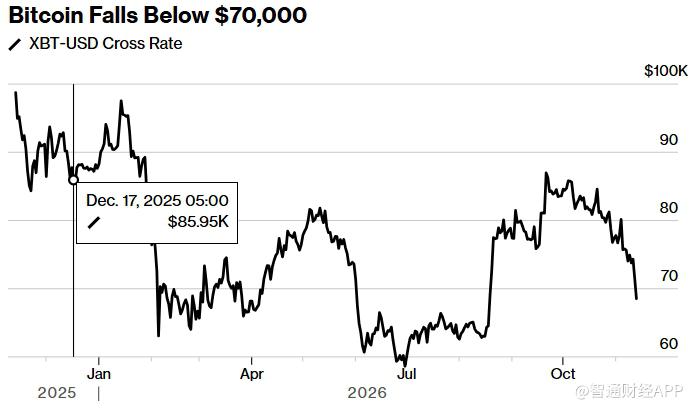
Paul Howard, senior director of cryptocurrency trading company Wincent, said that compared to before, the frequency of large-scale liquidations has increased markedly in the past 12 months. He pointed out that many cryptocurrency investors are increasingly using leveraged trading in order to pursue high risk and high returns, and external events, including major macroeconomic news, often trigger more drastic forced liquidation of positions.
Currently, derivatives trading accounts for about three-quarters of the total cryptocurrency market's trading volume.
Alex Kuptsikevich, chief market analyst at online trading platform FxPro, said that trading with derivatives has become the norm even for investors with limited capital. He pointed out that before the European trading session began, due to relatively limited institutional capital participation, market liquidity was low, and price trends were more difficult to predict. In this case, price fluctuations can easily trigger a large number of stop-loss orders, which in turn can trigger chain sell-offs.
However, some people in the cryptocurrency industry believe that large-scale liquidation should not simply be viewed as a direct reflection of market fragility.
Fabian Dori, chief investment officer of digital asset bank Sygnum Bank, said that chain liquidations reflect the distribution of leveraged positions in the market rather than a judgment on the value of related assets themselves. He pointed out that large-scale forced liquidation has long been a characteristic of the cryptocurrency market.
In addition to leveraged trading amplifying price fluctuations, Bitcoin has also recently been affected by a range of macroeconomic and industry factors. High oil prices and continued stubborn inflation have further strengthened the market's expectations that the Federal Reserve will continue to raise interest rates. As US Treasury yields rise, the opportunity cost for investors to hold risky assets such as Bitcoin that do not generate interest income also rises.
Meanwhile, as the Democratic Party regains control of the US Senate and House of Representatives next year, the market anticipates that the cryptocurrency industry may face more stringent regulatory scrutiny. Furthermore, the continued outflow of funds from Bitcoin ETFs and the subsequent impact of the recent $6 billion hacking attack on the cryptocurrency trading platform Binance also continued to weigh on market sentiment.
Notably, the cryptocurrency market is also currently facing a new potential challenge: Bitcoin may be losing to AI-related stocks in the process of competing for speculative funding. The recent sell-off in the AI sector has not only intensified risk aversion in global financial markets, but may also provide some investors with more attractive opportunities to buy technology stocks, thereby weakening the momentum for capital to flow into the cryptocurrency market.
This change is in stark contrast to the expectations of some cryptocurrency bulls previously. Just a few months ago, some investors also believed that once the rise in AI stocks cooled down, speculative funds seeking high returns might switch to Bitcoin. Currently, however, the opposite is likely to be the case. As technology stock prices fall, investors seeking bargain opportunities are more likely to increase their holdings of AI-related stocks rather than switching their capital to cryptocurrencies.
Noelle Acheson, author of the cryptocurrency research newsletter “Crypto Is Macro Now,” said that with the launch of the US Spot Bitcoin ETF in 2024, Bitcoin has gradually become an asset driven by macroeconomic factors.
She pointed out that once Bitcoin becomes a macro asset, it will need to compete with other assets affected by macroeconomic factors to compete for capital that investors can use to allocate high-risk, high-return assets.
For Bitcoin, this means that the cooling of the AI investment boom will not necessarily bring in the expected inflow of capital. In contrast, against the backdrop of falling valuations of technology stocks, rising expectations of interest rate hikes, and frequent large-scale breakouts in the cryptocurrency market, whether Bitcoin can re-attract speculative capital is becoming an important factor affecting its future trend.