
Citi and Wells Fargo Just Cut Their Price Targets on Nvidia. Why Wall Street Is Growing More Cautious.
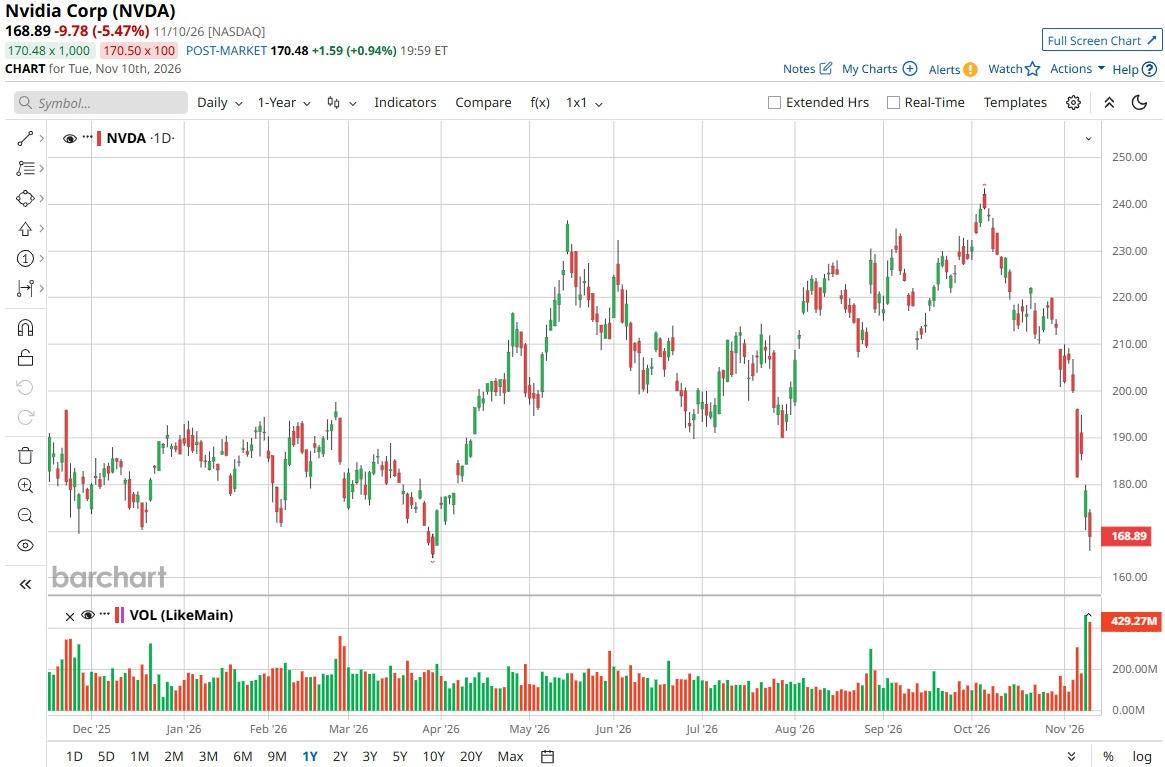
Nvidia (NVDA) stock is giving investors plenty to debate. Despite the excitement around its role in artificial intelligence (AI), shares stood at $166.19 on Nov. 12. That left NVDA stock down 11% year-to-date (YTD) and down 14% over the past 52 weeks, raising questions about what comes next.
Nvidia now faces fresh scrutiny after Citi and Wells Fargo lowered their price targets ahead of its upcoming earnings report. The revisions add another wrinkle to the debate over whether NVDA stock’s retreat represents an opportunity or a reason for greater caution.
Do these cuts reflect more measured expectations, or is Wall Street becoming less convinced about Nvidia’s upside? Let’s find out.
What Prompted the Two Price Target Cuts?
Nvidia designs chips and software for AI, gaming, and data centers. Its market capitalization of approximately $4.18 trillion places it among the largest technology companies, with AI infrastructure central to its business.
Citi analyst Atif Malik recently cut his Nvidia price target from $315 to $285 but kept a “Buy” rating on NVDA stock. Malik still expects results to beat estimates, though rising prices for high-bandwidth memory (HBM) could eat into profits.
“We expect higher sales to be offset by lower gross margins due to HBM price increases,” the analyst wrote. Malik also wanted updates on supply, demand, and how quickly Nvidia could turn outstanding orders into sales.
The investigation involving now former CEO Jensen Huang has added another concern. Nvidia’s board opened a review into whether foreign intelligence had targeted Huang following reports about a personal relationship. The alleged intelligence connection remains under investigation and has not been established, while Huang stepped down from his position on Nov. 12.
Wells Fargo analyst Joe Quatrochi also flagged the investigation as a source of uncertainty. He lowered his target from $315 to $300 but kept an “Overweight” rating. Quatrochi expects Nvidia to beat quarterly estimates and wants reassurance that customers will keep spending on AI infrastructure.
Both analyst firms remain positive on Nvidia, but their lower targets show caution about costs, spending, and the investigation. The calls suggest more measured expectations rather than a bearish turn.
Nvidia’s Business Growth
Nvidia released its second-quarter fiscal 2027 results on Aug. 26, with revenue rising 106% year-over-year (YOY) to $96.2 billion. That beat analysts’ $92.4 billion forecast. Adjusted earnings came in at $2.22 per share, above the $2.09 analyst estimate.
Higher sales also helped lift operating profits. Nvidia reported adjusted operating income of $63.96 billion, beating the $61.01 billion forecast by almost 5%. That gave Nvidia an adjusted operating margin of 66.5%, or roughly $0.67 in operating profit for every dollar of sales. Operating margin before those adjustments rose to 66.2% from 60.8% a year earlier.
Nvidia’s cash flow figures were mixed, as operating cash flow reached $74.42 billion for the six months ended in July 2026. Its free cash flow margin, however, fell to 22.2% in Q2 fiscal 2027 from 28.8% in the year-ago period. This means a smaller share of sales remained as cash after running the business and paying for capital investments.
Nvidia said demand was growing across more types of AI customers. CEO Jensen Huang pointed to expanding AI labs, new startups, wider use of open models, and growing interest in AI interacting with the physical world. Nvidia also noted that its Vera Rubin platform entered full production to support further AI infrastructure spending.
Looking forward, the company forecast revenue of $108 billion at the midpoint for Q3 fiscal 2027.
Where the Street Stands Now
Nvidia will report earnings on Nov. 17, after the market closes. Analysts expect EPS of $2.49 for the quarter ending October 2026, up from $1.24 a year earlier. That would mean growth of 101% YOY, or roughly double last year’s earnings.
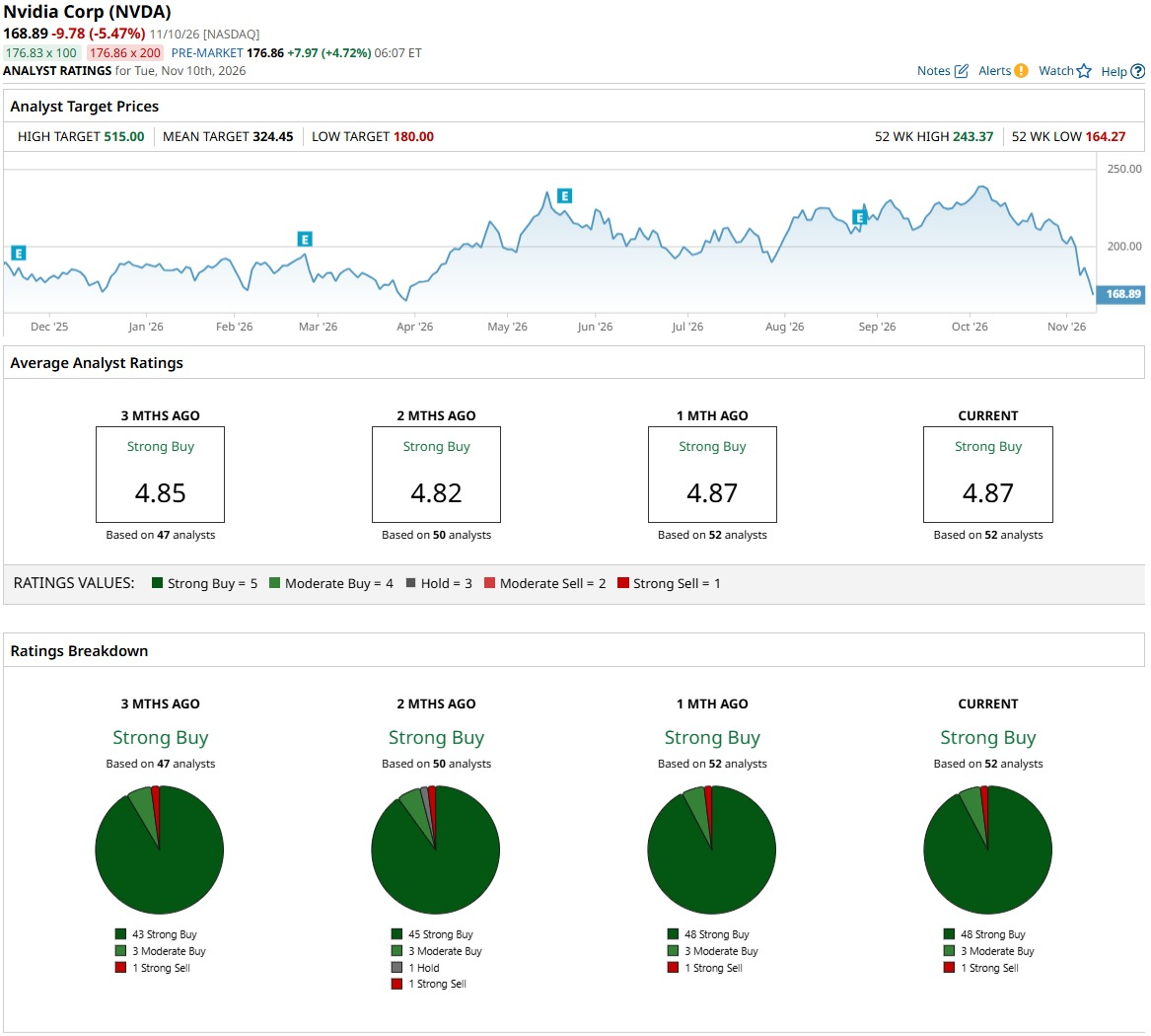
Despite Citi and Wells Fargo’s target cuts, analysts generally remain positive on NVDA stock. The consensus among 52 analysts is a “Strong Buy” rating with an average price target of $324.45. That implies potential upside of 95% from current levels, suggesting the two price target cuts have not changed the broader bullish view.
Conclusion
Wall Street is showing more caution on Nvidia, but it has not turned bearish. Citi and Wells Fargo lowered their targets while keeping positive ratings, and the wider consensus remains bullish. Margins and AI spending will likely face closer scrutiny as analysts look for reasons to maintain that confidence. Nvidia’s next results could ease concerns, though expectations leave little room for disappointment. The cuts suggest more guarded expectations, with the next report helping determine whether that caution is here to stay.
On the date of publication, Ebube Jones did not directly have a position in any of the securities mentioned in this article. All information and data in this article is solely for informational purposes. For more information please view the Barchart Disclosure Policy here.