
Has Intuit (INTU) Fallen Far Enough To Sit Below Fair Value?
Intuit has had a tough few years in the market, and that slump puts a spotlight on a simple question for investors who still follow the stock. Does the current share price make sense when set against what the business actually earns?
- Over the past 5 years, Intuit shares have fallen 48.9%, which puts the focus squarely on whether the earnings story has changed enough to justify where the stock trades today.
- Recent revenue growth of 14% and management’s expectation for slower top line expansion ahead can reshape how investors think about the durability of Intuit’s margins and the earnings power they are willing to pay for.
- There is a second opinion on Intuit worth weighing. See what analysts think Intuit's shares could be worth.
The issue now is whether today’s price for Intuit is justified by the earnings the company is producing and what those profits might reasonably support over time.
If you want to stress test this same earnings question beyond Intuit, you can compare it with 32 high quality undervalued stocks.
Is Intuit a Bargain on Earnings?
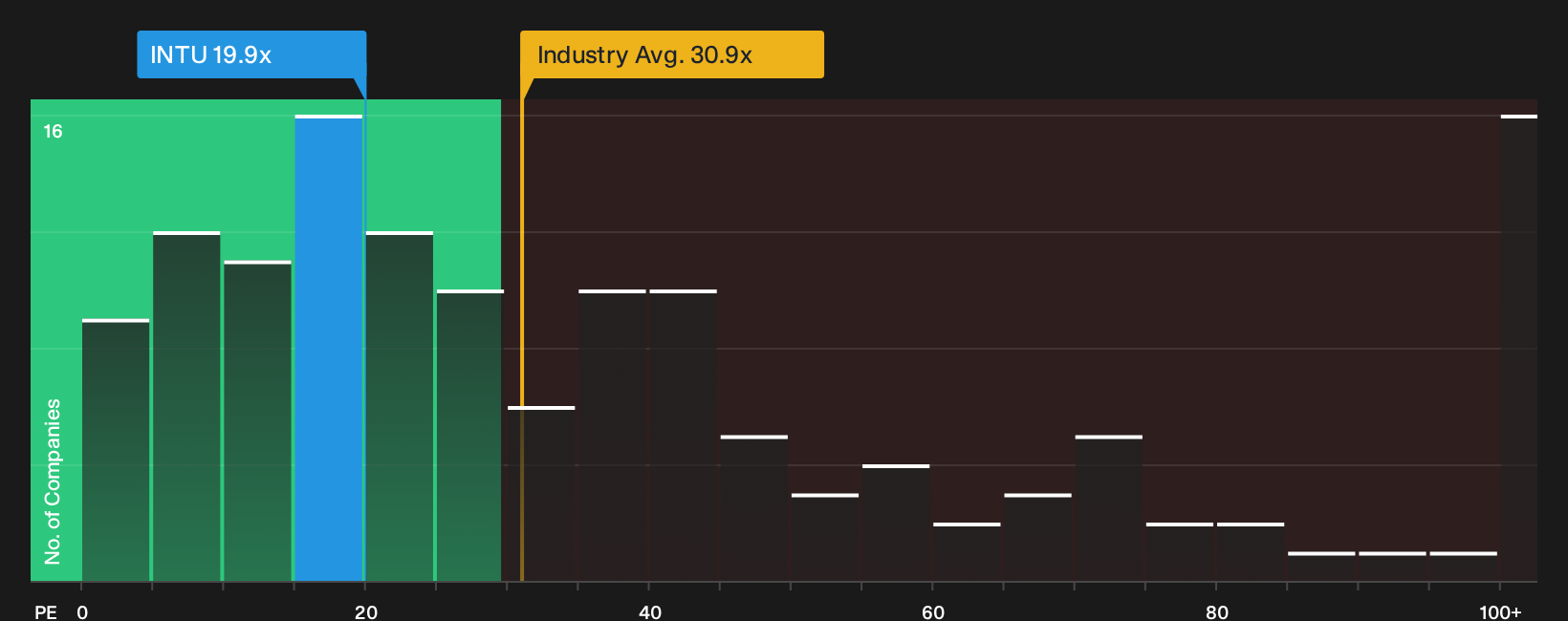
The P/E ratio fits Intuit because earnings still sit at the center of how investors judge its tax and finance software franchise. On this lens, the stock trades on roughly 19.9x earnings, which is well below the broader Software sector on 30.9x and far under a peer group average of 48.6x. That is a wide gap for a business built around recurring tax, accounting and personal finance products.
The fair-value model, which adjusts the P/E you might expect for Intuit’s growth profile, margins, size and risk, points to a higher multiple than where the shares change hands today. As a result, the framework flags the stock as undervalued on earnings. Because management now guides to slower revenue expansion after 14% growth in fiscal 2026, the current discount suggests investors are already pricing in a more cautious outlook even as the company leans into AI features across TurboTax, QuickBooks and Credit Karma. Explore the numbers behind Intuit's P/E valuation.
The Intuit Narrative: What Would Justify Today's Price?
Simply Wall St Narratives pick up where Intuit’s valuation puzzle leaves off. They spell out which paths for growth, profitability and earnings would need to play out for the stock to look meaningfully cheap or expensive at today’s level on the Community page. Each narrative ties its number to a concrete view of where Intuit’s expansion, margins and risk profile could go next, which you can track against future results and guidance.
Bullish and bearish views on Intuit hinge on whether its expanding product ecosystem and AI push outweigh growing execution and partner risks.
Bull case: 39% undervalued
According to tripledub, an investor in the Simply Wall St Community, the draw is Intuit’s mix of sticky software, cash generation and new products.
"Here’s what makes Intuit unusual, once a small business puts its financial life into QuickBooks, switching to a competitor is genuinely painful..."
Discover why this Narrative puts Intuit at 39% undervalued.
Bear case: 17% overvalued
The bearish analyst Narrative on Simply Wall St argues that AI costs, heavier partner dependence and slower growth could already be baked into Intuit’s price.
"Any slowdown in customer adoption or setbacks in orchestration could leave AI costs growing faster than usage, which would limit revenue uplift and squeeze net margins..."
Explore why this Narrative puts Intuit at 17% overvalued.
One more Intuit factor to check before you act
Price, profits and growth stories only go so far if the people steering Intuit and the way they are rewarded pull in a different direction to you as a shareholder. See who runs Intuit and how they are paid.
Have feedback on this article? Concerned about the content? Get in touch with us directly. Alternatively, email editorial-team@simplywallst.com