
AMD Stock Soars As It Inks Deal With Google Cloud. How to Play AMD Now.
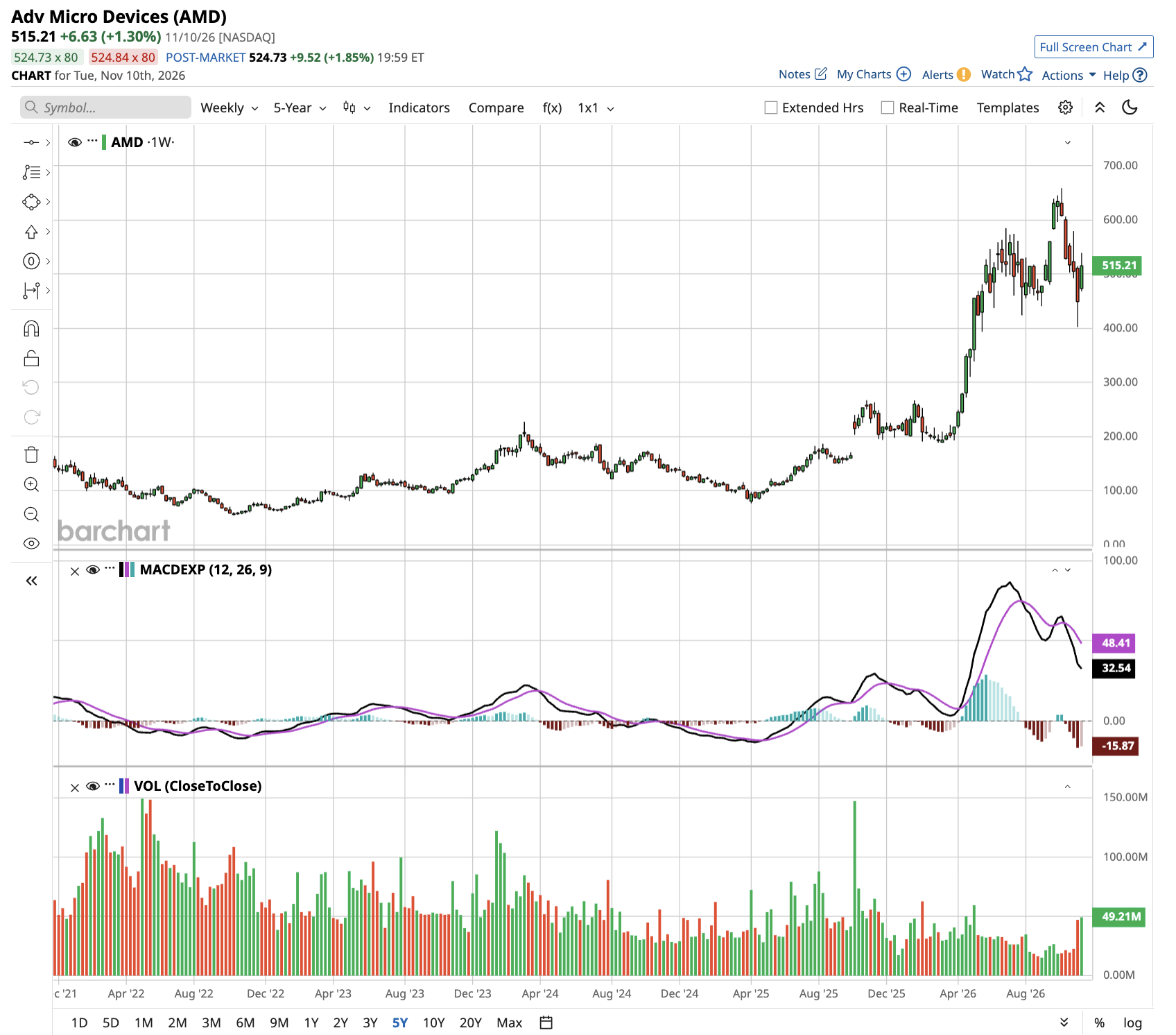
Advanced Micro Devices (AMD) recently landed a notable win with Alphabet's (GOOGL) Google Cloud. Specifically, the company’s fifth-generation EPYC processors will now run the host systems for Google’s newest artificial intelligence (AI) chip. AMD stock has climbed by more than 27% since the deal was announced.
Most of the attention in the AI space goes to the accelerators that train and run models. However, those chips need processors to prepare data and manage the work. AI accelerators, such as Google’s Tensor Processing Units (TPUs), are chips that run AI models, but they rely on a host processor to prepare data, coordinate workloads, and manage communication. “Accelerators depend on host processors to supply data, schedule work and connect AI workloads with the applications and services around them,” AMD noted in its Nov. 9 announcement.
AMD said its EPYC chips are now the host of choice for 10 leading hyperscalers and frontier AI labs, covering systems built on AMD, Nvidia (NVDA), and custom silicon technology. CEO Lisa Su made a similar point on the company's third-quarter earnings call, noting that OpenAI “selected Turin EPYC processors as the host CPUs for its first custom accelerator platforms.”
What Did AMD and Google Cloud Announce?
On Nov. 9, Google introduced two new versions of its TPUs — the 8tx and 8i Max — which compete directly with Nvidia. The 8tx targets government agencies and regulated industries that must protect sensitive data while it is being processed. “Built on the same silicon as TPU 8t and paired with 5th Generation AMD EPYC CPU hosts, TPU 8tx builds security directly into the hardware layer,” the firm noted. Reportedly, 8tx delivers “up to 2x lower latency compared to TPU 8t with a near-zero performance penalty.”
AMD's fifth-generation EPYC processors will run the host infrastructure for TPU 8tx. “By pairing 5th Gen AMD EPYC processors with our 8th-generation TPU architecture inside the AI Hypercomputer, we are bringing hardware-enforced confidential computing to cloud TPUs for the first time,” said Google Cloud Vice President and General Manager for AI and Computing Infrastructure Mark Lohmeyer.
AMD noted that the two companies have worked together across several EPYC generations. Google security experts have also reviewed AMD's security processor firmware.
AMD Continues to Grow at a Steady Pace
AMD reported Q3 revenue of $13.4 billion on Nov. 3, an increase of 45% year-over-year (YOY), while adjusted EPS rose 74% to $2.09. Data-center sales almost doubled to $8.5 billion, accounting for about 64% of total revenue. AMD guided Q4 revenue to about $17 billion, plus or minus 3%. For fiscal 2027, Su expects revenue growth above 80%, with server revenue roughly doubling. "Demand is higher than supply," Su told analysts on the earnings call.
On Nov. 10, AMD also announced availability of its sixth-generation EPYC server processors, built on the Zen 6 design. Companies can rent them through the cloud, too. Microsoft's (MSFT) Azure has instances in preview, and Oracle's (ORCL) Oracle Cloud Infrastructure plans to launch soon. Su said on the call that broader instance rollouts are planned for early 2027.
AMD claims its EPYC 9996 CPU delivers up to 2.2 times the performance of Intel's (INTC) Xeon 6980P. It also claims up to 3.7 times the performance of an Nvidia Vera system.
Meanwhile, on Oct. 27, AMD noted that Meta Platforms (META) has deployed millions of EPYC processors. AMD said it will invest $1 billion in Meta's equity offering.
Is AMD Stock Still a Good Buy?
AMD expects client and gaming sales to fall more than 20% sequentially from Q3, according to CFO Jean Hu. Meanwhile, Su forecasts PC shipments to drop by a double-digit percentage in 2027. Gaming revenue also already fell 40% YOY to $773 million in Q3, while inventories rose to about $11.5 billion.
Still, valued at a market capitalization of $906 billion, AMD stock is up 358% over the last three years. Analysts tracking the tech stock forecast EPS to expand 112% YOY to $6.93 in fiscal 2026, followed by possible growth of 131% to $16.04 in fiscal 2027.
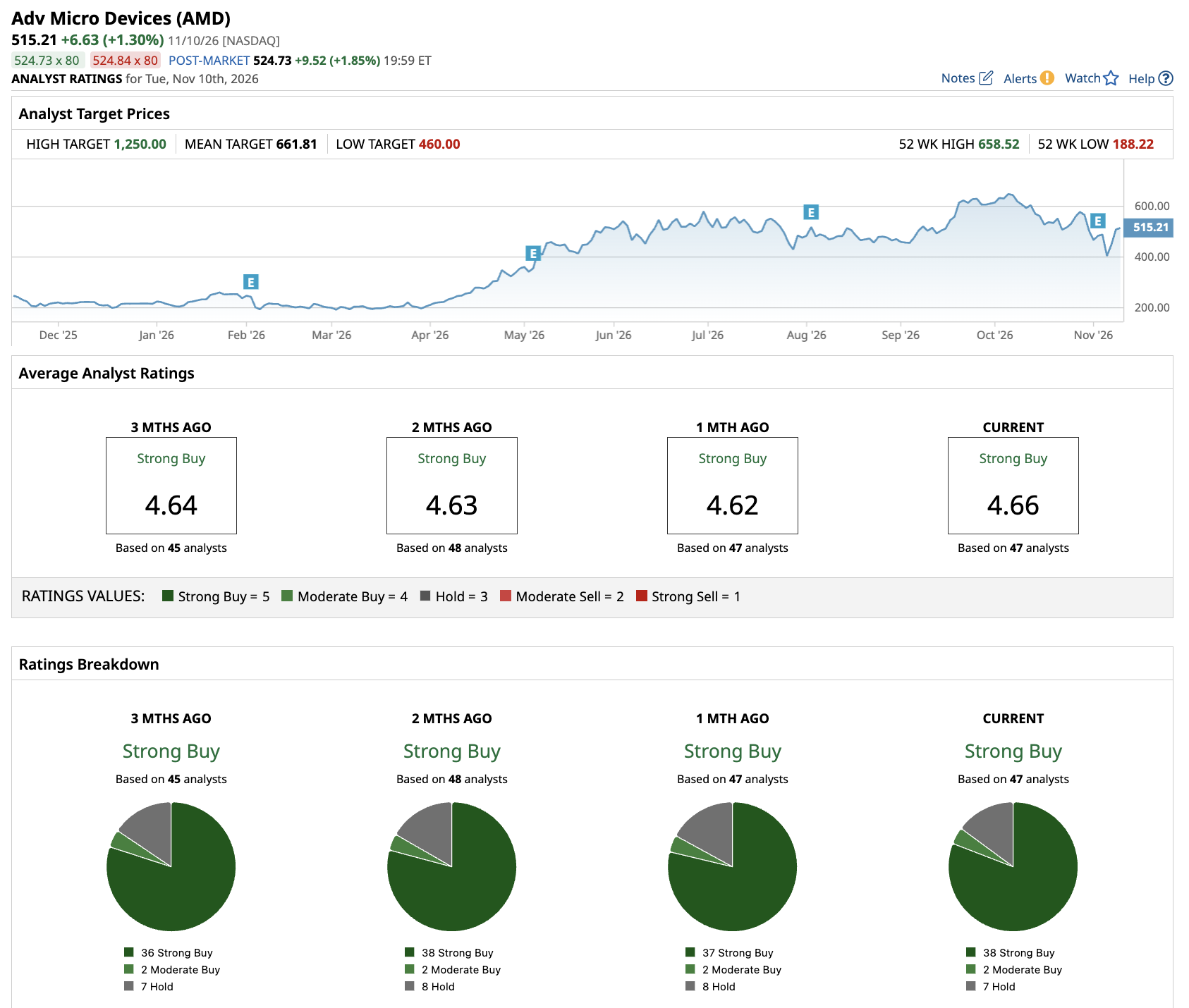
Out of the 47 analysts covering AMD stock, 38 recommend a “Strong Buy” rating, two analysts recommend a "Moderate Buy,” and seven recommend a “Hold” rating. The average price target of $660.37 represents potential upside of 13% from current levels.
On the date of publication, Aditya Raghunath did not directly have a position in any of the securities mentioned in this article. All information and data in this article is solely for informational purposes. For more information please view the Barchart Disclosure Policy here.