
1 Million Reasons to Buy the Dip in Tesla Stock (You Can Thank Terafab)
Tesla (TSLA) investors may have a new reason to look past TSLA stock’s recent weakness, as Terafab could become one of the most ambitious semiconductor manufacturing projects in the world. Reports indicate that the Tesla and SpaceX (SPCX) backed chip venture is targeting production of 1 million wafers per month by 2032, including roughly 700,000 memory wafers and more than 300,000 logic wafers.
While that target is far from guaranteed, CEO Elon Musk has acknowledged that Terafab’s timeline is highly aggressive and the sheer scale highlights the potential strategic importance of securing in-house chip capacity for Tesla’s autonomous vehicles, Cybercab, Optimus humanoid robots, and AI infrastructure. Terafab is also targeting volume production as early as the second half of 2028, with the project already engaging semiconductor equipment suppliers.
For investors looking to buy the dip in Tesla stock, Terafab could represent a potentially powerful long-term catalyst by reducing reliance on external chip suppliers while giving Tesla greater control over the critical semiconductor supply chain. Let's take a closer look.
About Tesla Stock
Tesla is an automotive and clean energy company headquartered in Austin, Texas. Tesla designs, manufactures, and sells electric vehicles (EVs), alongside energy storage solutions such as Powerwall and Megapack, solar products, and related services.
Over the years, Tesla has expanded globally with a network of production facilities, showrooms, service centers, and Supercharger stations, and has increasingly emphasized advanced software and autonomous capabilities as part of its long-term strategy. Tesla is one of the world’s most valuable companies, with a current market capitalization of $1.54 trillion.
TSLA stock has remained under pressure over the past year, reflecting investor concerns about its valuation and the substantial investment required to build out its AI, robotics, and autonomous driving (AD) ambitions. The stock is down 8% over the past 52 weeks and 12% year-to-date (YTD), while it remains 20% below its 52-week high of $498.83. That December peak came amid elevated optimism surrounding its AI and robotics opportunity, but the shares subsequently faced a prolonged pullback as investors questioned the pace at which those businesses could translate into meaningful revenue and profits.
However, Tesla has shown signs of renewed buying interest in recent sessions. TSLA stock jumped more than 4% on Nov. 6 after suffering an 11% plunge in the previous session, then surged another 6% on Nov. 9. The rebound came as investors digested developments that could strengthen Tesla’s longer-term AD story.
On Nov. 9, Tesla said Robotaxi rides would begin in San Antonio, Texas, while management has identified the Cybercab as its primary robotaxi product and expects the business to become a significant contributor to revenue and profitability in 2027. The ambitious targets surrounding Terafab may have also contributed to the recent surge. TSLA stock has surged in the last three sessions, taking its past five-day return to around 16%.
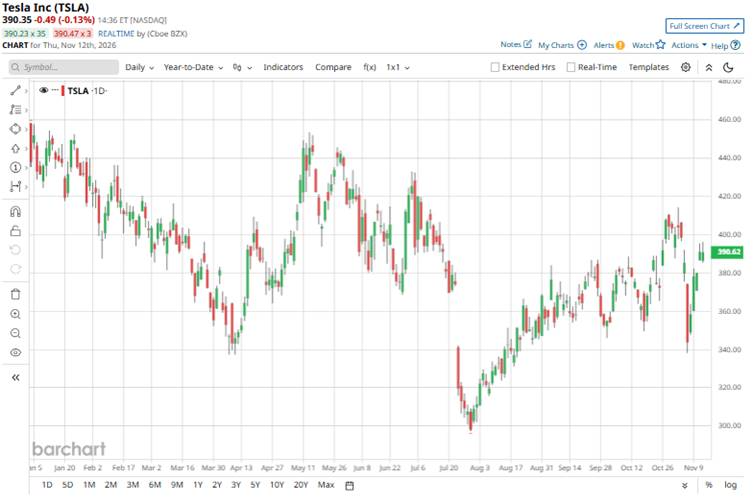
TSLA stock trades at a forward price-to-earnings (P/E) ratio of 570 times, which is well above the industry average. The stock also trades at 15.8 times sales, which is a premium compared to its peers.
A Mixed Quarter
Tesla reported its third-quarter 2026 results on Oct. 21, delivering a mixed picture. Tesla generated $28.04 billion in Q3 revenue, essentially flat year-over-year (YOY). Automotive revenue declined 3% YOY to $20.6 billion, while energy generation and storage revenue fell 16% YOY to $2.9 billion. The decline in these two businesses was offset by a 33% increase in Services and Other revenue to $4.6 billion.
The earnings picture was more challenging, partly attributable to substantially higher operating expenses. Non-GAAP net income declined a more modest 4% to $1.7 billion, while adjusted EPS came in at $0.48 versus $0.50 a year earlier, beating the consensus.
However, Tesla did make progress on gross profitability. Gross profit increased 9% YOY to $5.5 billion, while total gross margin expanded 160 basis points to 19.6%.
Vehicle deliveries remained a weak point. Tesla delivered 486,532 vehicles in Q3, down 2% YOY, although production increased 4% to 464,391 vehicles. Model 3/Y production rose 5% to 457,387, while deliveries of those models declined 1% to 478,237. Deliveries of other models dropped 48% YOY to 8,295, reflecting the continuing transition and production constraints across Tesla's broader lineup.
Importantly, management said battery availability remained a constraint on increasing vehicle volumes and that it ended the quarter with its largest passenger-vehicle backlog in four years.
On the other hand, Tesla's energy business provided a more encouraging signal for the long-term growth story. The company deployed 13.7 gigawatt-hours of energy storage, up 10% YOY. Management said demand from data centers was particularly strong, with the company reporting its highest-ever order rate and backlog for energy storage. Tesla also began production at Megafactory Texas, which has planned annual capacity of 50 GWh, and started shipping Megapacks using its own LFP cells produced in Nevada.
Another important growth indicator was Full Self-Driving (FSD) adoption. Active FSD subscriptions increased 67% YOY to 1.74 million. Plus, more than 75% of new Tesla deliveries in North America included an FSD subscription.
Cash generation was another bright spot, although capital requirements remain substantial. Tesla generated $6.3 billion of operating cash flow, essentially flat YOY, and $1.5 billion of free cash flow, down 62% because capital expenditures more than doubled to $4.7 billion. The company ended Q3 with $45.5 billion in cash, cash equivalents, and short-term investments, up 9% YOY.
For the full year, however, management reduced its capex outlook to approximately $20 billion, down from its previous expectation of about $25 billion, while continuing to invest heavily in AI compute, robotics, batteries, and semiconductor manufacturing. Looking forward, analysts predict EPS to decline 39% YOY to $0.67 in fiscal 2026 before rising 58% YOY to $1.06 in fiscal 2027.
What Do Analysts Expect for Tesla Stock?
Barclays analyst Dan Levy upgraded Tesla to “Overweight” from “Equal Weight” on Oct. 26, while raising the price target to $450 from $370. The move reflected a more constructive view of Tesla's core business and improving Robotaxi trends. On the other hand, UBS analyst Joseph Spak recently maintained a “Neutral” rating on TSLA stock but raised his price target to $425 from $391.
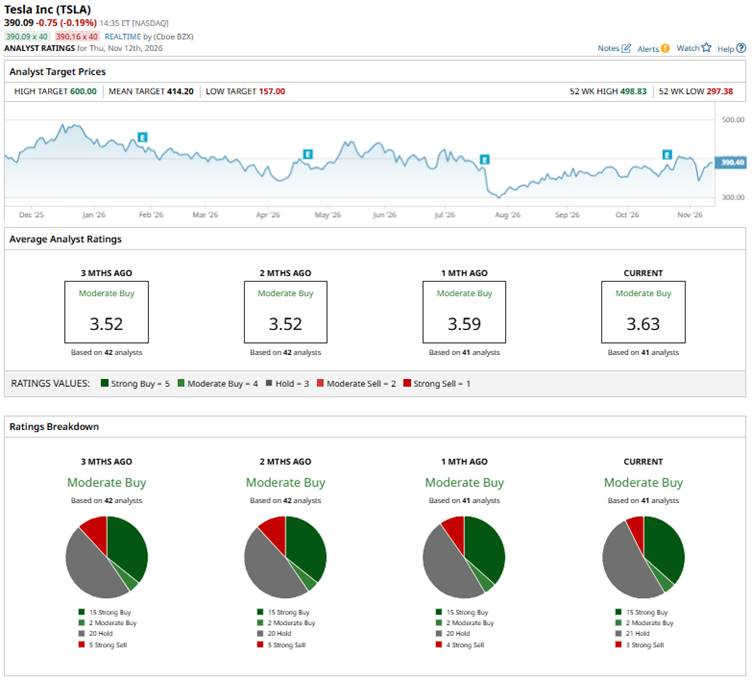
Overall, TSLA stock has consensus “Moderate Buy” rating, indicating a cautiously bullish stance. Of the 41 analysts covering the stock, 15 advise a “Strong Buy,” two recommend a “Moderate Buy,” 21 analysts have a “Hold” rating, and three have a “Strong Sell.” The average analyst price target of $414.20 indicates potential upside of 4% from current levels, while the Street-high target price of $600 suggests the stock could rally as much as 51%.
On the date of publication, Subhasree Kar did not directly have a position in any of the securities mentioned in this article. All information and data in this article is solely for informational purposes. For more information please view the Barchart Disclosure Policy here.