
Consumer discretionary - education services stocks Q3 highlights: Bright Horizons

As the Q3 earnings season comes to a close, it’s time to take stock of this quarter’s best and worst performers in the consumer discretionary - education services industry, including Bright Horizons NYSE:BFAM and its peers.
The Consumer Discretionary sector, by definition, is made up of companies selling non-essential goods and services. When economic conditions deteriorate or tastes shift, consumers can easily cut back or eliminate these purchases. For long-term investors with five-year holding periods, this creates a structural challenge: the sector is inherently hit-driven, with low switching costs and fickle customers. As a result, only a handful of companies can reliably grow demand and compound earnings over long periods, which is why our bar is high and High Quality ratings are rare. Education services companies provide postsecondary instruction, professional certifications, test preparation, and corporate training, both online and in-person. Tailwinds include lifelong-learning demand driven by rapid technological change, employer-sponsored upskilling programs, and growing acceptance of online credentials. Headwinds are substantial: heavy regulatory oversight—particularly around student-loan eligibility and enrollment practices—can abruptly alter business models. Reputational risk from scrutiny over student outcomes and debt burdens constrains marketing strategies. Competition from free or low-cost digital alternatives (MOOCs, employer-built academies) pressures pricing.
The 5 consumer discretionary - education services stocks we track reported a mixed Q3. As a group, revenues beat analysts’ consensus estimates by 1.9%.
Amidst this news, share prices of the companies have had a rough stretch. On average, they are down 5.8% since the latest earnings results.
Bright Horizons NYSE:BFAM
Founded in 1986, Bright Horizons (NYSE:BFAM) is a global provider of child care, early education, and workforce support solutions.
Bright Horizons reported revenues of $841.5 million, up 4.8% year on year. This print was in line with analysts’ expectations, but overall, it was a softer quarter for the company with full-year revenue guidance slightly missing analysts’ expectations and full-year EPS guidance missing analysts’ expectations.
“Our third quarter results reflect the strength of our diversified portfolio, with revenue up 5%, including 13% growth in back-up care,” said Stephen Kramer, Chief Executive Officer. “This fall, we were proud to celebrate 40 years of partnering with leading employers to support working families. Our commitment to providing safe, nurturing environments and high-quality care and education for the children and families we serve has guided us since our start in 1986, and I am grateful to our global team, whose dedication brings that commitment to life every day.”
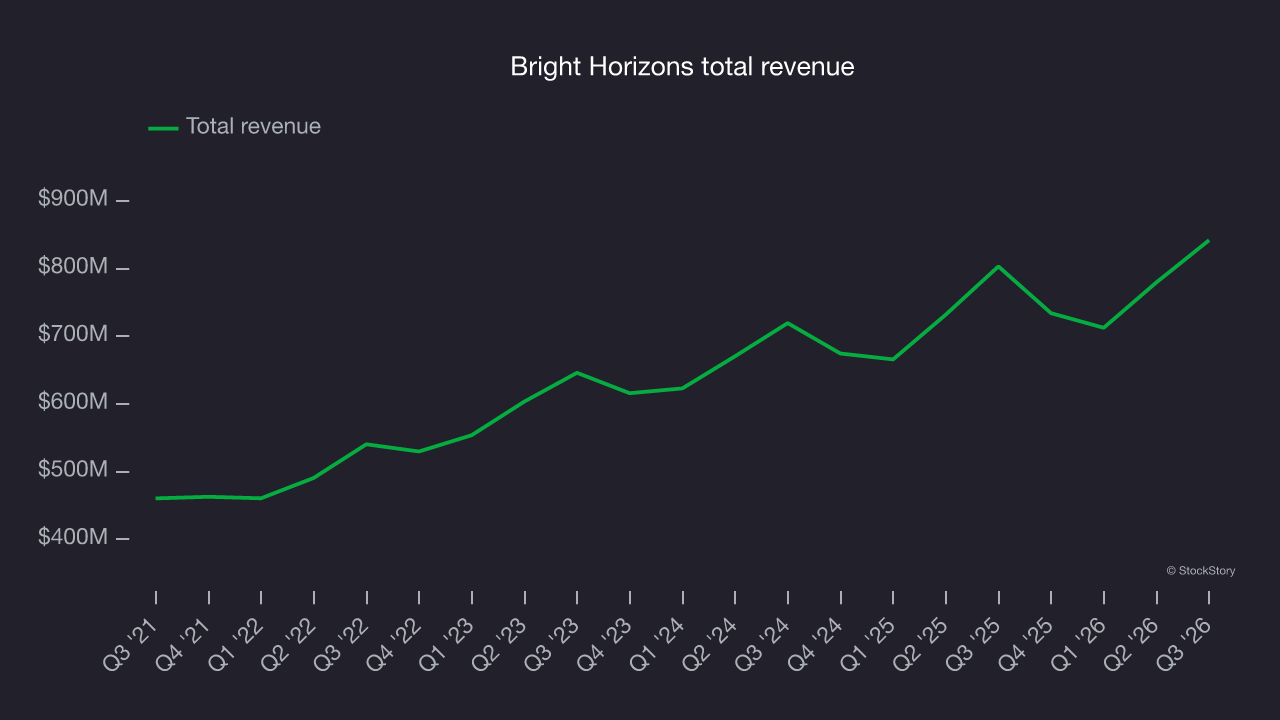
Bright Horizons delivered the weakest full-year guidance update in the group. The market seems disappointed with the results as the stock is down 21.2% since reporting and currently trades at $52.79.
Read our full report on Bright Horizons here, it’s free.
Best Q3: Lincoln Educational (NASDAQ:LINC)
Established in 1946, Lincoln Educational (NASDAQ:LINC) is a provider of specialized technical training in the United States, offering career-oriented programs to provide practical skills required in the workforce.
Lincoln Educational reported revenues of $159.2 million, up 12.6% year on year, outperforming analysts’ expectations by 4.9%. The business had a solid quarter with a beat of analysts’ EPS estimates and full-year revenue guidance slightly topping analysts’ expectations.
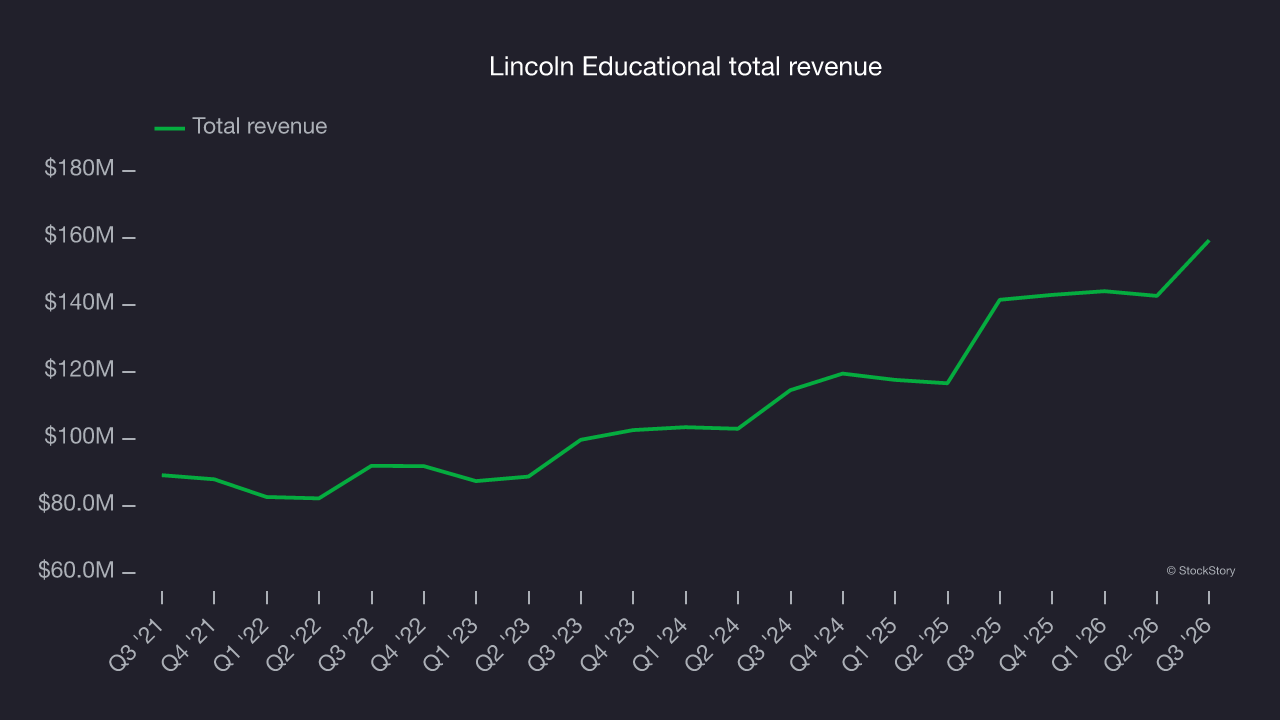
Lincoln Educational delivered the biggest analyst estimate beat and highest full-year guidance raise among its peers. The market seems happy with the results as the stock is up 30% since reporting. It currently trades at $22.96.
Is now the time to buy Lincoln Educational? Access our full analysis of the earnings results here, it’s free.
Weakest Q3: Strategic Education (NASDAQ:STRA)
Formed through the merger of Strayer Education and Capella Education in 2018, Strategic Education (NASDAQ:STRA) is a career-focused higher education provider.
Strategic Education reported revenues of $325.1 million, up 1.6% year on year, in line with analysts’ expectations. It was a sluggish quarter as it posted a significant miss of analysts’ EPS estimates and a miss of analysts’ EBITDA estimates.
Strategic Education delivered the weakest performance against analyst estimates and slowest revenue growth of the whole group. As expected, the stock is down 26.1% since the results and currently trades at $54.89.
Read our full analysis of Strategic Education’s results here.
Laureate Education (NASDAQ:LAUR)
Founded in 1998 by Douglas L. Becker and based in Miami, Laureate Education (NASDAQ:LAUR) is a global network of higher education institutions.
Laureate Education reported revenues of $485.1 million, up 21.2% year on year. This number beat analysts’ expectations by 0.7%. It was a satisfactory quarter as it also produced a beat of analysts’ EPS estimates.
Laureate Education pulled off the fastest revenue growth in the group. The stock is down 3.9% since reporting and currently trades at $34.95.
Read our full, actionable report on Laureate Education here, it’s free.
Covista (NYSE:CVSA)
Formerly known as DeVry Education Group, Covista (NYSE:CVSA) is a global provider of workforce solutions and educational services.
Covista reported revenues of $511.5 million, up 10.7% year on year. This print surpassed analysts’ expectations by 4.5%. Overall, it was a solid quarter as it also recorded a beat of analysts’ EPS estimates and a solid beat of analysts’ EBITDA estimates.
The stock is down 7.6% since reporting and currently trades at $119.01.
Read our full, actionable report on Covista here, it’s free.
Market update
Over the past year, investors have been forced to repeatedly answer the same question: What is the market’s biggest risk? The answer has changed several times, and each shift has reshaped market leadership.
Late in 2025 and early 2026, artificial intelligence became the market’s primary uncertainty. Investors questioned whether AI would erode software pricing power and weaken competitive moats as AI made it easier to replicate once-differentiated products.
By the spring, technology took a back seat to geopolitics. The U.S. conflict with Iran briefly became the market’s dominant narrative, raising concerns about oil prices, inflation, and global growth. But as energy markets remained orderly and fears of a prolonged supply disruption faded, investors quickly turned their focus back to fundamentals.
Want to invest in winners with rock-solid fundamentals? Check out our Strong Momentum Stocks and add them to your watchlist. These companies are poised for growth regardless of the political or macroeconomic climate.