
The AI Xinyun “Big Three” have already submitted documents. What investment signals does it release?
The Zhitong Finance App learned that the latest Q3 financial reports released by the three neocloud (neocloud) leaders answered the two biggest concerns of the market separately: demand is not bad, delivery is bad. CoreWeave (CRWV.US) and Nebius (NBIS.US) quarterly reports hit a new high this week. In addition to the previous IREN (IREN.US), the revenue of all three companies exceeded expectations, and contract reserves all hit new highs. However, none of the three stocks rose — after CoreWeave's earnings report, it jumped more than 15%, but Nebius closed down 16.8% to $128.64.
The difference is not the order book, but rather who turned the signed contract into a billable cabinet. The boom in artificial intelligence has been hailed as a huge opportunity for new cloud operators, but it turns out that building the ability to meet demand is a costly race against time.
Demand side: All three companies have exceeded expectations, but the quality of revenue must be discounted
CoreWeave's revenue for the quarter was $3.661 billion, up 168% year over year, higher than the market consensus of about $3.55 billion; contract reserves rose from $104 billion at the end of June to $132.5 billion, compared to only $55.6 billion a year ago. Nebius had revenue of $981 million, up 571% year over year, the fastest of the three, including the AI cloud business of $974 million. IREN's fiscal quarter ended at the end of September, with revenue of US$228 million, up 66% month-on-month, and AI cloud revenue of US$200 million, up 182% month-on-month, and segment gross margin of about 86%.
However, one figure must be taken out separately: Of Nebius' 981 million US dollars, about 325 million US dollars came from non-recurring revenue from the first phase of the “asset-light cooperation model,” but one-time revenue. After removal, its endogenous growth rate is still fast, but the “571%” headline figure cannot be directly tied to CoreWeave's 168%.
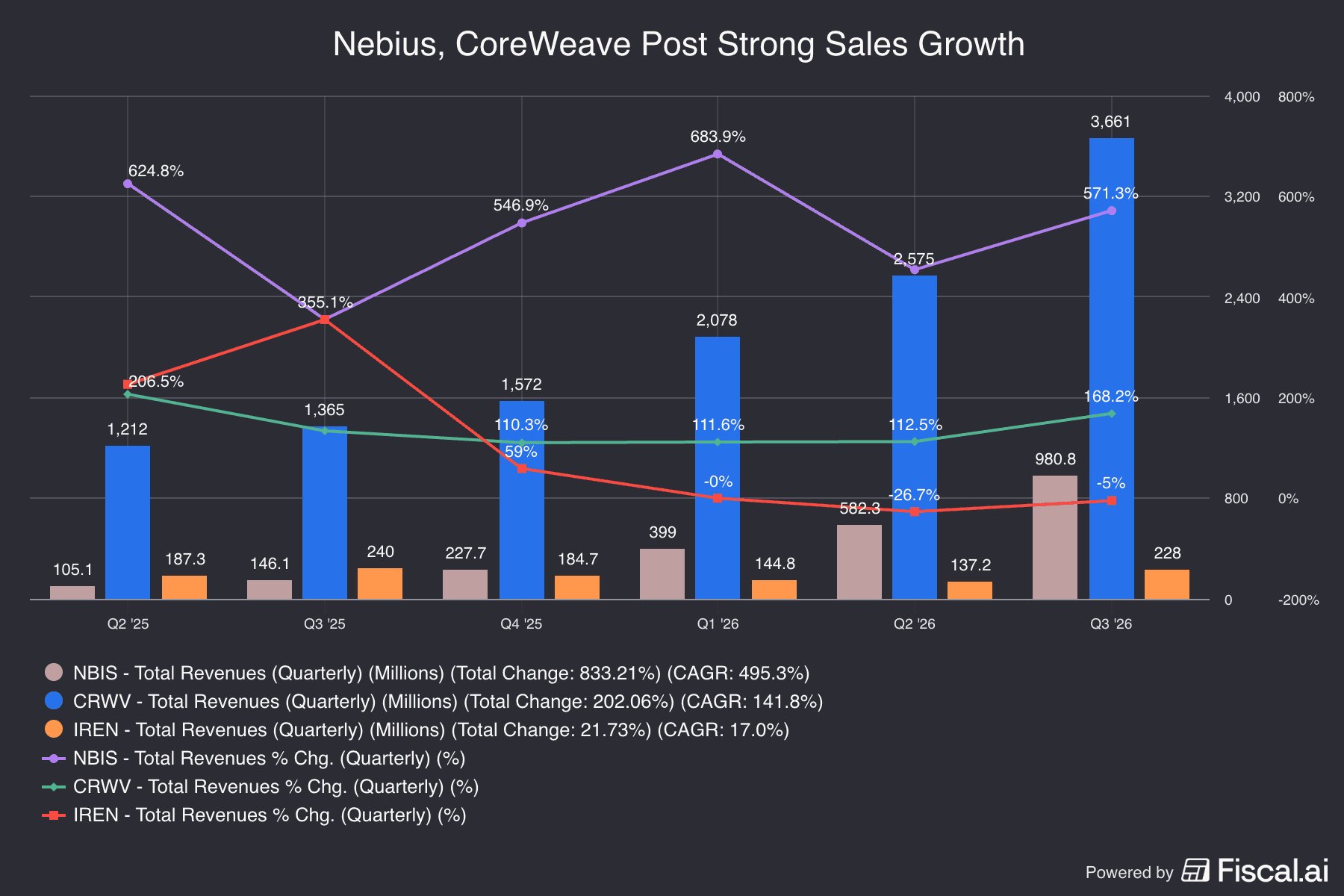
What the three companies have in common is even more remarkable: the contracts were all signed in Changli. Nebius and Meta have a five-year $12 billion agreement, IREN and Microsoft have a five-year contract of about 9.7 billion US dollars. Out of CoreWeave's $132.5 billion reserves, the computing power already introduced to the market was basically sold out in 2027 — CEO Michael Intrator said in a conference call that qualified customer demand was about 10 times the available capacity over the same period.
The pricing power is back, and this is the only proof that bears have been knocked out
Two of the core arguments that have suppressed Xinyun's stock price over the past two months are worth noting: GPU residual value will return to zero, and depreciation will eat up profits. The rebuttal given in Q3 is not on the new card, but on the old card.
Intrator revealed that in the third quarter, rental prices for previous-generation GPUs based on Nvidia's Ampere and Hopper architectures rose 30% to 50% month-on-month, and higher than the original contract price; some devices are signing multi-year contracts that exceed the accounting depreciation period. The company raised prices for various services by about 25% in July, and then by about 10% at the end of the third quarter. The current spread is about $20 million to $25 million per megawatt annualized revenue for long-term contracts of four to five years, and more than $40 million for short-term contracts.
Nebius's curve is the same: new contracts in Q3 are priced at over $25 million per megawatt, and Q2 is still between $20 million and $25 million. IREN offered a more direct line — the new five-year contract was $22 million per megawatt, and the H100 re-signing price was double the original.
The significance of the increase in the price of old cards is that it simultaneously removes half of the assumptions of “zero residual value” and “depreciation eats up profit”: if a card from three years ago can be renewed at a higher price after the contract expires, the depreciation period is not a source of risk, but rather a deferred confirmation of profit. Of course, this evidence currently only covers three self-described contract samples, and does not constitute an industry-wide price index.
Financing side: Advance payments replace debt, and interest is still eating up profits
The debts of all three companies are rising rapidly, but the structure is changing — from “borrowed money to build a computer room” to “customers pay first to build a computer room.”
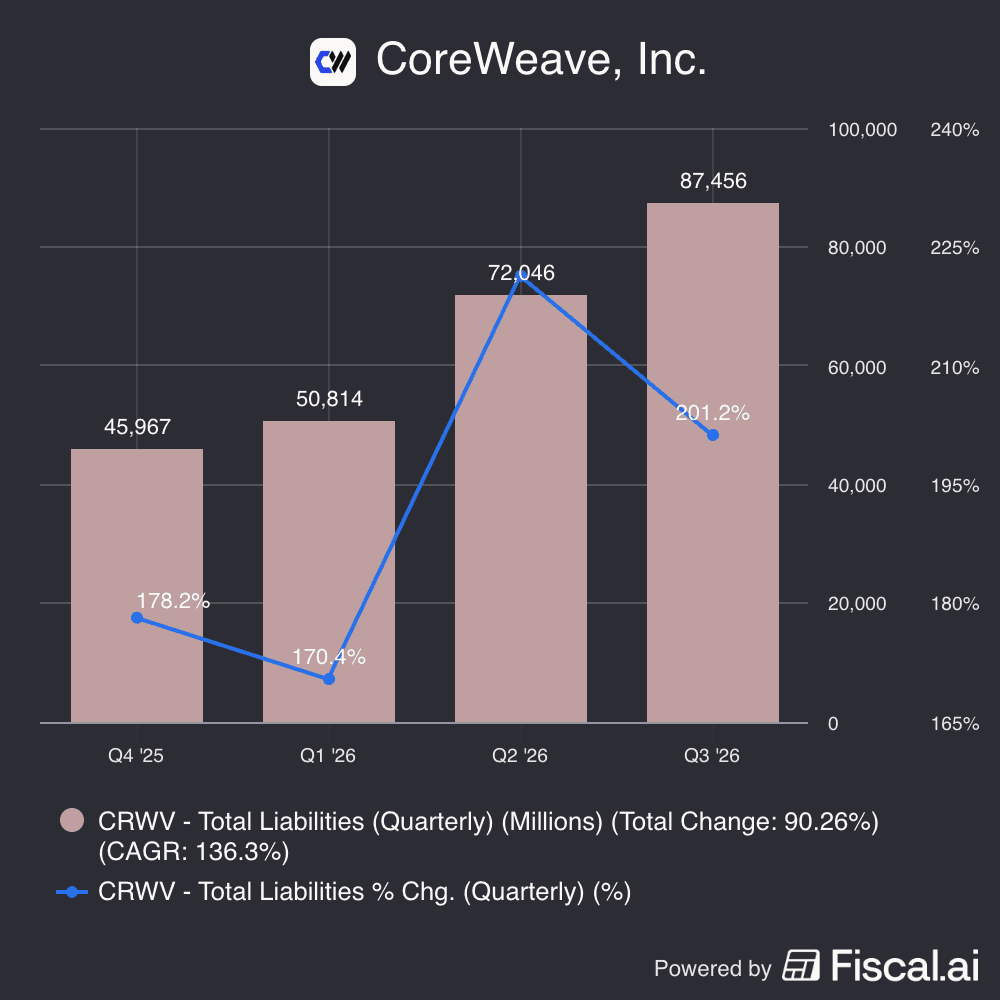
CoreWeave's debt size was around $46.9 billion at the end of September. According to Intrator, growth is supported by multiple sources of funding: financing guaranteed by customer contracts, operating cash flow, and customer advances and guarantees of approximately $9 billion over the next three months. The problem is interest: GAAP operating profit for the quarter was $207 million, and net interest expenses were $846 million, up 173% year over year. The growth rate was already ahead of revenue; based on adjusted operating profit of $379 million, it only covered 45% of interest. Interest guidance for the fourth quarter was US$1.05 billion to US$1.15 billion, which is equivalent to more than 80% of the median value of the full-year adjusted operating profit guidance (US$1,325 billion). The good news is that the weighted average cost of debt has dropped to 7.9%.
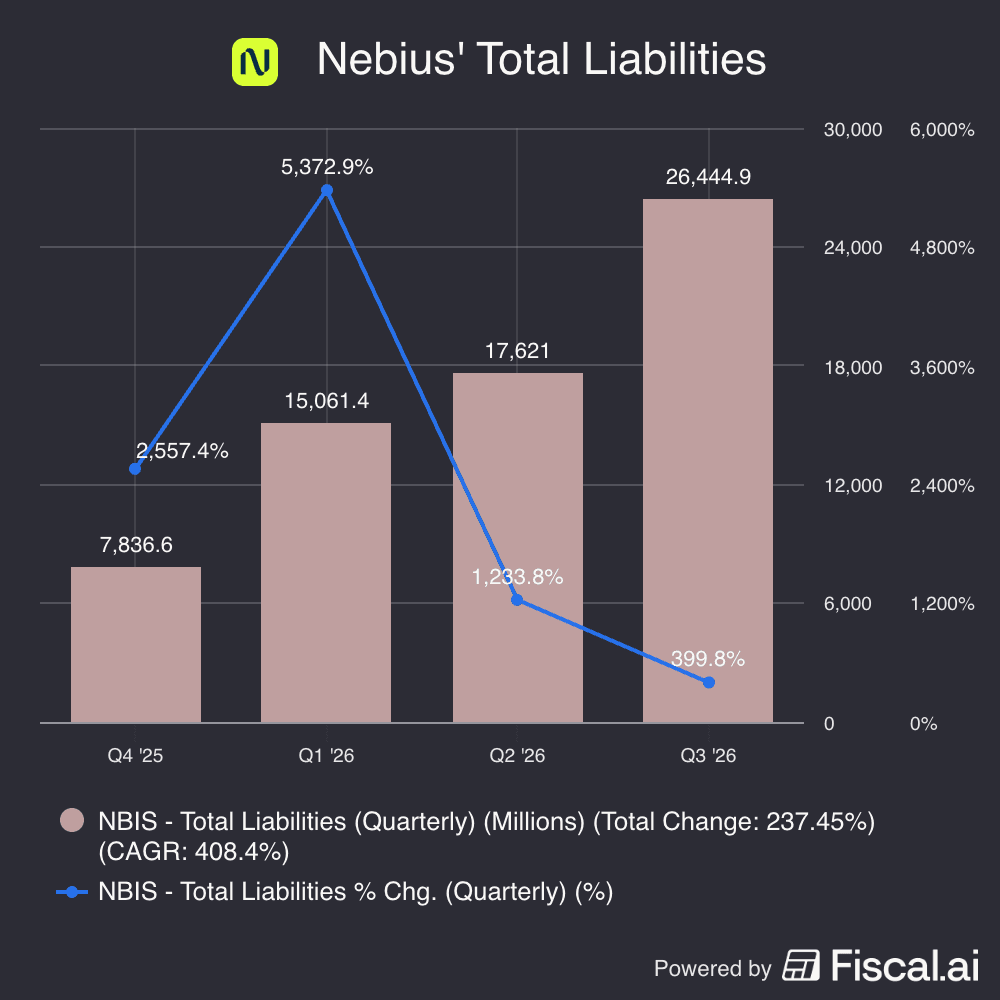
Nebius's financing structure is the cleanest of the three. Advance payments from Q3 contracted customers cover more than 100% of the relevant capital expenditure, and Q2 is still only 50% to 60%; the company expects to receive $10 billion in advance payments in 2026, $17 billion to $20 billion in 2027, plus loans secured by investment-grade customer contracts, to cover 75% to 85% of the capital expenditure of $40 billion to $45 billion in 2027. Cash was $7.4 billion at the end of the quarter, and it also received $3.5 billion in financing from Citi in October.
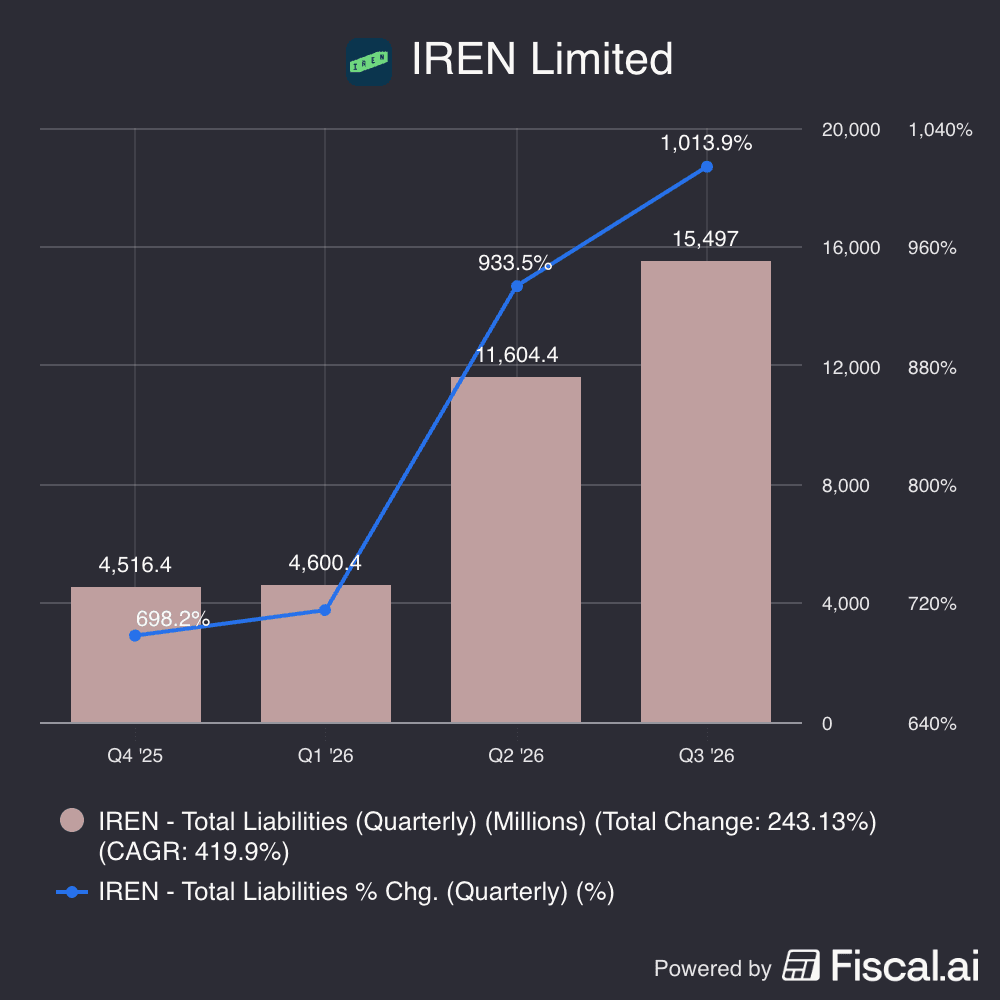
IREN is following the third path: the co-CEO says the company has no debt, and the customer prepaid about 90% of the associated GPU capital expenses on the five-year contract. The cost is small — the remaining planned capital expenditure for this fiscal year is approximately $15 billion, of which approximately $6 billion has yet to be funded.
The real weakness: extension, not demand
Nebius and IREN are rising stars in cloud computing. They have recently switched their business focus to cloud computing and are currently expanding production capacity to complete the first large orders they have received. For them, the key to measuring success is the ability to deliver on these promises quickly and efficiently.
Nebius was the only company with clear guidelines for revisions this week. 2026 revenue was pushed to the lower end of the $3 billion to $3.4 billion range (approximately $3 billion), below the LSEG consensus of $3.37 billion. The reason is not demand; in Vineland, New Jersey: Third-party operator DataOne prematurely ended temporary power supply before the Bloom Energy fuel cell climb was completed, and site progress was several months behind. Currently, slightly more than half of the Microsoft contract (up to $19.4 billion) of capacity is planned to be delivered before the end of the year, and the rest until the second quarter of 2027. The company emphasized that the delayed portion was not cancelled and that its own site was “on schedule or ahead of schedule.”
IREN's delay is more subtle: Horizon 1 was delivered to Microsoft in August and certified by Nvidia Exemplar, but Microsoft then requested that part of the network infrastructure be reconfigured and upgraded to allow 200 megawatts of capacity to serve the latest generation of cutting-edge models. The ARR target of over $4 billion was therefore pushed from the end of the year to January 2027, possibly until the end of February at the latest. The company stated that incremental capital expenses were “completely insignificant” and did not incur penalties. One side of the evidence is that Microsoft's capital expenditure last quarter was reduced due to delays on the IREN side.
Instead, CoreWeave was the only one of the three “ahead of schedule”: the annual capital expenditure guidance floor was raised from $35 billion to $37 billion on the grounds that infrastructure delivery was faster than originally planned.
CoreWeave is the largest new cloud company, and Nebius and iREN are also in a net loss. This is understandable given the ongoing investment and expansion cycle, but investors have begun to pay more close attention to the rate of cost growth.
What is even more alarming is the changing attitude on the customer side. According to reports, Microsoft is tightening the review of new cloud vendor projects such as IREN, Nebius, and Nscale to re-evaluate whether to sign new agreements. The order books of all three companies are highly concentrated on a small number of very large customers, which means that the “extension” is not only a scheduling issue, but may also affect the next round of signing.
The difference between the three families is the difference between a “landlord” and a “contractor”
Looking at the three financial reports together, the difference is not in the growth rate, but in how assets and contracts are matched.
CoreWeave has the strongest pricing power and the heaviest leverage of the three: sold out in 2027, the price of old cards increased, and profit margins rose from 1% in Q1 to more than 10% in Q3, but single-quarter interest is close to the level of adjusted operating profit for the whole year, and free cash flow is negative 7.7 billion US dollars. It is betting that “as long as demand is tight enough, financing costs can be passed on.”
Nebius has the cleanest financing structure and the fastest growing company, but two details need to be clarified: about one-third of the quarterly revenue is non-recurring; at the same time, the depreciation period for servers and network equipment was extended from 4 to 5 years, and this assumption was used to guide the break-even before tax for the fourth quarter of 2027. The depreciation period is an accounting choice and does not change cash flow.
In the face of the tightening financing environment, Nebius increasingly relies on long-term prepayments from major customers and loans secured by long-term contracts to cover Capex (prepayment+collateral financing in 2027 can cover 75% to 85% of Capex). The cost is that bargaining power is skewed towards large customers, and it is impossible to leave more production capacity to high prices and short contracts. The original core advantage of “short flexible pricing+low debt” over CoreWeave is being reduced, and the valuation difference between the two will also narrow.
IREN is the most elastic and the smallest: AI cloud revenue nearly tripled month-on-month, gross profit margin was 86%, Texas 2.15 gigawatts were connected to the grid, and about two-thirds of the $20.3 billion backlog of orders came from investment-grade counterparties. But it also relies the most on a single customer, and the ARR milestone has been driven away by a design change in one contract for two months.
The price given by the market
Since the beginning of the year, Nebius is up 54%, CoreWeave is down 21%, and IREN is down 48%. Sellers are still bullish: 31 of CoreWeave's 41 analysts bought, with a 12-month average upside of 112%; Nebius bought 15 out of 22, up 116%; IREN 20 bought, up 191%.
Driven by a surge in demand for cloud services, Xinyun concept stocks continued to rise for most of this year. However, over the past two months, market sentiment has weakened due to market concerns about the sustainability of cloud spending by large technology companies, the debt-driven business model of new cloud companies, and the overall decline in artificial intelligence concept stocks.
All three are still making net losses. The market's repricing in this round is not “whether demand will come”, but “whether contracts can be converted into revenue on time, and how much interest will be paid for it.” The answer to Q3 is half and a half: pricing power is improving, delivery is lagging behind, and interest is still eating up profits. Whoever fixes the second of these three lines first will get the valuation repaired first.
Furthermore, the general correction of AI-related stocks in recent months, the departure of Nvidia CEO Hwang In-hoon, the postponement of some data center projects in Nebius and Iren, and the cautious attitude of the incoming Democrat-led Congress on artificial intelligence remain uncertainties.