
Does New Sustainability Chief Change The Bull Case For Levi Strauss (LEVI)?
- Levi Strauss appointed Jeannie Renné-Malone as chief sustainability officer in early December 2026, putting her in charge of the global sustainability team and adding her to the Supply Chain Leadership Team after more than two decades in sustainability roles, most recently at VF Corporation.
- Her track record in areas like Science-Based Targets and green bond frameworks gives Levi Strauss an experienced operator who can link sustainability priorities directly to supply chain decisions and financing structures.
- The key question is how Levi Strauss's investment narrative could evolve as a seasoned sustainability leader joins its supply chain leadership.
Scan how Levi Strauss is repositioning around leadership, then size up other apparel and consumer stocks with strong fundamentals using our curated list of solid balance sheet and fundamentals (23 results).
Levi Strauss Investment Narrative Recap
For Levi Strauss, the long game still hinges on getting direct to consumer back on track, executing the U.S. distribution shift cleanly, and keeping wholesale steady. According to LunaRodas, an investor in the Simply Wall St Community, the recent call already raised questions about delayed cost savings and softer DTC comps. The Jeannie Renné Malone hire looks important for longer term brand and sourcing quality, but it does not directly change the near term store traffic or distribution timing story.
The biggest near term swing factor remains how quickly management can translate new product, marketing and the ongoing distribution transition into cleaner margins and better comps. The key operational risk sits in execution, especially after the Hebron to Groveport move produced delays and required extra spending. Dividend consistency also sits in the background as a smaller risk, given an unstable track record flagged in the data.
The Chicago flagship opening on Michigan Avenue ties closest to the current growth and margin debate. It leans into Levi Strauss brand equity, helps showcase premium assortments, and supports the DTC thesis that management has been defending after flat comps. For anyone tracking the story, that store is a very visible test of what the refreshed consumer experience can do.
LunaRodas argues that direct engagement with customers and better retail execution now matters at least as much as wholesale guidance tweaks. The Chicago site, with customization sessions and capsule drops, gives the business another laboratory for what resonates before decisions ripple into broader distribution. That kind of feedback loop could matter for marketing spend efficiency and product mix at a time when every extra point of margin is being scrutinized.
LunaRodas pins fair value at US$18.72 mainly on the belief that Levi Strauss can still translate the Asia store rollout, the ROSÉ activation, and the Groveport distribution transition into a cleaner earnings profile once the current DTC and logistics execution issues are worked through.
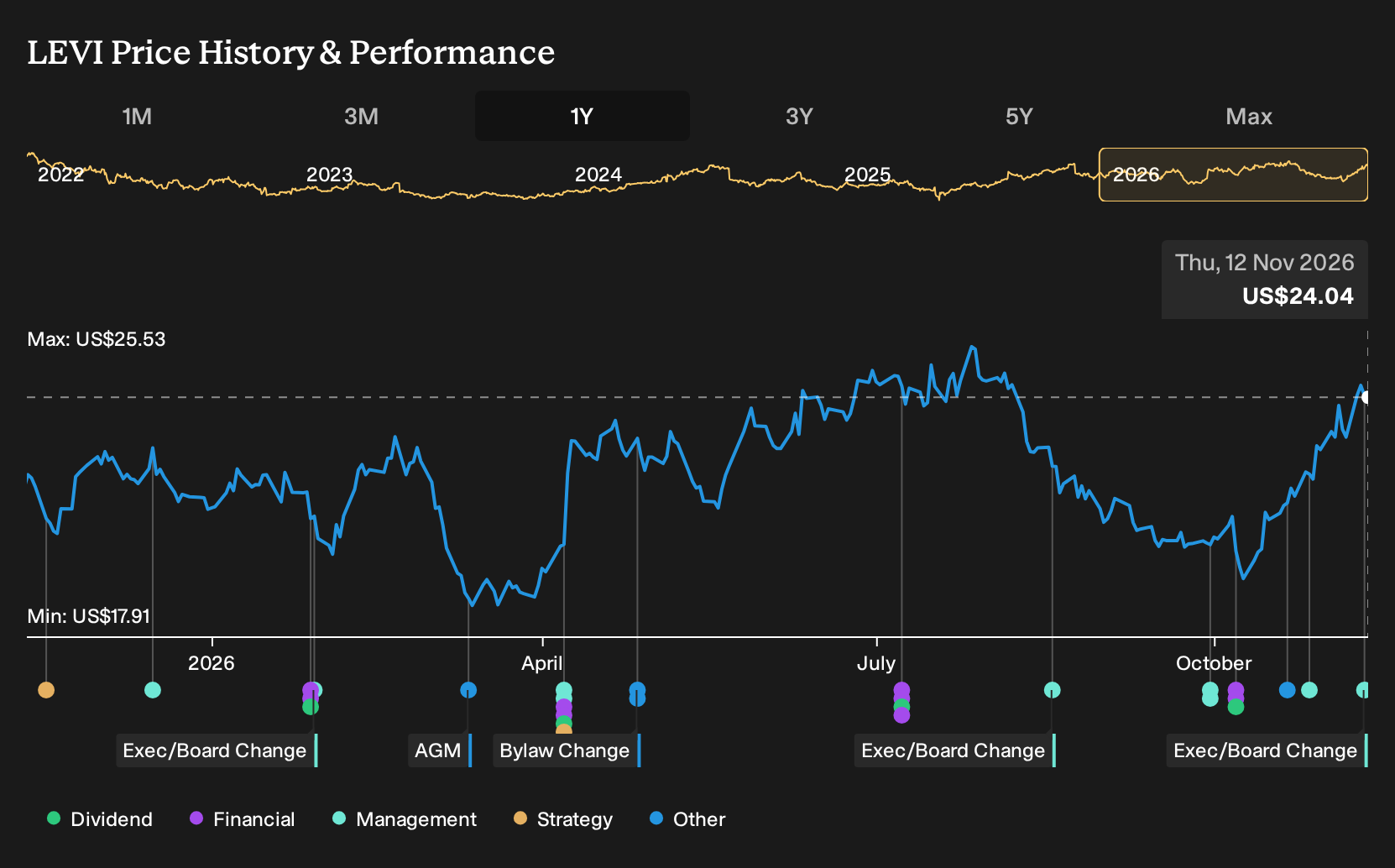
Uncover why Levi Strauss' fair value indicates a 22% potential downside to its current price, which leaves little room for error.
Exploring Other Perspectives
Some of the lowest ranked analysts frame a very different risk for Levi Strauss. They worry that EBIT margins could stall closer to 9.9% by 2029 on about US$7.5b of revenue and US$747.1m of earnings. Those forecasts came before this sustainability hire, so opinion may shift and it is worth exploring several viewpoints yourself.
Explore 4 other Levi Strauss fair value estimates, including one that suggests as much as 40% downside from the current price!
Form Your Own Verdict
Don't just follow the ticker. Dig into the data and build a conviction that's truly your own.
- A great starting point for your Levi Strauss research is our analysis highlighting 3 key rewards and 1 important warning sign that could impact your investment decision.
- See our latest analysis for Levi Strauss. The report includes a comprehensive fundamental analysis summarized in a single visual, the Snowflake, making it easy to evaluate Levi Strauss' overall financial health at a glance.
Looking for more Levi Strauss investment ideas?
If you want to put Levi Strauss in context, it helps to line it up against a wider field of opportunities. Use the Simply Wall St Screener to spot other businesses with balance sheets, cash flows and dividends that suit your own risk and return preferences.
- If you are hunting for potential mispricing, compare Levi Strauss with companies that currently screen as 32 high quality undervalued stocks.
- Income focused investors can weigh Levi Strauss against sturdier yield options by scanning a curated set of 6 dividend fortresses.
- If capital preservation is high on your agenda, consider how Levi Strauss stacks up next to a 29 resilient stocks with low risk scores.
Have feedback on this article? Concerned about the content? Get in touch with us directly. Alternatively, email editorial-team@simplywallst.com