
Energizer Holdings (ENR) Keeps Its Dividend Steady As Valuation Questions Build
Energizer Holdings (ENR) set its next shareholder payout in motion after the board declared a regular dividend of $0.30 per share, payable on December 9, 2026, to investors of record on November 24.
Energizer Holdings’ recent dividend move follows a solid run, with a 30-day share price return of 10.62% and a year-to-date gain of 21.27%. However, the 5-year total shareholder return decline of 20.60% indicates that longer-term momentum has been weaker.
Scan beyond Energizer Holdings and compare this dividend move with a hand picked set of income ideas in our 6 dividend fortresses to see how other high-yield payers stack up.
Bulls point to Energizer Holdings’ recent share rebound, steady dividend and positive annual net income growth. Bears focus on the weaker 3 and 5 year returns. Which side do the current valuation metrics actually support?
Preferred P/E of 20.3x for Energizer Holdings: Is it justified?
The market is pricing Energizer Holdings at a P/E of 20.3x based on the last close of $24.17, which screens as rich against the broader Household Products group and also against an estimated fair P/E level.
The P/E multiple compares the share price to earnings per share and gives you a quick shorthand for how much investors are paying for each dollar of profit. For a mature consumer products business like Energizer Holdings, this gauge often reflects what the market expects from future earnings rather than just today’s results.
Here the picture is mixed. The stock looks expensive versus the global Household Products industry average P/E of 17.8x, and it also trades above an estimated fair P/E of 18.9x that the fair ratio model points to as a level valuations could gravitate toward if expectations cool.
Explore the SWS fair ratio for Energizer Holdings.
Result: Price-to-earnings of 20.3x (OVERVALUED)
Still, the longer stretch of weaker 3- and 5-year total returns, plus the current premium P/E, could quickly sour sentiment if earnings delivery disappoints.
Find out about the key risks to this Energizer Holdings narrative.
Another View: SWS DCF Model Paints A Different Picture
The P/E screen flags Energizer Holdings as expensive, yet the SWS DCF model points the other way. At a share price of $24.17 versus an estimated future cash flow value of $95.71, the stock is assessed as trading about 74.7% below that DCF estimate. That gap suggests a very different risk and reward balance. Which lens do you trust more when the numbers disagree this much?
Look into how the SWS DCF model arrives at its fair value.
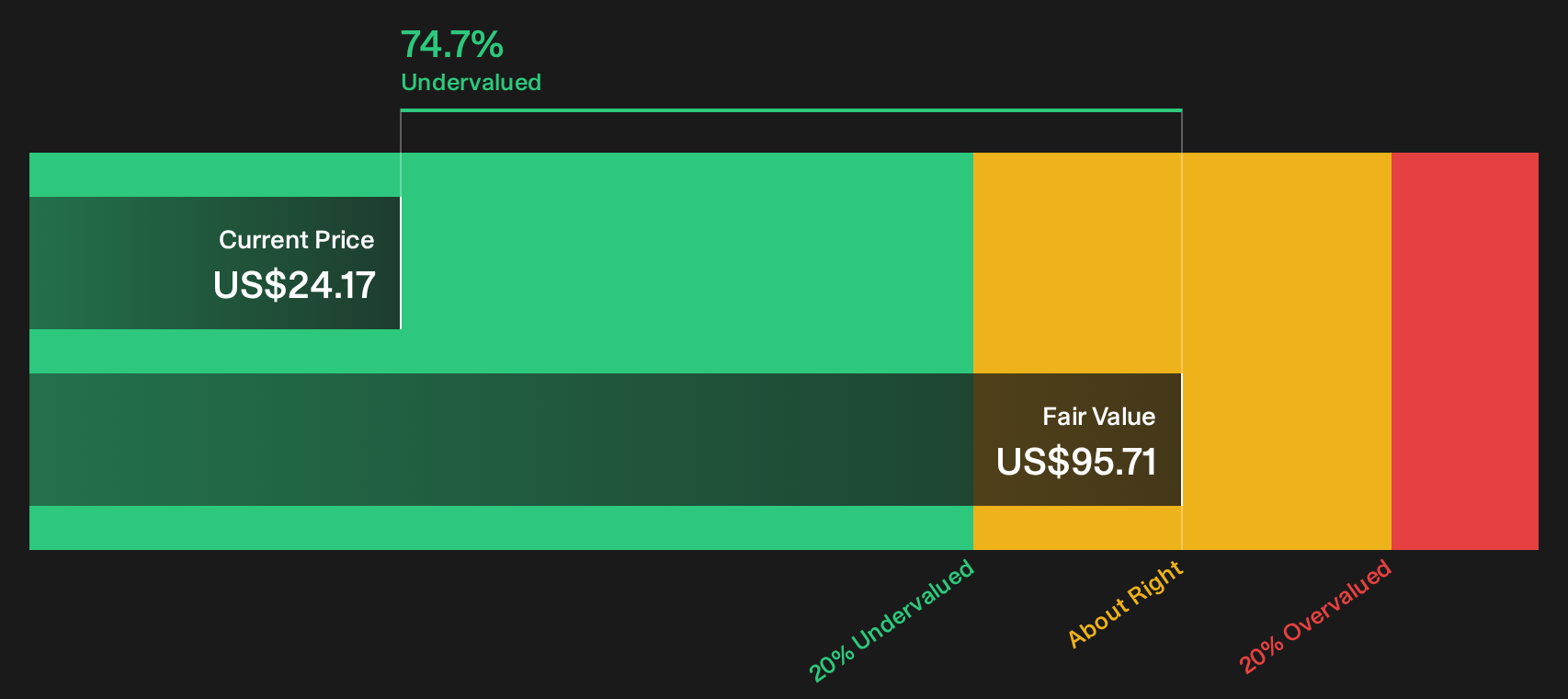
Simply Wall St performs a discounted cash flow (DCF) on every stock in the world every day (check out Energizer Holdings for example). We show the entire calculation in full. You can track the result in your watchlist or portfolio and be alerted when this changes, or use our stock screener to discover 32 high quality undervalued stocks. If you save a screener we even alert you when new companies match - so you never miss a potential opportunity.
Next Steps
Mixed signals on Energizer Holdings can feel confusing, so act while the data is fresh. Test the story against your own risk tolerance and income goals using the 2 key rewards and 4 important warning signs.
Looking for more investment ideas beyond Energizer Holdings?
If Energizer Holdings has you thinking harder about value, do not stop here. Use the screener to look for potentially stronger income, quality, and upside candidates.
- Target sturdier portfolios by focusing on resilient businesses with lower perceived risk using the 29 resilient stocks with low risk scores.
- Identify potentially mispriced opportunities by scanning for quality companies that the market may be overlooking with the 20 high quality undiscovered gems.
- Strengthen your foundation by filtering for companies with healthier finances and robust fundamentals through the list of solid balance sheet and fundamentals (23 results).
Have feedback on this article? Concerned about the content? Get in touch with us directly. Alternatively, email editorial-team@simplywallst.com