
The risk of Fed austerity is heating up! Bitcoin falls below $69,000 under full pressure on the crypto market
The Zhitong Finance App learned that all cryptocurrencies, starting with Bitcoin, declined as investors assessed the risk of the Federal Reserve's further tightening of monetary policy. According to CoinDesk data, as of press release, Bitcoin reported $68,800, and once reached the $68,000 mark during the day, the lowest level since August 19. The broader cryptocurrency market is also under pressure. Ethereum fell below $2,000 for the first time since August, while Ripple (XRP) hovered around $1, while Solana (SOL) fell below $80. Small-cap tokens, including GT, Stacks, and XMR, all fell 7% or more.
According to Coinglass's data, cryptocurrency exchanges have forcibly closed more than $1.3 billion worth of cryptocurrency futures positions in the past 24 hours. Among them, the amount of forced liquidation of Bitcoin-related positions alone reached US$677 million.
Meanwhile, the US Dollar Index (DXY) strengthened to its highest level since April 2025. US Treasury yields also rose. The benchmark 10-year US Treasury yield returned above 5% overnight and stood at 5.1%; the yield on 2-year US Treasury bonds, which is sensitive to monetary policy, rose by a cumulative total of about 39 basis points over four trading days, the biggest increase over the same period since June 2022.
The overall and core CPI monthly rates of the US in October were higher than market expectations, indicating that price pressure is still high, strengthening the reasons for the Federal Reserve to continue to raise interest rates. According to data released by the US Department of Labor (BLS) on Tuesday, the US CPI rose 0.4% month-on-month, higher than market expectations of 0.3%, and the previous value was 0.6%; excluding volatile projects such as energy and food, the core CPI rose 0.3% month-on-month, higher than market expectations of 0.2%. The previous value was 0.3% (CPI and core CPI for October had no year-on-year data due to the shutdown of the US federal government in October last year).
This CPI data is the last CPI data before the Federal Reserve's December 8-9 interest rate meeting (the November CPI is scheduled to be announced on December 10, the day after the resolution, and the year-on-year standard will resume at that time). In October, which was announced last week, 165,000 new jobs were added, far exceeding expectations. The unemployment rate fell to 4.1%. Combined with the fact that core inflation has not cooled down, the market focus has turned to whether the December rate hike was 25 or 50 basis points.
After the release of the US CPI data for October, the market raised its bet on the Fed's interest rate hike. In addition to the data, the hawkish remarks of the Federal Reserve officials also provided “ammunition” for investors to increase their bets on the Fed's interest rate hike. On Thursday, New York Federal Reserve Chairman Williams, the “top three” of the Federal Reserve, said that US inflation is still high and policy makers must take further action to contain price pressure. San Francisco Federal Reserve Chairman Daly said on the same day that in order to further reduce inflation, the Federal Reserve is likely to need to raise interest rates further. She also revealed that more and more companies are considering raising prices.
Cleveland Federal Reserve Chairman Hammark reiterated that the Federal Reserve needs to further raise interest rates to cope with demand pressure and continued high inflation brought about by the artificial intelligence (AI) investment boom. She believes that the Federal Reserve should adjust monetary policy to a restrictive level and prefer to gradually tighten policy through smaller and more frequent interest rate hikes rather than adopt more aggressive interest rate hikes.
In contrast, Federal Reserve Governor Waller's position is tougher. In his speech before the US CPI data for October was released, he proposed a clear threshold: even if inflation improved in October, he would still prefer to raise interest rates by 25 basis points in December; if the core CPI is about 0.3% or higher month-on-month, then a 50 basis point increase should be considered. Subsequent readings hit this condition, causing the market to begin to re-evaluate the Federal Reserve's future interest rate path.
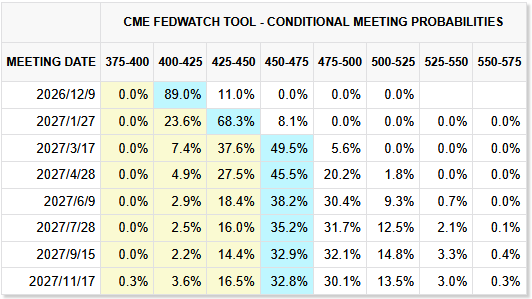
According to CME's “Federal Reserve Watch” tool, the market currently predicts that the probability that the Fed will raise interest rates by 25 basis points in December is 89%, while the probability of raising interest rates by 50 basis points is 11%.
The US PPI for October will be announced on Friday evening Beijing time. After many hawkish remarks by Federal Reserve officials, the capital chose to actively reduce positions before PPI data was released to avoid taking the risk of inflation exceeding expectations once again before the weekend. This is one of the major reasons the cryptocurrency market is under pressure.
Furthermore, the uncertain situation in the Middle East has also heightened investors' risk aversion. Earlier, it was reported that US Vice President Vance is considering holding face-to-face talks with Iran's Supreme National Security Council Secretary Rezai to push for an end to the war in Iran. US President Trump is open to this. However, on November 12, local time, Trump said that the US did not need to reach an agreement with Iran. Trump said those days are long over. He claims that the US already has hundreds of billions of dollars in Iran's capital and the Strait of Hormuz.
Iran's Revolutionary Guard Corps issued a statement on November 13 saying that it attacked and destroyed the US military's early warning radar in Bahrain that day. This is Iran's first known attack on US military facilities in the Middle East in two months. Islamic Parliament Speaker Kalibaf said in an interview with Al Jazeera TV on November 11 that Iran and the US should not maintain the current state of “no war, no peace,” nor does Iran necessarily have to go through negotiations to achieve this goal; Iran must establish a sustainable deterrent. Kalibaf reiterated that the Strait of Hormuz will never return to the way it was before. The US side must implement the seven conditions proposed by Iran before negotiations can continue, and the Strait of Hormuz will be reopened.