
Is the safe-haven aura malfunctioning? The sell-off in US debt has made a comeback, and Wall Street just breathed a sigh of relief and was frightened
The Zhitong Finance App learned that just as global bond investors are beginning to believe that the worst phase of this year's sell-off has passed, the sharp rise in US Treasury yields has forced them to re-examine this judgment.
The multiple factors that have stirred up the world's largest bond market show little sign of abating: stubborn inflation and hawkish rhetoric from the Federal Reserve have prepared traders for more aggressive interest rate hikes, while increasing debt supply has further increased upward pressure on yields. Even though the turmoil caused by Nvidia (NVDA.US) stirred up the stock market and risk sentiment, this round of sell-off in the bond market has not stopped, weakening people's expectations that US debt has regained its traditional safe-haven role.
“The current environment is even more difficult than during the COVID-19 pandemic and the global financial crisis,” said Kellie Wood (Kellie Wood), Schroder's fund manager based in Sydney. She is currently shorting US debt. “In the past few times, it was a one-way trend; now there are continuous supply shocks, and interest rates are fluctuating sharply. We all need to be prepared for yields to continue to rise before the end of the year.”
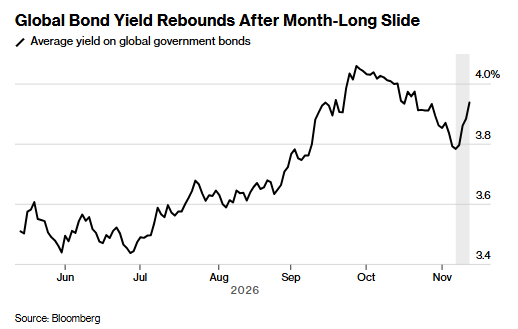
This week, US debt has been hit hard, and the range of pressure is not limited to short-term varieties that are highly sensitive to policies. The combined increase in US two-year Treasury yields on Tuesday and Thursday (the spot market closed on Wednesday) was the biggest since March 2023, while the 10-year yield increase was the biggest since April 2025. As of Friday session in the Asian market, the two-year yield was 4.86%, and the 10-year yield was 5.12%.
This is a sharp reversal of the situation just a week ago — when the Democratic Party won a landslide victory in the US midterm elections, combined with concerns about artificial intelligence (AI), prompted investors to flock to take refuge in US debt. Since then, this influx of bullish positions has been completely reversed due to Federal Reserve Governor Christopher Waller (Christopher Waller) supporting interest rate hikes and saying that if inflation continues to accelerate, he is inclined to raise interest rates by 50 basis points. A higher-than-expected consumer price report reinforced this shift, as did Dallas Federal Reserve Chairman Lorie Logan (Lorie Logan).
As a pricing anchor for global financing costs, the current round of pressure on US bonds is being transmitted outward to the global market. An indicator that measures returns on US bonds fell again after the latest round of surging yields, reversing the recovery that had previously narrowed this year's losses to 1%.
“The sell-off in developed market sovereign bonds is far from over,” said Tracy Chen (Tracy Chen), portfolio manager at Brandywine Global Investment Management, adding that the main drivers are still strong. “The next target level for the 10-year yield should be 5.5%, after which consolidation may occur again.”
According to strategist Alyce Andres, “when the new round of inflation data was released on Friday, there was still room for continuation of the two-year US bond sell-off.”
However, for some investors, rising yields are creating opportunities. George Boubouras (George Boubouras) of hedge fund K2 Asset Management believes that 10-year US bonds are attractive at around 5.3%, adding that the recent rebound is not a false start.
“We'll be buying at 5.3% and will keep buying until it jumps to the next level,” said Melbourne-based Bubla, who is the company's managing director and head of research, investment and consulting.
Interest rate pricing expectations
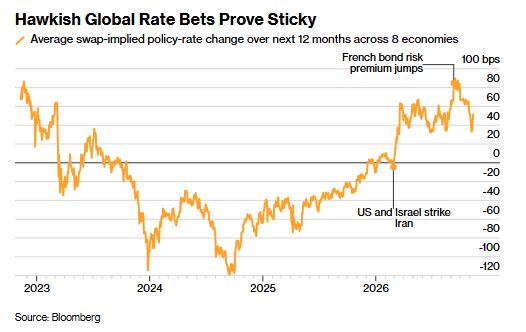
Outside of the US, yields in Japan and Australia are recovering to multi-year highs. France's yield soared due to market concerns about the country's fiscal outlook and political instability, and resumed an upward trend after falling back in early November.
Traders are increasing their bets on global policy tightening. According to compiled data, the swap market currently prices the average change in policy interest rates of the eight economies over the next year by more than 50 basis points, which is higher than the 33 basis points on November 6. The latter is the lowest level since June.
“Unless risky assets (such as stocks) crash drastically or oil prices fall back to pre-war levels, interest rate hikes by major central banks are likely to exceed current market expectations,” Steven Barrow (Steven Barrow), head of G10 strategy at Standard Chartered Bank in London, wrote in the report.
Schroder's Wood saw a more divided picture. Although US interest rates may need to rise — possibly more than 5% — as inflation accelerates and grows faster than the rest of the world, she boosted Australian and European bonds, betting that local central banks will relax their policies in 2027 to avoid recession.
“2027 will be a year of differentiation, with economies at different stages of the cycle,” she said. “For active bond managers, 2027 has great potential.”