
First time in almost 30 years! Using the equivalent of 500 million euros, the New York Federal Reserve report confirmed that Japan and the US jointly interfered in the yen exchange rate
The Zhitong Finance App learned that the New York Federal Reserve released a report on Thursday confirming previous market news that the US Treasury used its holdings of about 500 million US dollars worth of euros to support the yen in an intervention coordinated with Japan on July 31.
The New York Federal Reserve stated in its quarterly foreign exchange intervention report: “As a fiscal agent for the US Treasury, the New York Federal Reserve bought 79.4 billion yen in the spot foreign exchange market and sold the euro in the foreign exchange stabilization fund.” At current exchange rates, this amount is approximately $497 million.
According to the report, the operation was aimed at “dealing with what the US Treasury believes to be disorderly fluctuations in the yen.” The report reiterated the Federal Reserve's previous statement that the Federal Reserve itself did not participate in the intervention.
At the time of this joint intervention, the yen exchange rate fell to 163.9 yen per dollar, the lowest level since the 80s of the last century. According to data from Japan's Ministry of Finance, as of August 26, Japan had invested a record 97.5 billion US dollars in this intervention.
The action at the end of July was the first time in nearly 30 years that Japan and the US jointly intervened to support the yen. US Treasury Secretary Scott Bessent once said that the US had invested a “symbolic” amount of money in this operation. The US Treasury Secretary defended this intervention on the grounds that Japan holds a large amount of US treasury bonds. If Japan sells US treasury bonds on a large scale to buy yen, it may further push up US borrowing costs.
The yen is still hovering around 160, and Katayama Satsuki once again signals intervention
Since July, both Bezent and Japan's Finance Minister Katayama Satsuki have hinted that they may interfere in the foreign exchange market again. Currently, the yen exchange rate is once again hovering around the 1 dollar to 160 yen mark. This level has been the focus of market speculation and intervention in the past.
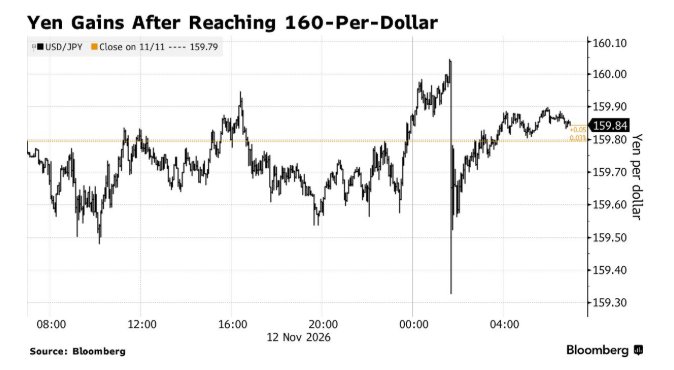
Katayama Satsuki said in an interview on Friday that after the yen briefly falls below a critical threshold, Ministry of Finance officials will continue to maintain close communication with the US side and take appropriate action as needed in response to the unilateral and rapid fluctuations in the foreign exchange market.
“We are currently seeing sharp, one-sided fluctuations in the foreign exchange market,” Katayama Satsuki said. “We will continue to work closely with the US Treasury and respond appropriately.”
According to information, the yen has always been under pressure from the huge interest rate gap between the US and Japan. The Bank of Japan's benchmark interest rate is 1.25%, which is more than 2.5 percentage points lower than the Federal Reserve.
Katayama Satsuki reiterated that Japan and the US have the same position on the exchange rate issue, and pointed out that US Treasury Secretary Scott Bessent has repeatedly expressed his preference for a strong yen reflecting economic fundamentals. She said that the leaders of the two countries shared the same views at the summit.
Katayama Satsuki also said that she doesn't think there is a problem with the difference in spending when Japan and the US collaborated to intervene in the foreign exchange market on July 31.