
The inflationary pressure in the US is not limited to energy! The AI boom and service costs push up the risk of the Federal Reserve's interest rate hike
The Zhitong Finance App learned that this week, international oil prices fell to their lowest level in more than two months, yet US Treasury yields rose sharply. The market generally expects the Federal Reserve to raise interest rates by 25 basis points in December, and may even raise interest rates by 50 basis points. Why has oil prices fallen, yet the Fed's austerity pressure remains unabated? The newly released US CPI report for October gave the answer: the sources of pressure on US inflation have gone beyond the energy sector.
Policymakers had hoped that some of the key factors driving up prices — including oil supply shocks and service costs — would be mitigated. But that wasn't the case: after excluding the volatile food and energy categories, core CPI rose 0.3% month-on-month, higher than expected for the third month in a row.
Chicago Federal Reserve Chairman Goulsby called the October data “almost disturbing.” Federal Reserve Governor Waller warned before the CPI data was released that officials might need to raise interest rates by 50 basis points at the December meeting.
The report also shows that the sharp rise in fuel prices caused by the Middle East conflict is being transmitted to other parts of household budgets. Nearly record diesel prices have driven up transportation costs, and service inflation remains strong; at the same time, the prices of some commodities most affected by tariffs continue to rise.
Energy shock spreads to food and transportation
The price of petroleum products soared after the war in Iran, and its impact extended far beyond gas stations for American consumers.
Food prices are an example. The increase in grocery prices last month hit a record high since April. Agricultural equipment relies on diesel, and research shows that transportation alone accounts for about 9% of retail food costs.
Transportation costs within the city — that is, the cost of local buses, taxis, and online car-hailing — recorded the biggest monthly increase since 2020, and the cost of air tickets and delivery services also increased at the same time. High transportation costs are likely to further drive up consumer goods prices.
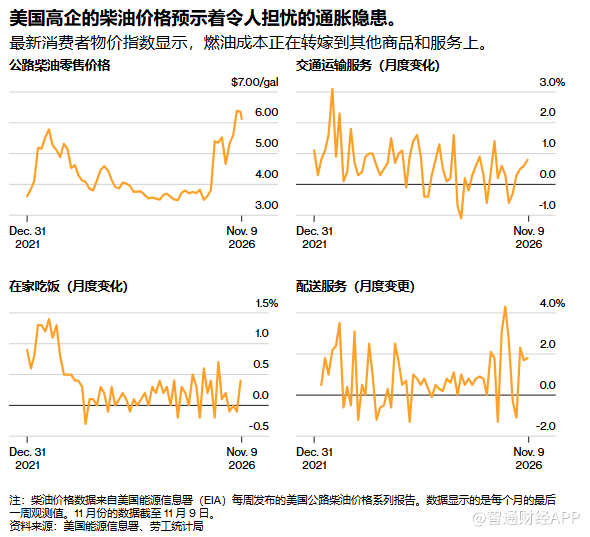
Michael Pierce, chief US economist at the Oxford Institute of Economics, said that the CPI report “really highlights the transmission effect of rising energy prices.” “We knew it would be worse because of the lag effect.”
Households may be able to delay purchasing non-essential items such as furniture and electronics, but they don't have much flexibility when it comes to groceries, utilities, and transportation.
Service inflation remains high
Strong inflation in the service sector has also spread beyond categories directly affected by energy costs, such as air tickets and express delivery.
Service prices, excluding energy and rent, rose 0.4% in October, and also recorded strong increases in the previous two months. The costs of entertainment services, motor vehicle insurance, and a range of medical services have all risen. As the single item with the most weight in the CPI, the landlord's equivalent rent increased by another 0.3%.
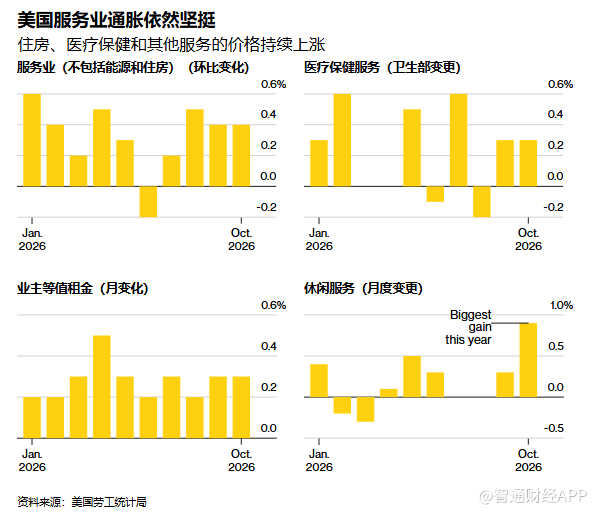
Service prices are often linked to wages, rent, insurance, and other operating costs, so cooling may be slower than commodity prices. Without continued easing, overall inflation is likely to remain high.
AI and electronic products have become new variables
The boom in artificial intelligence (AI) investment is also affecting inflation through technology product prices and overall demand.
Over the past three months, consumer payments for computers and peripherals have increased 25% on an annualized basis. Smartphone prices recorded their biggest increase on record last month, but this coincided with the release of the new iPhone Duo by Apple (AAPL.US). Electricity prices rose 0.9% in October, the biggest increase in six months, and data centers amplified electricity demand.
Analysts at TD Securities and Morgan Stanley said these increases are in line with demand for AI-related chips and other electronic products.
At a time when policymakers are trying to ensure that strong demand does not fuel inflation, the boom in building data centers and related infrastructure is also boosting the overall economy. Morningstar's chief US economist Preston Caldwell said in a report to clients that recent data has raised “the possibility that the economy will heat up again, and the driving force comes from the huge demand side boost brought about by the AI boom.” “If this trend continues until 2027, it may push the Federal Reserve to raise interest rates several times.”
However, Morgan Stanley estimates that AI has only contributed about 6 basis points to the core CPI so far this year, but since software and electronic products weigh more heavily in the core PCE price index, its impact on this index is even more obvious. The risk is that as the investment boom continues, the sources of pressure that have so far been moderate and concentrated may become more important.
All in all, this stubborn CPI report further consolidated the market's expectations for the Fed's interest rate hike. According to CME FedWatch tool data, the market expects that the probability that the Fed will raise interest rates by 25 basis points in December has exceeded 90%, and the probability of raising interest rates by 50 basis points is 9.5%. However, the real concern of the market is not only whether interest rates will be raised in December, but also that the end of the current austerity cycle may be pushed higher and farther.