
In the Red for 2026, Here’s How You Should Play Broadcom Stock Before the End of the Year
Semiconductor stocks have had a difficult stretch, with mounting pressures making it harder for the sector to regain its footing. Disappointing corporate results, questions surrounding the enormous sums being committed to artificial intelligence (AI) infrastructure, and increasingly demanding valuations have all contributed to the recent weakness across chipmakers.
Adding to the uncertainty, political developments have brought fresh concerns about the industry's growth prospects. Following Democrats’ victory in the Nov. 4 midterm elections, speculation grew that tighter oversight of data center construction could slow AI expansion. Amid this, Broadcom (AVGO), a prominent name in the AI chip market, has consequently come under pressure.
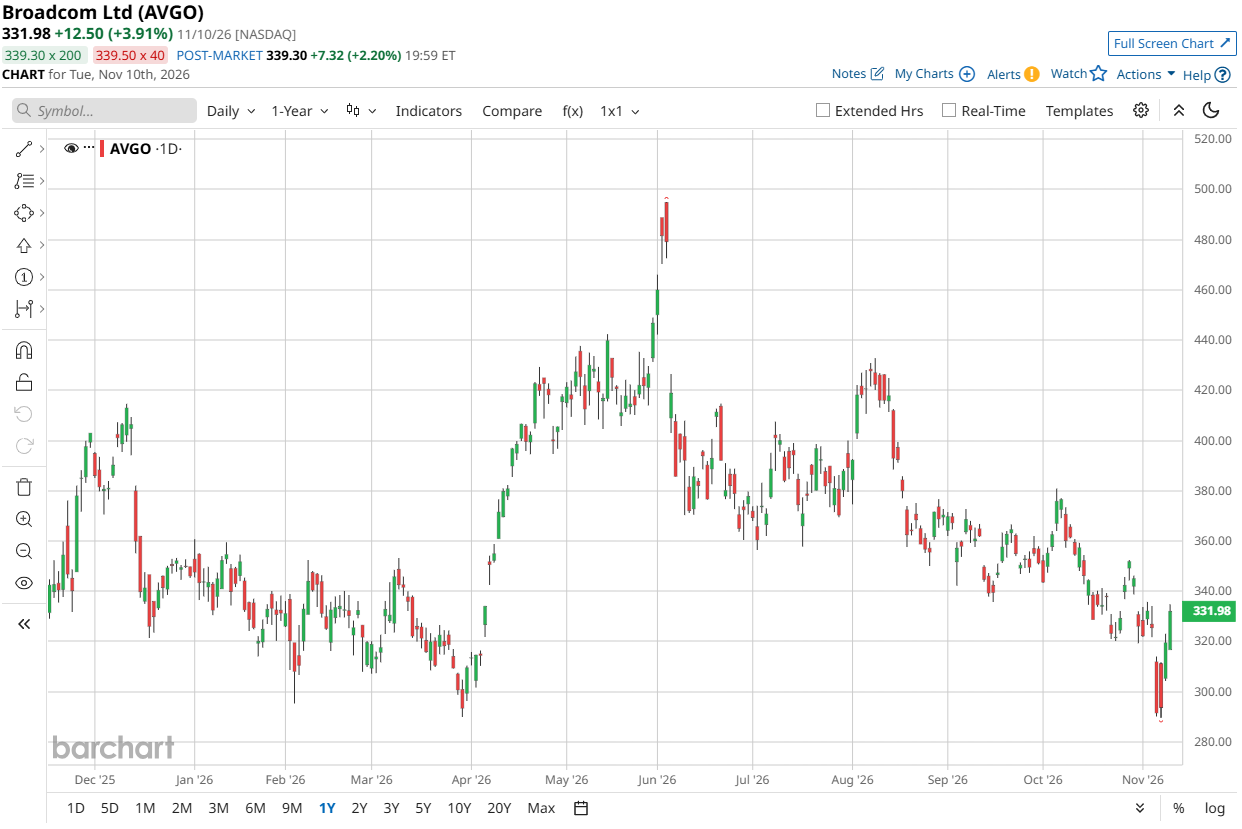
The stock recently touched a 52-week low of $289.77 on Friday, Nov. 6, and has struggled to recover alongside the broader market. Yet, the share price weakness has not been accompanied by a sudden deterioration in its AI business. Broadcom continues to develop custom chips for hyperscalers seeking greater computing efficiency and expects to double its AI semiconductor revenue in 2027.
That contrast between the stock's performance and its underlying business makes Broadcom particularly interesting at this juncture. However, with a handful of major customers accounting for substantial AI demand and data center expansion facing practical constraints, the question is whether the decline offers an attractive opportunity or signals further challenges.
About Broadcom Stock
Broadcom has built a wide-ranging business across semiconductors and enterprise infrastructure software, supplying products to customers worldwide. With a market cap of roughly $1.5 trillion, its portfolio spans networking, wireless connectivity, data storage, broadband and industrial solutions, alongside VMware's virtualization, private cloud and hybrid cloud platforms.
The Palo Alto, California-based company has also developed a substantial software presence through its cybersecurity, mainframe, application networking, and enterprise software offerings. These solutions serve a diverse customer base, including data centers, telecommunications providers, businesses and industrial operators.
However, Broadcom's strong position in the AI ecosystem has not translated into positive stock performance this year. AVGO stock has declined 7.4% over the past 52 weeks and is down 4.1% year-to-date (YTD). The recent weakness has been sharper, with shares falling 22.8% over the past six months and plunging 21.4% over the past three months.
The valuation offers another perspective on the current share price. AVGO stock is currently trading at 27.39 times forward adjusted earnings and 14.39 times sales, with both multiples sitting at a premium to the industry averages.
Beyond its growth prospects, Broadcom has maintained a consistent record of returning cash through dividends. The company has raised its dividend for 15 consecutive years and currently pays $2.60 per share annually, translating into a yield of 0.81%. Its latest quarterly payout of $0.65 per share was distributed on Sept. 30 to shareholders of record as of Sept. 21.
Broadcom Surpasses Q3 Earnings
Broadcom's Sept. 2 Q3 FY2026 results showed that demand across its core businesses remained robust despite the pressure on its shares. Revenue surged 85.5% year over year to $29.6 billion, exceeding analyst expectations of $29.48 billion and reflecting continued expansion of AI-related spending.
The top-line strength carried through to profitability, with non-GAAP operating income climbing 92.2% to $20.1 billion. Non-GAAP net income grew 94.8% from the year-ago value to $16.4 billion, while non-GAAP EPS advanced 96.4% YOY to $3.32, ahead of the Street’s estimate of $3.24.
Much of this momentum came from the semiconductor business, where revenue increased 127.4% to $20.8 billion. Demand for custom AI accelerators and networking chips remained particularly strong as hyperscalers continued building out their AI infrastructure.
The software business added another layer of support, with infrastructure software revenue rising 29% to $8.8 billion. VMware's private cloud and virtualization offerings contributed to this growth, giving Broadcom an additional source of revenue alongside its rapidly expanding semiconductor operations.
Strong earnings growth was accompanied by healthy cash generation. Free cash flow increased 94.5% to $13.7 billion, equivalent to 46% of revenue, highlighting the company's ability to convert its expanding business into substantial cash flow.
The momentum is expected to carry into the next quarter, with management projecting Q4 revenue of approximately $34.8 billion, up 93% YOY. Meanwhile, non-GAAP operating income is expected to represent 66% of revenue.
On the other hand, analysts expect Q4 FY2026 EPS to increase 114.3% YOY to $3.45, while full-year FY2026 EPS is projected to rise 84.2% from the prior year to $10.37. For FY2027, earnings are expected to climb another 68.3% to $17.45.
What Do Analysts Expect for Broadcom Stock?
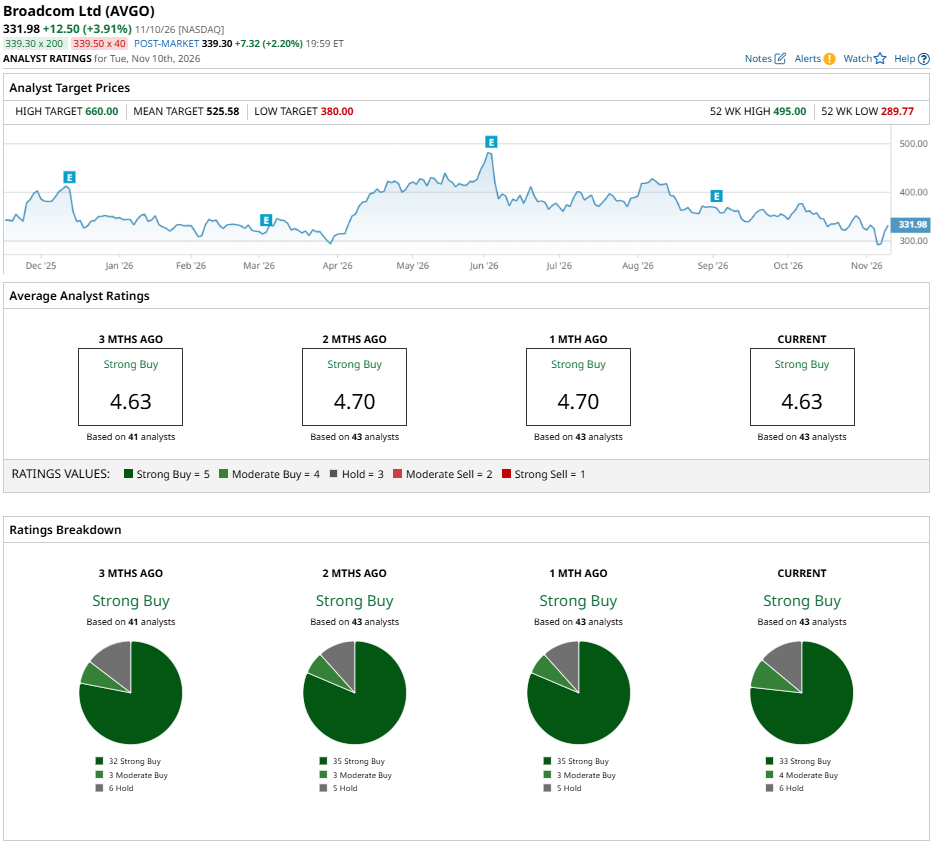
Despite the considerable pullback, Wall Street's assessment of Broadcom remains positive, assigning it an overall “Strong Buy” rating. Among 43 analysts covering the stock, 33 have assigned it a “Strong Buy” rating, four recommend a “Moderate Buy,” and six have a “Hold” recommendation.
Against that backdrop, the stock’s average price target of $525.58 represents potential upside of 58.3%. Meanwhile, the Street-high target of $660 suggests a gain of 98.8% from current levels.
On the date of publication, Aanchal Sugandh did not directly have a position in any of the securities mentioned in this article. All information and data in this article is solely for informational purposes. For more information please view the Barchart Disclosure Policy here.