TrendForce: New demand is insufficient to keep up, and downward pressure on prices in the PV industry chain is gradually showing
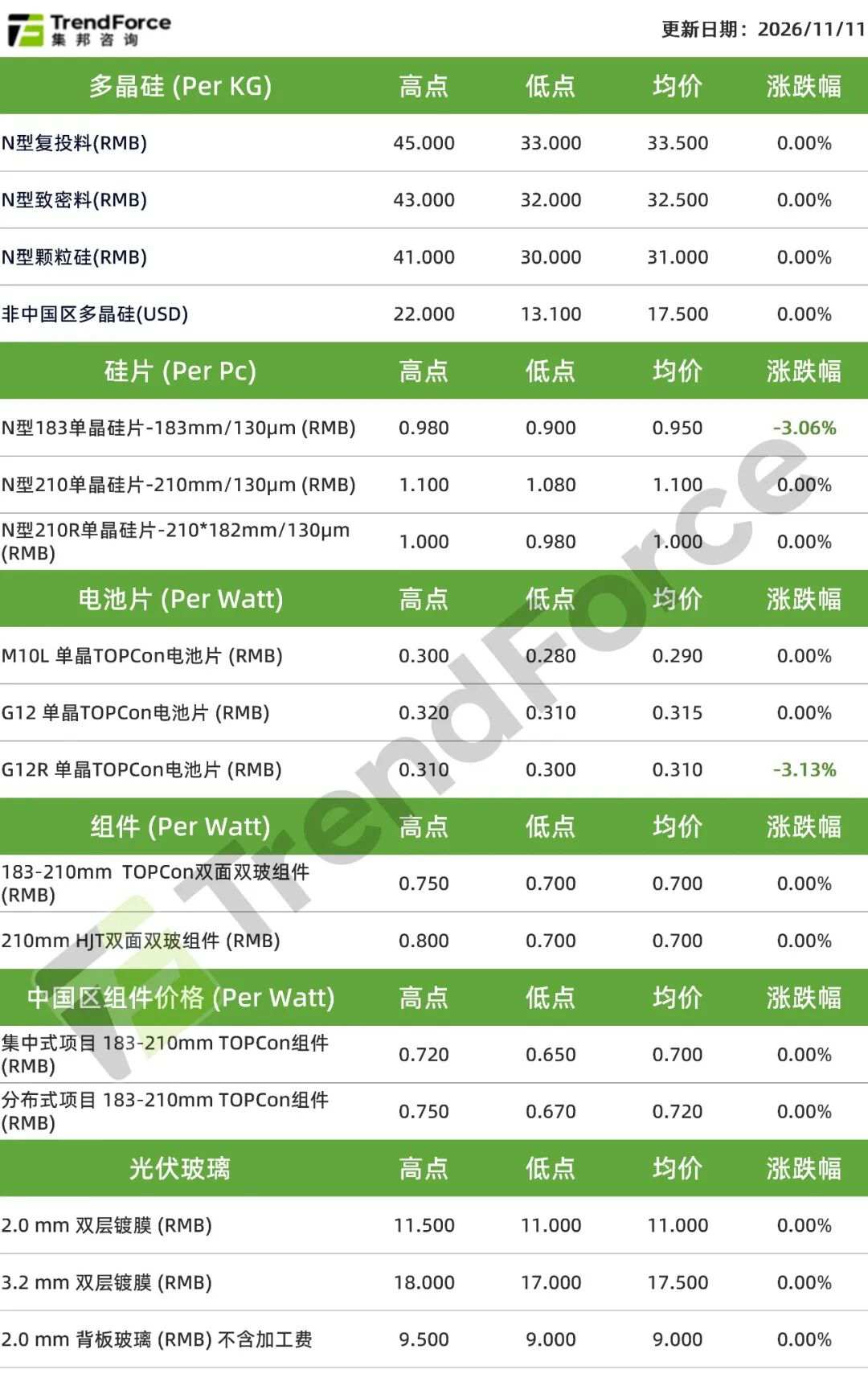
The Zhitong Finance App learned that TrendForce published an article stating that in the face of insufficient follow-up of new demand, the downward pressure on prices in the PV industry chain is gradually showing. The supply of polysilicon and silicon wafers is still relatively loose, with a slight excess compared to downstream demand; photovoltaic cells and photovoltaic modules have not changed much recently, and the overall trading sentiment is lackluster, and the pattern continues to be weak and stable.
polysilicon
Currently, polysilicon stocks remain above 570,000 tons, and overpressure on supply and demand is still high. Domestic polysilicon companies continued to cut production this month. Domestic silicon production is expected to drop to around 95,000 tons for the whole month, but compared to the slight excess demand for downstream pulsating crystals, the trend of inventory accumulation is slowing down.
Currently, downstream procurement is still mainly based on stocks that just need to be replenished. Prices for dense materials from leading manufacturers are still above 40 yuan, but prices in the futures market are significantly lower than those offered by spot manufacturers. Some companies have begun to replenish inventory through futures dealer channels, putting some pressure on spot market prices.
As the end of the year approaches, capital and inventory pressure on some enterprises is gradually increasing. Combined with downstream demand, the phenomenon of individual polysilicon companies cutting prices and shipping is not ruled out. Overall polysilicon prices are expected to drop clearly and steadily.
silicon wafer
Currently, silicon wafer inventory remains around 27GW, and the overall supply is still relatively abundant, while demand for downstream cells is not supported enough, and inventory pressure has not been relieved. Some companies have already experienced low price shipments, and the overall price trend continues to be weak and steady.
In terms of size, 183 size silicon wafers were affected by weak supply and demand, and the mainstream price dropped to around 0.95 yuan/sheet; the mainstream price of 210R size silicon wafers remained around 1 yuan/sheet; the 210N size was mainly driven by domestic centralized project demand, and the price remained around 1.1 yuan/sheet.
Overall, current silicon wafer prices are intertwined, and bearish voices are increasing in the market. Full-size prices are showing signs of a weak and steady decline. Subsequent trends require close attention to silicon prices and downstream demand.
photovoltaic cells
The current inventory of photovoltaic cells has been maintained for about 7 days. There has been little change recently, and the overall shipping pressure is fair. However, the performance of products of different sizes varies.
Among them, 183 size products were affected by weak supply and demand, and the price remained around 0.29 yuan/W; in overseas markets, India's demand for 210R high-efficiency batteries fell somewhat, and traders sold them at low prices, and mainstream transaction prices declined slightly to around 0.31 yuan/W; in contrast, 210 size batteries benefited from domestic centralized project demand support in the fourth quarter, and the price remained around 0.315 yuan/W.
Subsequent photovoltaic cell price trends are still under some pressure. On the one hand, if upstream polysilicon prices loosen, the cost support for photovoltaic cells may weaken; on the other hand, as terminal demand enters the seasonal low season, the relationship between PV battery supply and demand may weaken again, and prices may be under pressure.
photovoltaic module
Currently, domestic centralized photovoltaic projects are in the installation and completion stage at the end of the year. Order deliveries for 210 size modules have increased, but demand for other size products is still relatively weak. Most of the terminals are mainly about the delivery of orders that are just needed and that won the bid in the early stages, and the overall trading sentiment is lackluster.
Currently, leading companies price TopCon components at 0.70-0.72 yuan/W, while second-tier companies remain at around 0.68 yuan/W, continuing to maintain a weak and stable pattern.
In the short term, as the overseas policy window gradually came to an end in November and domestic year-end projects entered the final stage one after another, domestic and foreign market demand showed a contraction trend. Market demand was dominated by stock orders, and follow-up on new orders was insufficient. Under pressure from supply and demand, there is a slight downside risk in prices. However, against the backdrop of increased anti-domestic expectations and heightened awareness of corporate cost control at the policy level, the industry's willingness to stabilize prices has increased. The future focus will be on the implementation of relevant policies and the polysilicon price situation.