
USA Rare Earth Earnings Report Left Me With 1 Big Unanswered Question
Key Points
USA Rare Earth completed its $2.8 billion acquisition of Serra Verde Group in September.
Investors should now closely eye profitability.
USA Rare Earth (NASDAQ: USAR) occupies a unique position within the global mining industry.
Currently, China dominates the rare-earth market. The country controls around 94% of global rare-earth magnet production and 91% of rare-earth magnet refining. Rare-earth magnets are critical components in many industrial and household applications, including electric motors, wind turbines, hard drives, medical devices, and aerospace and military applications.
Missed AI’s "Act 1"? Act 2 Could Be 15x Bigger. Most investors think they missed the AI boat because they didn't buy Nvidia in 2005. But according to our analysts, we’re only at the end of "Act 1"—the R&D phase. "Act 2" is the global rollout. Continue »
China's dominance in both mining and refining has pushed the U.S. government to secure domestic supply. In response, the U.S. has heavily funded USA Rare Earth through grants, loans, and even a direct equity stake.
From a macro perspective, USA Rare Earth promises to become the world's most complete, vertically integrated "mine-to-magnet" supplier outside China. The company isn't just focused on mining. It has also assembled processing and refining assets that allow it to control the entire supply chain for rare-earth magnets.
After spiking to more than $31 per share last year, USA Rare Earth shares have corrected sharply, with current prices hovering around $8. That grants the company a market cap of just under $3 billion.
This could be an opportunity to buy low for a unique company with strong government backing. But after the company reported earnings on Nov. 9, I was left with one major concern that could keep me on the sidelines for the rest of the year.
Here's my biggest concern with USA Rare Earth stock today
To become a vertically integrated supplier of rare-earth magnets, USA Rare Earth has had to conduct a variety of acquisitions.
Last year, the company acquired Indian Ocean Rare Metals for $100 million in cash plus 6.74 million shares of common stock. The purchase gave USA Rare Earth access to alloy-processing capabilities -- a necessary component of becoming a truly vertically integrated supplier. Six months later, the firm agreed to purchase Texas Mineral Resources, mainly to gain full ownership over that company's Round Top Heavy Rare Earth Project in Texas. This was an all-stock acquisition, with a deal price of around $73 million.
The following month, USA Rare Earth made its biggest acquisition yet: the $2.8 billion buyout of Serra Verde Group, which operates a rare-earth mine and processing facility in Brazil. The deal price was funded with $300 million in cash and the issuance of 126.8 million shares.
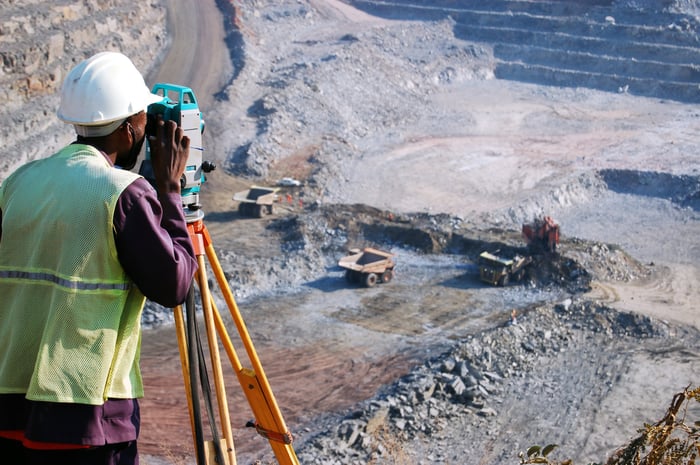
Image source: Getty Images.
USA Rare Earth currently has ample liquidity, as most of its acquisitions have been funded through stock sales. Various capital raises have equipped the company with $1.16 billion in capital, accompanied by minimal debt. But now it is time for the company to prove it can integrate all its acquired assets into a profitable business.
Sales are expected to explode from around $100 million in 2026 to over $1 billion in 2027. But will profits follow? Analysts remain split. Consensus estimates call for a break-even 2027, with perhaps a small profit. But the most bearish analyst anticipates a loss per share of -$1.32. The most bullish analyst expects positive earnings per share of $1.07.
It's very difficult to forecast exactly how well all of USA Rare Earth's acquisitions will integrate over the next 12 months. Similar to Wall Street, I am split on what might happen next -- keeping me on the sidelines until investors receive some indication of where things are headed.
Ryan Vanzo has no position in any of the stocks mentioned. The Motley Fool has no position in any of the stocks mentioned. The Motley Fool has a disclosure policy.