
Dear Baidu Stock Fans, Mark Your Calendars for November 16
Baidu (BIDU), one of China's leading technology companies, has built a strong presence in internet search, cloud computing, and artificial intelligence (AI). The company is now stepping up its efforts to reshape its business around AI, a transition that could redefine its growth trajectory.
With competition heating up across China's AI sector, Baidu's upcoming earnings announcement is expected to provide an opportunity to assess how effectively it is executing this strategy. That said, the company is scheduled to release its Q3 FY2026 financial results before the market opens on Monday, Nov. 16.
The timing is particularly significant given the stock's recent earnings-related volatility. Following its Q2 announcement, Baidu’s shares declined 12.7% in a single trading session. Against this backdrop, the upcoming results could serve as another major catalyst for BIDU stock.
About Baidu Stock
Headquartered in Beijing, China, Baidu operates across several technology-driven businesses, including internet services, AI solutions, cloud computing, and digital entertainment. Its portfolio spans search engines, online marketing, digital maps, autonomous driving, AI-powered products, and mobile applications.
Baidu also operates through its iQIYI segment, which focuses on producing and distributing online videos, games, comics, and other entertainment content.
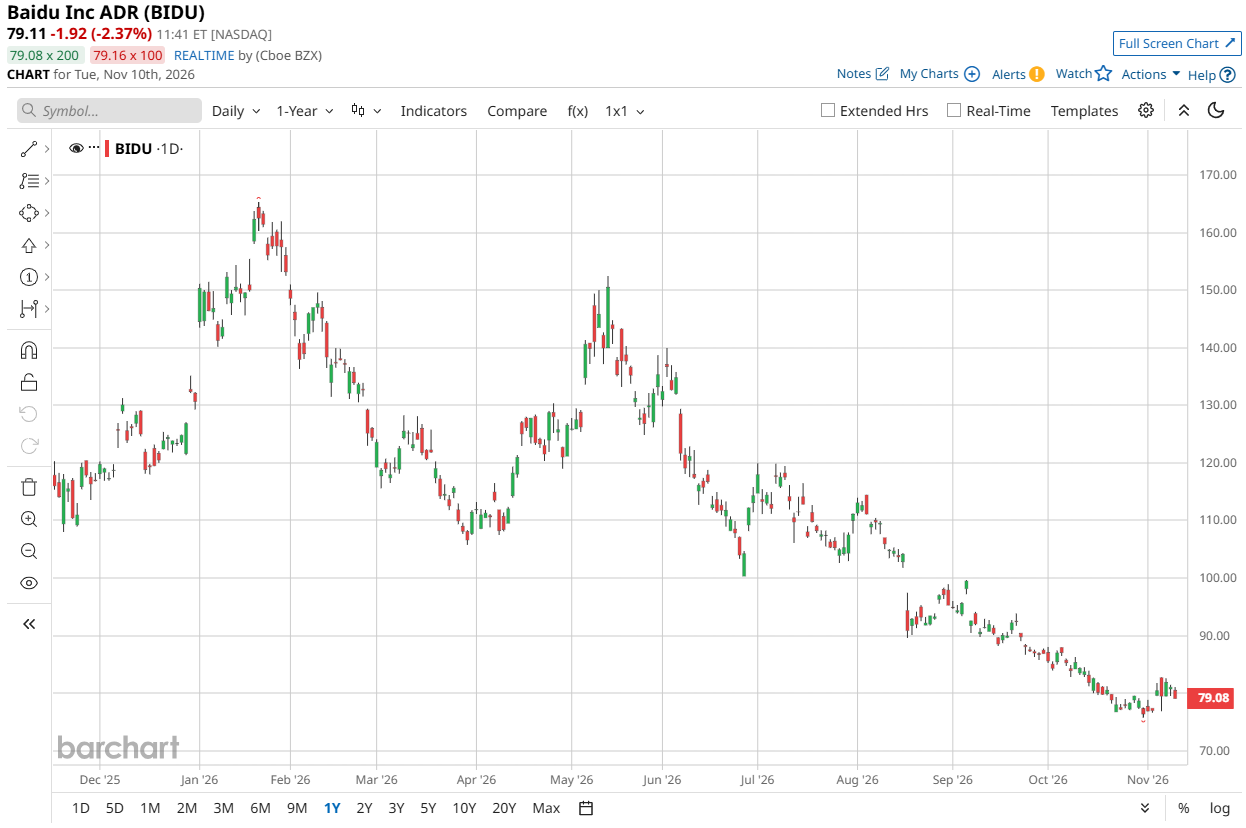
With a market cap of nearly $27.3 billion, Baidu has faced considerable pressure in the stock market. Shares have declined 40% over the past 52 weeks and are down 39% year-to-date (YTD). The weakness has continued in the short term, with the stock down 25% over the past three months.
Currently, Baidu’s shares trade at 14.82 times forward adjusted earnings and 1.40 times sales. Both multiples exceed their respective industry averages, highlighting the premium attached to the company's shares.
A Closer Look at Q2 Earnings
Reported on Aug. 18, Baidu’s Q2 FY2026 results highlighted a growing divide between its expanding AI operations and its struggling traditional advertising business. Consolidated revenue fell 4% year-over-year (YoY) to RMB 31.3 billion ($4.62 billion), as gains from AI-related activities were insufficient to offset continued weakness in online marketing.
While Baidu’s business mix is gradually shifting toward AI, its established operations still account for a substantial portion of overall revenue. Baidu Core AI-powered Business revenue rose 25% YoY to RMB 12.5 billion ($1.9 billion), representing 50% of Baidu General Business revenue.
AI Cloud Infrastructure was the primary growth engine, with revenue increasing 50% YoY to RMB 7.3 billion ($1.1 billion) as enterprises increased demand for AI computing resources. Within AI Cloud Infra, GPU Cloud revenue surged 283% YoY, accelerating further from 184% growth in the prior quarter.
However, growth across other AI businesses was considerably more modest. AI Applications revenue increased 3% YoY to RMB 2.5 billion ($374.5 million), while AI-native Marketing Services revenue was approximately flat YoY at RMB 2.6 billion ($389.5 million).
These figures suggest that, although demand for AI infrastructure is gaining momentum, broader monetization across Baidu’s AI ecosystem is still taking shape. Profitability faced similar headwinds. Non-GAAP operating income decreased about 15% from the prior year's quarter to RMB 3.8 billion ($558 million), while adjusted EBITDA slipped 5% to RMB 6.2 billion ($906 million).
Despite these challenges, management continues to prioritize investment in AI. Their main objectives include accelerating AI Cloud monetization, strengthening AI applications, and rebuilding competitiveness in the advertising business.
On the other hand, for Q3 FY2026, analysts project EPS to decline 53.7% YoY to $0.57. Full-year FY2026 EPS is expected to fall 43.6% from the previous year to $3.64. However, the outlook improves for FY2027, when the bottom line is projected to increase 25.3% YoY to $4.56.
What Do Analysts Expect for BIDU Stock?
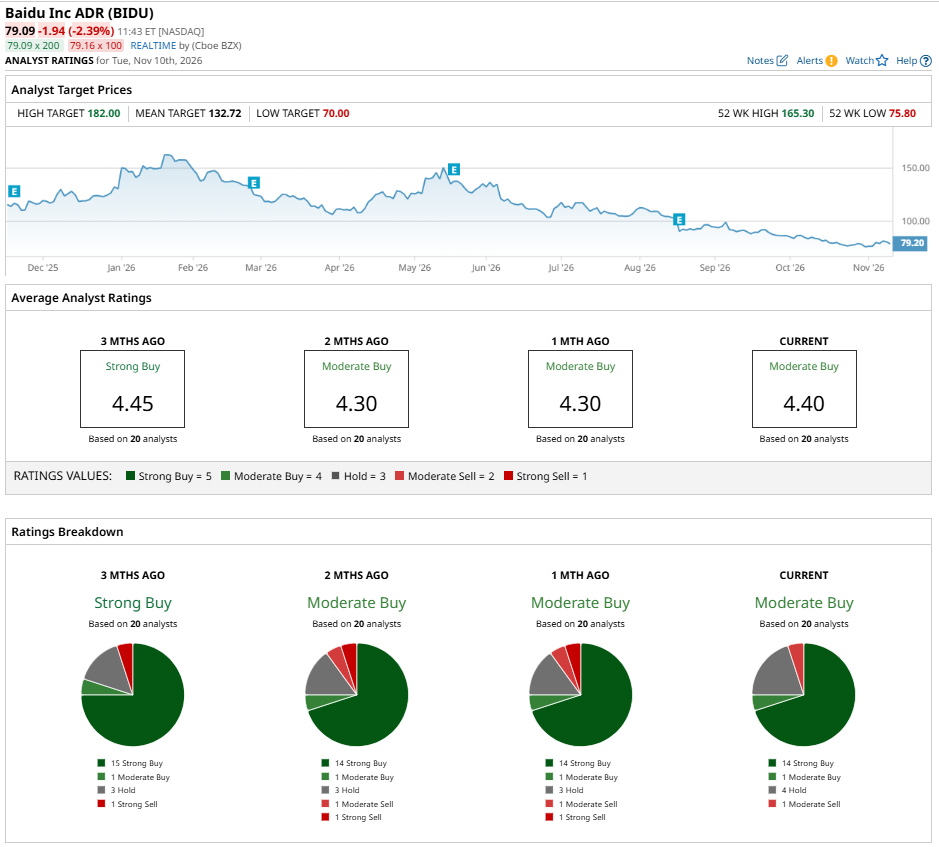
Despite the considerable decline in BIDU stock, Wall Street's overall assessment remains at “Moderate Buy.” Of 20 analysts currently covering the stock, 14 have assigned a “Strong Buy” rating, one has issued a “Moderate Buy” recommendation, four maintain a “Hold” rating, and one has a “Moderate Sell” view.
Analyst price targets indicate meaningful upside potential. The average price target of $132.72 implies potential upside of 68%, while the Street-high target of $182 suggests a gain of 130% from current levels.
On the date of publication, Aanchal Sugandh did not directly have a position in any of the securities mentioned in this article. All information and data in this article is solely for informational purposes. For more information please view the Barchart Disclosure Policy here.