
Alibaba Advances a Multibillion-Dollar Chip Spin-Off in Hong Kong as the Nvidia Scandal Turns the Deal Into a Double-Edged Bet
Alibaba (BABA) formally advanced plans to spin off its T-Head chip design arm in Hong Kong, with the exchange clearing the deal to proceed after a confidential application filed on September 11 and market reporting pointing to a raise of roughly $2 billion to $3 billion, likely next year.
The deal lands just as a scandal involving Nvidia (NVDA) CEO Jensen Huang and alleged Beijing spy Alice Huang has thrown the entire US-China semiconductor relationship into sharp relief, and Alibaba itself is named in the allegations.
Final approval still rests with the listing committee and China's securities regulator, while Alibaba has disclosed neither size nor timing and says T-Head would remain a consolidated subsidiary.
A Scandal That Cuts Both Ways
On the bullish side, the Nvidia scandal strengthens the self-sufficiency thesis, with Congress now appearing far more likely to attach chip-tracking requirements to its year-end defense bill — a shift that makes in-house silicon an insulating asset against hyperscaler peers that depend on external supply.
On the bearish side, allegations that Alibaba financed Megaspeed's Malaysian subsidiary, and that restricted Nvidia GPUs ultimately served Alibaba workloads, introduce reputational and potential sanctions risk that international investors will price in. Those allegations remain unproven, and Alibaba has not responded.
Unlocking a Buried Asset
T-Head was previously buried inside Alibaba Cloud and was nearly impossible to value, so a standalone listing creates a public benchmark for whether the group's sum-of-the-parts is being discounted. Until now, investors had no clean way to isolate what the chip unit contributes to the broader group.
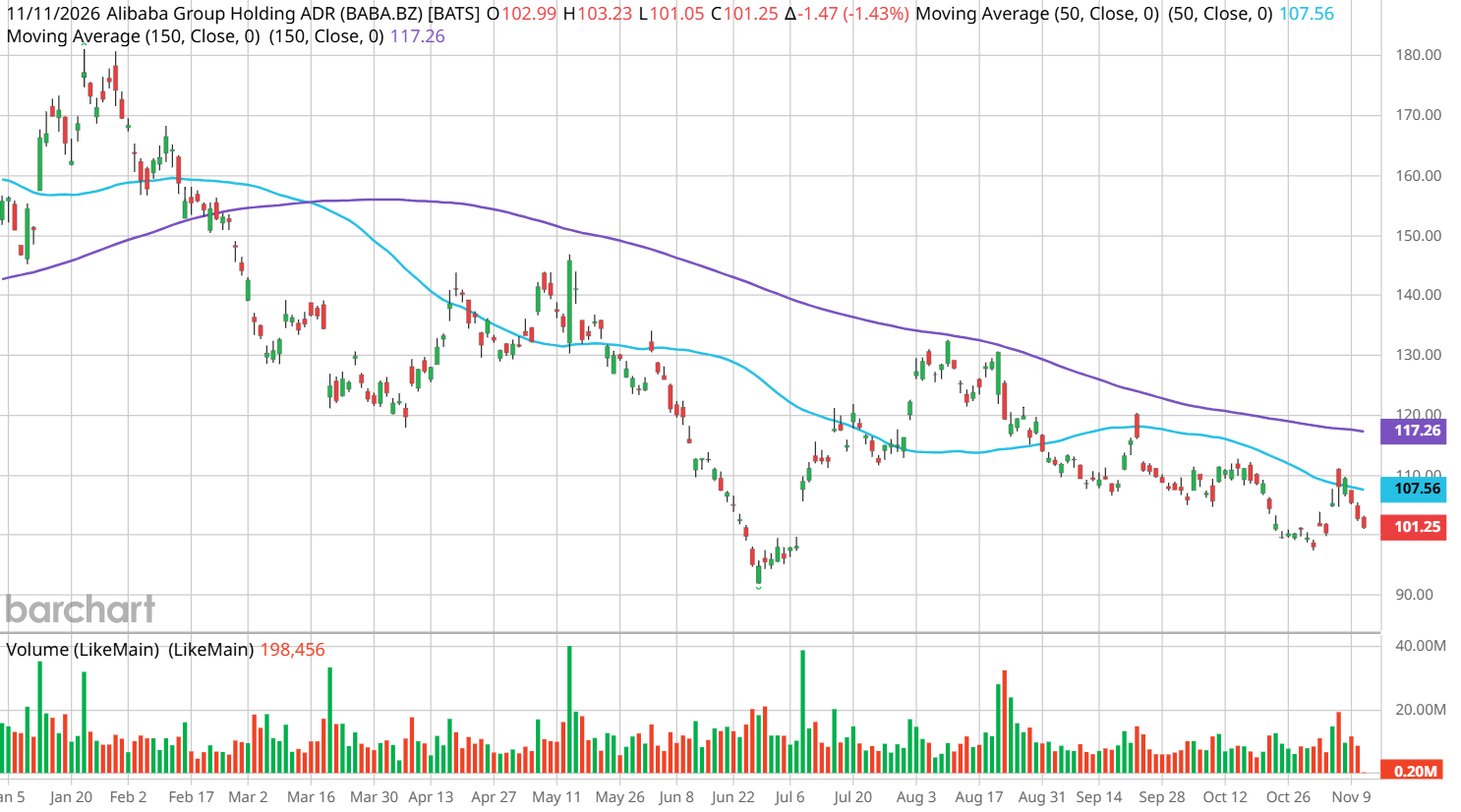
That is a pointed question with Alibaba's US-traded shares down roughly 30% year to date, a steep slide that raises the stakes on how the market ultimately prices T-Head.
The Zhenwu V900, slated for mass production in the first quarter of 2027 and pitched at three times its predecessor's performance, will anchor any valuation narrative. Domestic analysts loosely compare that predecessor to Nvidia's H200, which gives investors a rough yardstick for where Alibaba's silicon sits against the global leader.
Follow the BABA Cash
Capital needs are the less glamorous but equally important driver, with Alibaba having already raised about $10.2 billion in an August share sale while funding a roughly 380 billion yuan, three-year AI capex plan.
Combined free cash flow at Alibaba, Baidu (BIDU), and Tencent (TCEHY) turned negative in the first half, so outside equity for T-Head would ease pressure on the balance sheet.
Is Hong Kong's IPO Window Closing?
However, execution risk is elevated, as Hong Kong's IPO pipeline has cooled sharply after a record first nine months, with October deals closing below offer price. That swing from record activity to below-offer trading is a notable but underappreciated headwind, since T-Head would be marketed to the same increasingly skeptical buyers.
GPU maker Denglin debuted lower after pricing at the bottom of its range, while regulatory delays have already pushed Baidu's Kunlunxin listing into next year.
With investors now rewarding earnings visibility over technology narratives, T-Head's commercialization data will matter far more than any benchmark claims Alibaba makes about the V900.
The Next Catalysts to Watch
The near-term calendar centers on decisions from the listing committee and China's securities regulator, the year-end defense bill in Washington, and V900 mass production slated for the first quarter of 2027. Each of those checkpoints could either validate the self-sufficiency story or reinforce the sanctions overhang.
On balance, Alibaba’s semiconductor spin-off is a credible value-unlocking catalyst, but its pricing will hinge on regulatory clearance, V900 delivery, and the geopolitical fallout from Washington's widening investigation — meaning the same scandal that makes T-Head strategically vital could also cap what investors are willing to pay for it.
This article was created with the support of automated content tools from our partners at Sigma.AI. Together, our financial data and AI solutions help us to deliver more informed market headline analysis to readers faster than ever.
On the date of publication, Sarah Holzmann did not directly have a position in any of the securities mentioned in this article. All information and data in this article is solely for informational purposes. For more information please view the Barchart Disclosure Policy here.