
As Nvidia Unveils New Robot Models, Here’s What NVDA Stock Investors Should Be Watching
Robots have spent years learning to walk, roll, and hop. Now they are learning to align gears and connect cables.
That shift took center stage this week at a robotics conference in Austin, Texas, as Nvidia (NVDA) arrived with new tools built for robots that work with their hands. For investors, the question is bigger than one product launch. Does a robotics push change the case for owning the big tech stock?
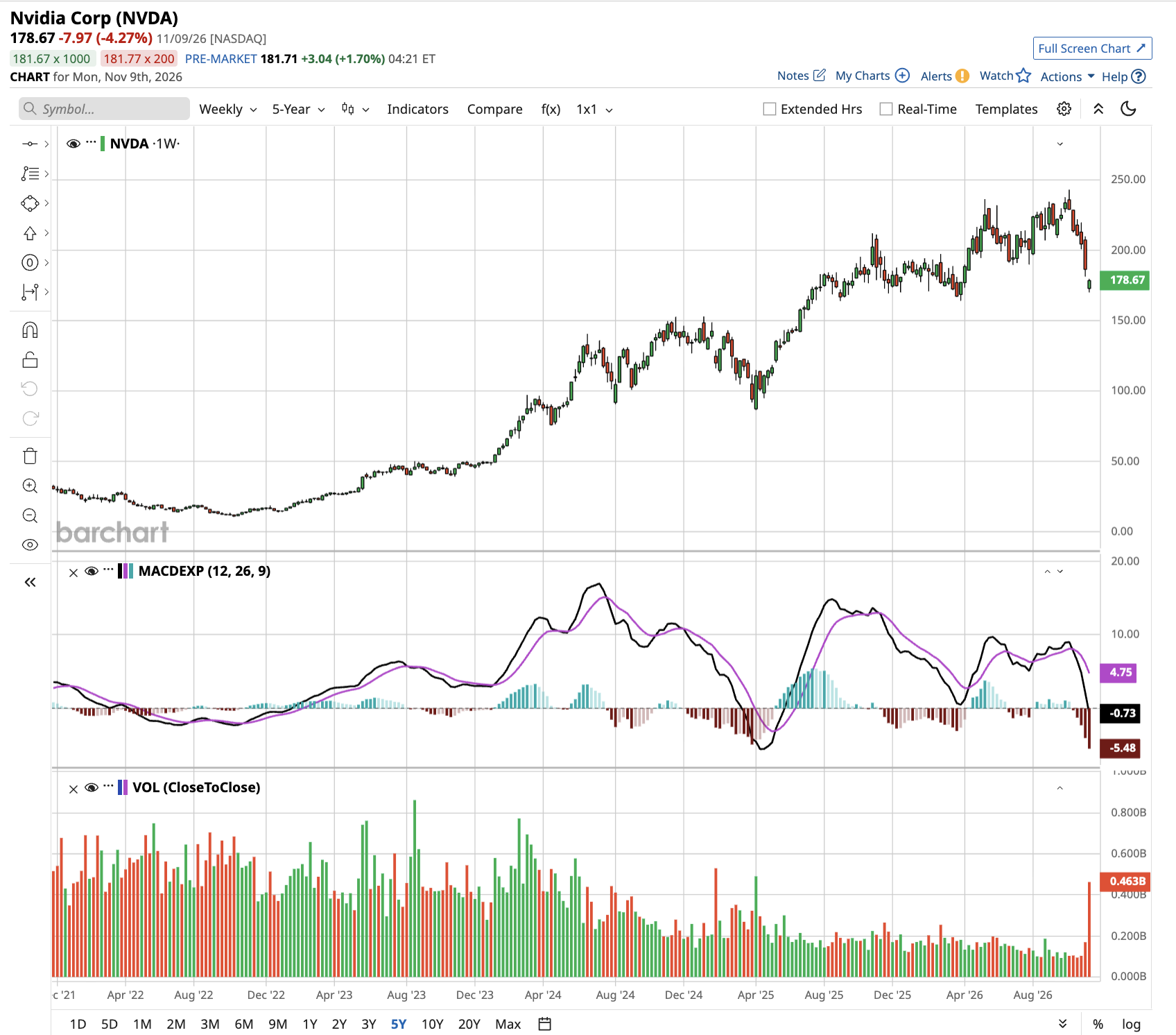
Why AI Spending Powers Nvidia Stock
Valued at a market cap of more than $4 trillion, Nvidia is among the largest companies in the world. In fiscal Q2 2027 (ended in July), Nvidia reported revenue of $96 billion, up more than 100% year over year. Data center sales rose 18% sequentially to $89 billion.
Nvidia tied the strong demand to cloud giants, given that the top five hyperscalers could spend $800 billion on capital expenditures in 2026 and a staggering $1.3 billion in 2027.
Nvidia is also earning more per data center. Chief Financial Officer Colette Kress said its revenue opportunity per gigawatt has grown from about $18 billion with Hopper to $40 billion with Vera Rubin. She expects revenue to grow about 70% in fiscal 2028, despite supply-related headwinds.
GR00T 2 Teaches Robots New Skills
Nvidia announced GR00T 2 and Isaac Lab 3.0 on Nov. 9 at the Conference on Robot Learning, Seeking Alpha reported.
GR00T 2 is an open-world action model built on Nvidia's Cosmos platform, according to a company statement. Basically, it looks through the robot’s cameras, imagines the next few seconds, and decides how the robot’s hands should move.
In a test of 50 tasks Nvidia’s Dexter robot had never been trained on, GR00T 2 completed 40 tasks at least once, succeeding in 40% of all attempts. Most misses came from one step that lacked precision.
With one demonstration per task, it averaged 71% success, and with five demonstrations the success rate climbed to 95%. Nvidia's whitepaper says the five-demonstration result is high partly by design, because the tasks were chosen from ones the model learns well.
In the whitepaper, GR00T 2 averaged 71.7% success on six long tasks, such as assembling a toy car in 24 stages, while rival models topped out at 12.5%. The model can also learn from human demonstrations and move those skills between different robot bodies.
Simulation is the New Classroom
Before a robot works on a real factory floor, it practices in a virtual copy of the same. Nvidia’s simulation tools can train thousands of virtual robots at once. Isaac Lab 3.0 now models soft items such as cables and cloth, so skills learned on screen carry over to hardware. In one test, Nvidia says it delivered up to 2.5 times the training speed of the prior version.
One example is AlphaNIST, where a single policy learned all 20 tasks on an assembly board with millimeter-scale parts. It hit more than 98% training success, versus 81% for separate policies, using about 39 times less GPU time.
Companies are already testing the tools.
- MicroAGI uses GR00T 2 to swap Ethernet cables with a robotic arm.
- Foxconn is applying it to factory automation for server manufacturing.
- Siemens is evaluating it for industrial uses.
UC Berkeley professor Ken Goldberg called agentic robotics "the most exciting technological development since the internet in 1995," according to the statement.
CEO Jensen Huang pushed the same theme at GTC Berlin on Oct. 21. He called humanoid robotics the next great industry, one "likely to be extremely large." He said a reference robot, the Agile ONE, arrives in the first quarter of next year.
On stage, a small robot named Microduck walked around after learning its skills in the cloud and in a digital twin.
Risks Behind Nvidia Stock
While Nvidia continues to grow at an enviable pace, it reported a gross margin of 75% in fiscal Q2. Kress forecasts gross margins to narrow to 74% in Q3 due to memory prices. Kress expects margins to bottom at 71% to 72% in the fourth quarter and should settle at 72% to 73% in fiscal 2028.
Nvidia has invested nearly $50 billion in frontier AI labs. Kress acknowledged "some will call this circular financing," and emphasized that the labs backed by Nvidia's balance sheet could drive roughly a quarter of next year's business.
Kress also said it includes no China data center compute revenue. Lastly, robotics is still in the early stages and is a long-term play. Nvidia did not share robotics revenue in its statement or on the earnings call.
Is NVDA Stock a Buy?
The bull case for investing in NVDA stock is clear. Revenue more than doubled, the outlook is limited by supply, and Huang said Vera Rubin is in full-scale production. The bear case is just as clear. Margins are heading lower, financing questions linger, and AI labs could account for a significant portion of the top line.
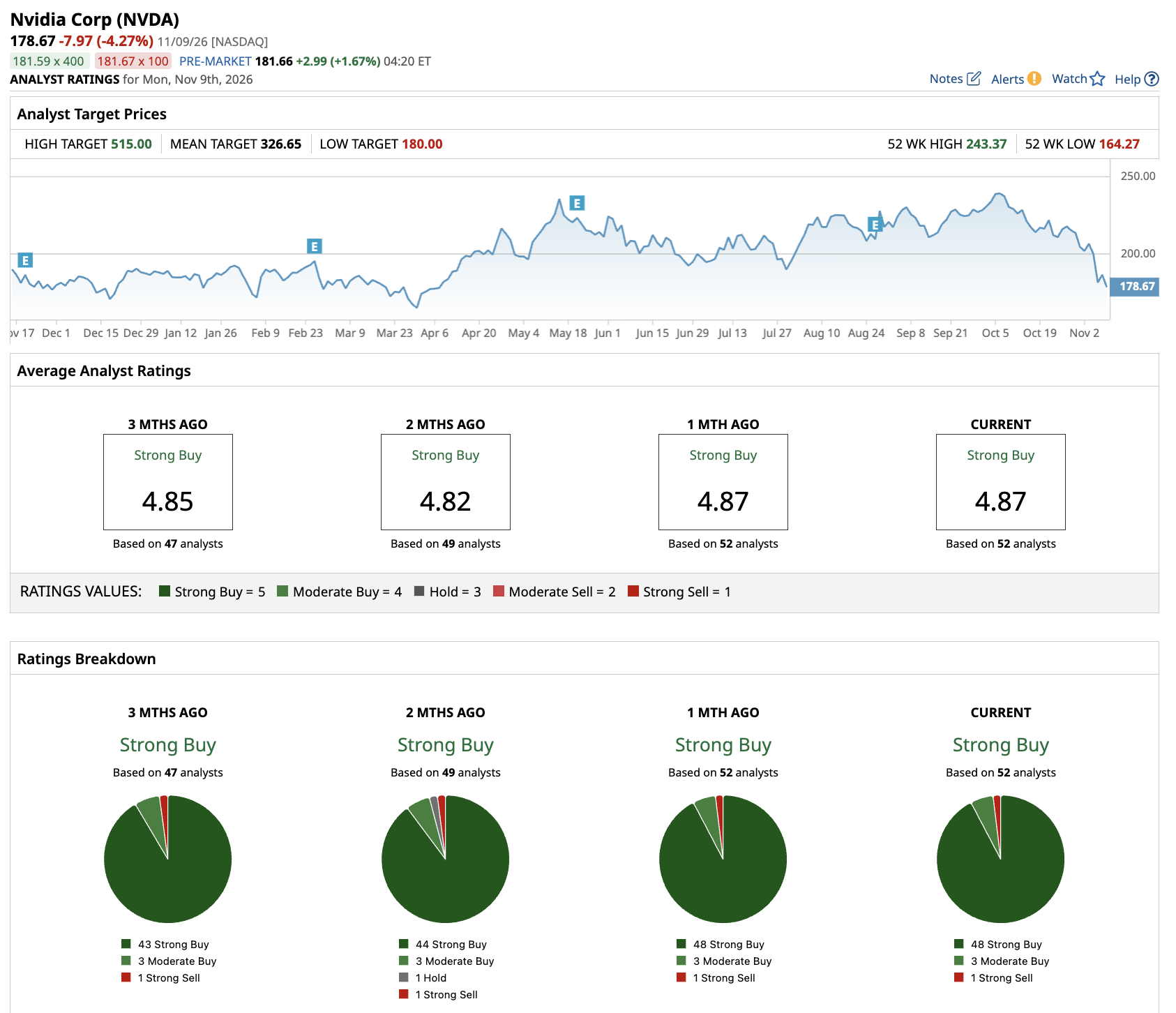
Out of the 52 analysts covering NVDA stock, 48 recommend “Strong Buy”, three recommend “Moderate Buy”, and one recommends “Strong Sell”. The average NVDA stock price target is $327, above the current price of $179.
On the date of publication, Aditya Raghunath did not directly have a position in any of the securities mentioned in this article. All information and data in this article is solely for informational purposes. For more information please view the Barchart Disclosure Policy here.