
Analysts See Micron Stock Doubling as MU Trades at Just 3.8x Earnings
Micron (MU) stock has come under considerable pressure, declining about 31% over the past month and trading nearly 43% below the 52-week high. The steep correction reflects mounting concerns surrounding the broader AI investment landscape, particularly questions about the long-term profitability and returns associated with massive AI infrastructure spending.
Moreover, investors remain cautious about the semiconductor memory industry's inherently cyclical nature, questioning whether current earnings levels can be sustained as supply and demand conditions evolve. Additionally, increasing competition from China's domestic semiconductor industry has introduced concerns about future memory supply expansion.
Despite the recent weakness, Micron's underlying business fundamentals remain supported by robust demand for memory products and solutions. And MU’s multi-year supply agreements provide greater revenue visibility.
The significant share price correction has also lowered its valuation. Trading at 3.8 times forward earnings, Micron trades at a significant discount to its historical valuation, despite benefiting from structural demand growth driven by AI adoption. Furthermore, it appears deeply undervalued relative to its earnings growth potential.
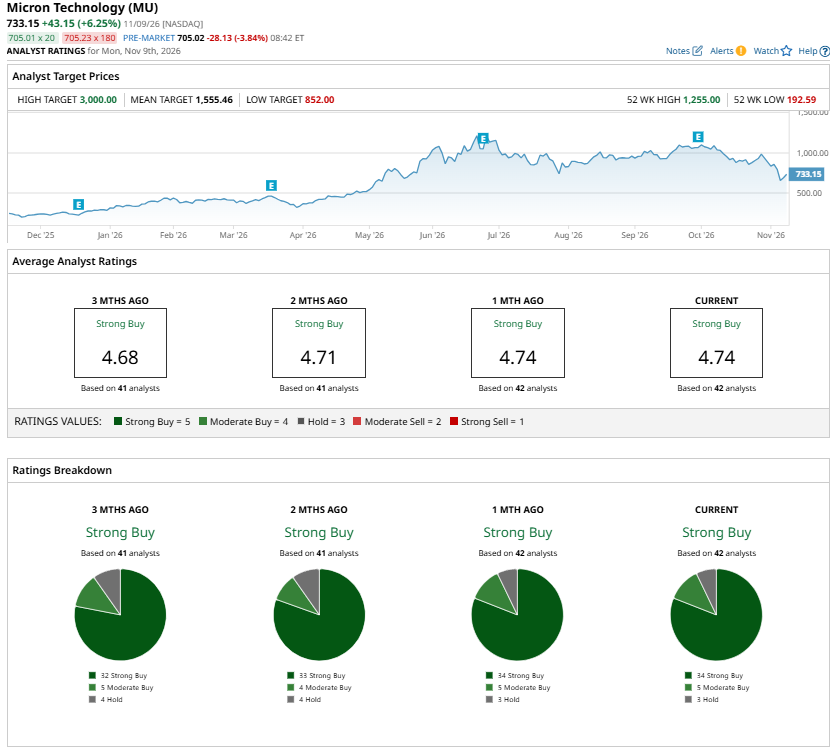
Given its extremely low valuation and solid prospects, analysts see the potential for MU stock to more than double over the next 12 months.
Micron’s Earnings Growth Potential Supports Upside in MU Stock
After delivering exceptional growth in fiscal 2026, Micron is set to sustain solid momentum in fiscal 2027 and beyond despite a high earnings base. MU will continue to benefit from favorable memory industry dynamics and ongoing AI infrastructure investments.
Micron’s near-term catalyst is the structural imbalance between memory demand and available supply. Management expects supply-demand conditions across memory and storage markets to remain exceptionally tight throughout fiscal 2027 and 2028, supporting higher prices and margin expansion. Although memory price increases may moderate, sustained supply constraints could continue to translate into favorable average selling prices (ASPs) and strong profitability.
High-bandwidth memory (HBM) represents another important earnings driver. Micron’s HBM business grew faster than its overall revenue in fiscal Q4 2026, reflecting higher shipments and broader customer adoption. More importantly, the company has already secured the majority of its HBM capacity for calendar 2027, with contracts incorporating substantial year-over-year (YoY) price increases. This combination of volume visibility and improved pricing should support revenue growth while enhancing the profitability of its HBM portfolio.
Micron’s near-term guidance also reflects strong operating momentum. For fiscal Q1 2027, management expects revenue of approximately $61.5 billion, representing sequential growth of more than 13% and a 351% increase YoY. Gross margin is projected to reach approximately 86.3%, highlighting the favorable impact of pricing and product mix. Although margins could moderate slightly in the first quarter, management expects profitability to strengthen subsequently as higher memory prices flow through the business. EPS is projected at $38.15, indicating solid sequential and YoY growth.
Micron has also strengthened the visibility and predictability of its future revenue through strategic customer agreements. The company has entered into 26 multi-year, take-or-pay contracts, representing approximately $150 billion in remaining performance obligations (RPO). These agreements provide greater demand visibility, facilitate capacity planning, and reduce uncertainty around future customer commitments.
Taken together, these developments suggest that Micron’s earnings growth is supported by more than a temporary improvement in memory pricing. Structural supply constraints, expanding AI-related HBM demand, favorable product mix, and longer-term customer commitments are supporting its growth.
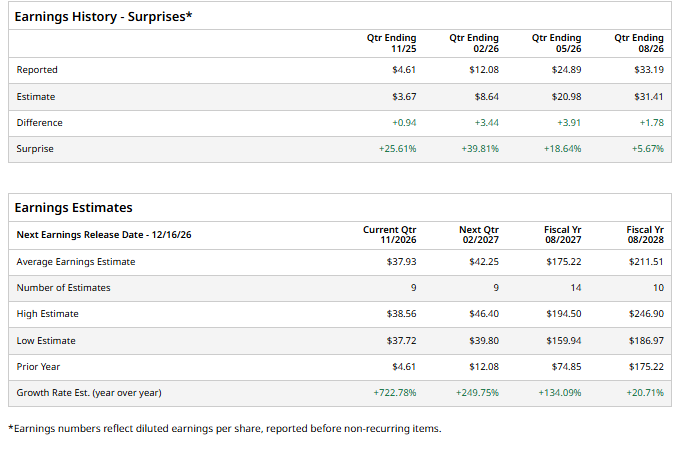
Wall Street analysts currently anticipate Micron’s fiscal 2027 earnings to increase by 134%, an impressive growth rate considering the extraordinary earnings expansion already recorded in fiscal 2026. Although EPS growth is likely to peak in fiscal 2027, the earnings trajectory could remain positive in fiscal 2028 as well.
Analysts currently expect earnings growth to moderate to approximately 20.7% in fiscal 2028. However, this deceleration should be viewed in the context of Micron’s exceptionally strong earnings base.
At an estimated forward price-to-earnings (P/E) multiple of just 3.8, MU stock appears inexpensive relative to its projected earnings growth. Consequently, despite the likelihood of slower growth beyond fiscal 2027, Micron’s valuation indiciates solid upside potential.
Micron’s Valuation Also Leaves Significant Room for Upside
Micron’s sharp share price correction appears disconnected from its underlying earnings prospects. Strong AI-driven demand, persistent memory supply constraints, expanding HBM adoption, and long-term customer agreements provide a solid foundation for continued earnings growth.
While memory industry cyclicality and potential pricing normalization remain key risks, Micron’s projected earnings expansion and a forward price-to-earnings (P/E) of just 3.8 suggest the market is undervaluing its growth potential.
With analysts maintaining a “Strong Buy” consensus rating and anticipating substantial upside over the next 12 months, MU stock appears well-positioned for a steep recovery.
On the date of publication, Amit Singh did not directly have a position in any of the securities mentioned in this article. All information and data in this article is solely for informational purposes. For more information please view the Barchart Disclosure Policy here.