
Has the market capitalization jumped to HK$14.5 billion and surged in two days of “access”?
On November 10, Xinde Semiconductor (07672) was officially listed on the main board of the Hong Kong Stock Exchange. The final issue price was HK$8.88. The opening price was HK$10.70, up 20.5% from the issue price, hitting an intraday high of HK$12.48, an increase of over 40%. Buying continued to gain strength in the afternoon, and finally closed at HK$11.4, up 28.4% from the issue price. It traded 22.75 million shares throughout the day, involving HK$245 million.
On the day after listing (November 11), the stock opened at HK$11.3. After falling to HK$11.05 in early trading, it received support and picked up rapidly. Buying continued to gain strength in the afternoon, and the volume surged higher at the end of the session. It hit a high of HK$13.92 in the intraday market, and finally closed strongly at HK$13.66, up 19.82% from the previous day's closing.
It is worth noting that at present, there are less than two months left until the end of the investigation period of the Hong Kong Stock Connect latest round of adjustments (until the end of December). After two days of listing, the market value of Xinde Semiconductor has jumped to HK$14.56 billion, so can it successfully enter Hong Kong Stock Connect during the Hang Seng Index annual inspection at the end of December?
Remain above the issue price for two days
According to the Zhitong Finance App, the high opening of Xinde Semiconductor on the first day was not surprising. An increase of more than 13% in the dark market has set the tone for the open market. Although the 9.84% Hong Kong public sale subscription ratio is not fanatical, with the first-hand signing rate as high as 80%, the retail side's willingness to cash in on profits and the ability to undertake it was roughly balanced during the opening phase.
The inclusion logic of the Hong Kong Stock Connect certainly depends on the continued satisfaction of the average market value, but it is more worth mentioning that the Hong Kong Stock Connect rules do not have an absolute limit on the length of listing for IPOs. As long as the market value and liquidity thresholds are met during the review period, a fast track of “listing this quarter and entering next quarter” can be achieved. This means that with a market capitalization of HK$14.56 billion, Xinde is already eligible to hit Hong Kong Stock Connect tickets in a very short period of time.
This expectation of “quick access” was clearly confirmed in the broker seat data for the first day. According to data from the Futu App, in terms of net sales, the biggest seller was China Galaxy International, with a net sales volume of 2.199 million shares. Grand Fire and Huatai International also net sold 605 million shares and 449,500 shares respectively, and the will to make a new profit market is extremely strong.
According to the Zhitong Finance App, under such heavy selling pressure, the stock price was still strong and closed up 28.4%, and the carrying power behind it came from funds that highly recognized the “access” logic. In terms of net purchases, Futu Securities, which represents a keen financial trend, made a net purchase of 461,000 shares, followed by BOC International, Overseas Chinese, etc.; more notably, the foreign-funded institution Barclays Asia also appeared among them. This kind of seat characteristic of “opening a new market, resolutely cashing out, and actively accepting allocation” shows that the market is not blindly hyping up, but rather that funds that value the potential of going south to raise the balance are actively collecting chips. This structure, which is able to stabilize its position and complete chip optimization even under massive sell-off pressure, has given Xinde Semiconductor a more solid market momentum on the way to opening the door to Hong Kong stocks.
Concentration and sedimentation of national distribution
However, its international placement data is not impressive at first glance. The subscription ratio is about 1.13 times, and there are 83 undertakers, which is not very enthusiastic in the recent Hong Kong stock IPO market. However, the gentleness of the surface conceals a key structural fact: cornerstone investors have locked in more than 35 million shares, accounting for more than 30% of international sales, and the ban period is until August 2027. This means that only about 60 million shares of state-owned chips are actually in circulation, distributed to 83 carriers. The initial amount distributed to a single household was over HK$1 million, and the allocation scale for core carriers reached tens of millions of Hong Kong dollars. This falls within the allocation range of small and medium-sized institutions and industrial capital, rather than decentralized retail holdings, which in itself constitutes a kind of hidden chip accumulation.
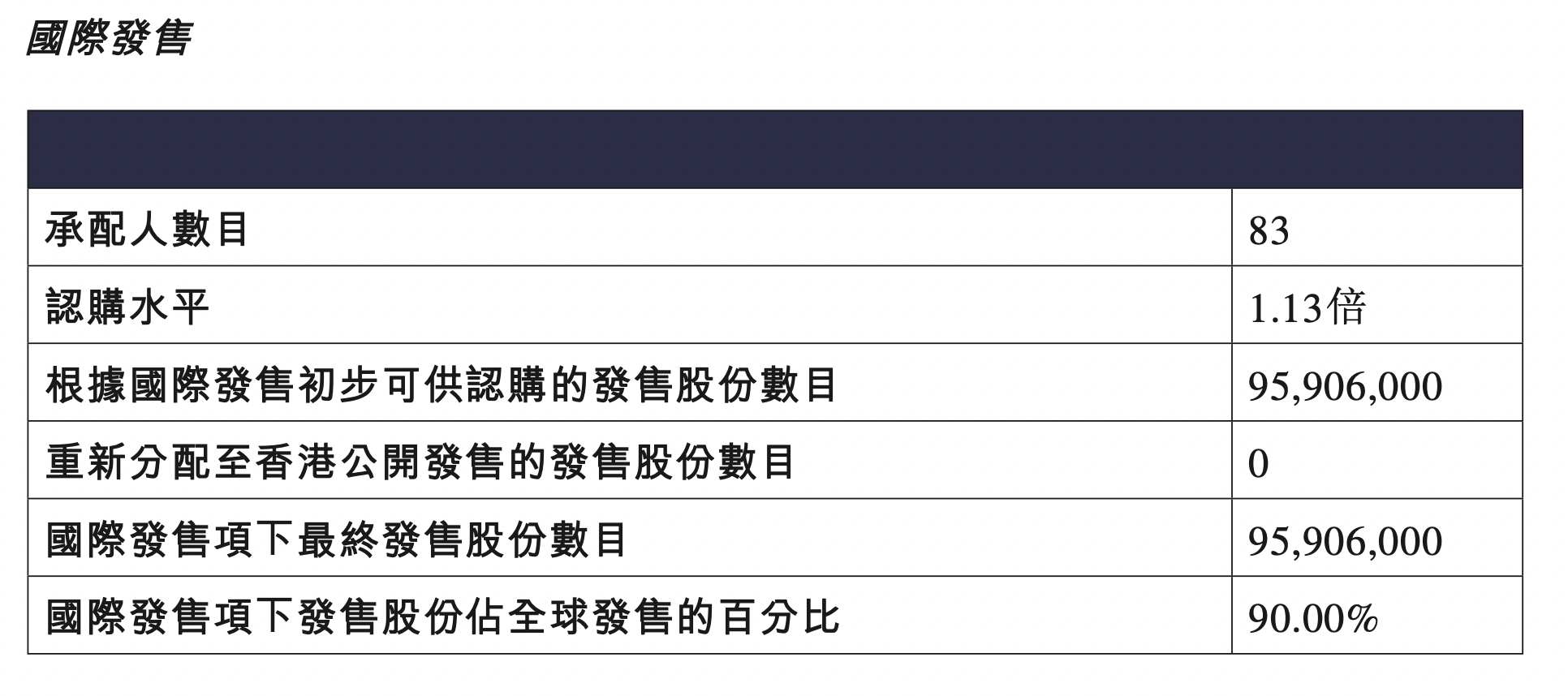
Although the specific identities of these 83 undertakers have not been announced, the nature of their funding can still be traced based on the pre-IPO shareholder map and cornerstone lineup. The Guangfa Fund entered the market with 15 million US dollars, representing approval of the pricing for long-term public funding; behind Guohui Hong Kong's $10 million was state-owned capital from Shandong Province; after penetrating 100 million yuan, Maxwell's shares were linked to Maiwei, a semiconductor equipment manufacturer. Equipment vendors have taken a stake in sealing and testing plants as the cornerstone. At a time when advanced packaging increasingly relies on joint definitions between the equipment side and the process side, the industrial meaning is greater than the financial meaning, and this part of the chip will not be easily loosened due to the increase on the first day.
The Zhitong Finance App noticed that judging from the pre-IPO shareholder list, it was no accident that Xiaomi Changjiang Industrial Fund, OPPO's Chen Mingyong's Star Tour Investment, and MediaTek's Gaintech appeared in early financing by Xinde. Terminal manufacturers and chip design companies invest in sealing and testing service providers as industry shareholders, which often correspond to strengthening supply chain relationships and prioritizing advanced packaging production capacity. Although these shareholders do not appear in the cornerstone list, it is not ruled out that their related parties or partners will participate in the subscription through state-owned distribution channels. If this were the case, the actual share of industrial capital among state-owned distributors would be higher than the surface data, and the actual selling pressure after the first day's high opening would also be less than the volume corresponding to the public circulation market, which is conducive to price stability before capital from the south enters the market.
In fact, in the context of the recent overall cold Hong Kong IPO market, it is not surprising that the 1.13 times national equity subscription ratio is not surprising. Since late October, the issuance of a number of IPOs has been delayed when they are close to listing. Since September, the public offering subscription ratio has clearly declined from the high level in the first half of the year, and the market temperature can be seen. The subscription data for Xinde Semiconductors is at a normal level in this frame of reference, and the reminder in the company announcement about the high concentration of equity is also worth paying attention to. However, the significance of the chip structure is that it determines whether this stock can rely on hidden lock-ups in industrial capital to maintain a decent price center during the window period when it lacks the support of capital going south. This stability has been tested for two consecutive trading days, from closing at above HK$11 on the first day, to a surge in volume and final closing at HK$13.66 at the end of the next day. The implicit hedging of industrial capital to support the price center is being confirmed on the market during the window period when entry expectations have not yet been fulfilled.
Advanced packaging labels are scarce, and the loss reduction slope is clear
Taking the focus from the chip game back to the fundamentals, there is a solid side to the story of Xinde Semiconductors.
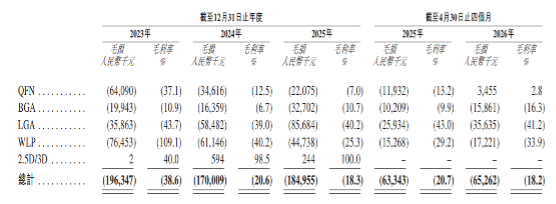
In 2025, the company's advanced packaging revenue was 737 million yuan, accounting for about 73% of total revenue. This ratio is clearly scarce in the Hong Kong semiconductor sector — only a few Hong Kong stock sealed and tested targets, and 70% of advanced packaging revenue is even more empty. This means that Xinde is naturally eligible for separate funding: it is not a “traditional packaging factory with a little advanced packaging concept”, but a sealing and testing company with advanced packaging as its main revenue. The prospectus uniformly classifies QFN, BGA, LGA, WLP, and 2.5D/3D into advanced packaging calibers. The revenue contribution of 737 million yuan in 2025 mainly comes from QFN, BGA and other product lines that have achieved large-scale mass production, indicating that the company's advanced packaging capabilities are not limited to a roadmap concept, but have been transformed into a real revenue base.
However, in 2025, 2.5D/3D advanced packaging revenue was 244,000 yuan, accounting for less than 0.03% of total revenue. This figure is indeed small when viewed alone, but its significance does not lie in current contributions; it marks that the company's cutting-edge packaging capabilities have already been introduced from 0 to 1. At a time when advanced packaging is increasingly dependent on the joint definition of equipment side and process side, 2.5D/3D is exactly the core direction of demand spillover of computing power chip packaging, and it is also a strategic landing point where industrial capital is willing to take a stake in a packaging and testing factory as a cornerstone. The lower the base, the greater the revenue flexibility brought about by subsequent production capacity implementation and customer introduction — this is not a “cutting-edge revenue has just started, so the story is thin”, but rather a “cutting-edge package options have not yet been priced, and there is enough room for improvement”. The path is clear: demand for computing power chip packaging spillover after the production capacity of the Nanjing AI packaging and testing base is the key catalyst for the fulfillment of this option.
Furthermore, the gross loss ratio narrowed from 38.4% in 2023 to 18.0% in 2025, and fell further to 17.9% in the first four months of 2026, narrowing by more than 20 percentage points in two years; the capacity utilization rate simultaneously increased to more than 80%. The slope of this loss reduction curve is rare in Hong Kong stock market testing targets. The signal it conveys is clear: the company is at a stage where production capacity is climbing and profits are approaching an inflection point, and the direction and speed of marginal improvement has already been verified in the report. Whether the gross loss ratio can cross the zero axis is the most worth tracking indicator for the next few quarters; the slope of the loss reduction curve is the underlying basis for the market's willingness to price the inflection point of profit ahead of time.
Taken together, Xinde Semiconductor is already eligible to hit Hong Kong Stock Connect tickets in a very short period of time. The market capitalization stood at HK$14.56 billion on the two days of listing, which is above the current dynamic threshold of about HK$9.1 billion to HK$10.2 billion, leaving plenty of buffer for the next 12 months to meet the average month-end market capitalization standards. The national distribution structure, loss reduction curve, and advanced packaging account for 70%, respectively, providing triple support for chip stability, improved visibility of profits, and scarcity of targets. The momentum for entry is moving from expectations to verifiability. With the first shot in the entry game, standing above the issue price for two consecutive days is only the starting point. Subsequent quarterly data will be a verification window for this narrative to move from “emboldened” to “realized.”