
The Uber Stock Correction Provides a Good Entry Opportunity With Ample Revenue Growth Drivers
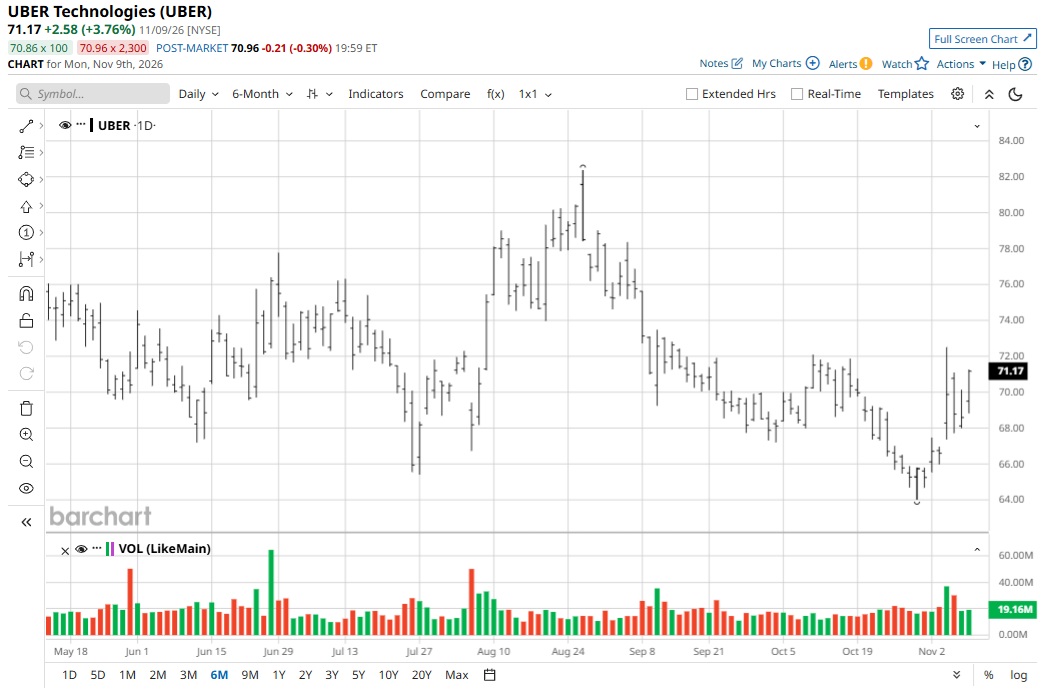
Uber Technologies (UBER) stock has underperformed with negative returns of 24.4% in the last 52 weeks, on the back of multiple factors.
Robotaxis and their potential impact on Uber remain a big concern. With Uber behind Waymo and Tesla (TSLA) in terms of technology and scale, growth is likely to be impacted. Further, the company’s earnings have been mixed, and the guidance for Q4 FY26 has disappointed Wall Street.
In July 2026, Uber also announced the acquisition of Hero for a consideration of $13.7 billion (adjusted for Uber’s prior stake purchases). The potential impact of this acquisition on growth acceleration remains a concern.
Amidst these concerns, there are positive developments. Amazon (AMZN) recently announced a major food delivery partnership with Uber Eats. Under the agreement, “U.S. Prime members will see no delivery fee on restaurant orders of $25 or more placed through Amazon and fulfilled by Uber Eats.” With the partnership covering 10,000 cities and towns, there is likely to be a positive impact on Uber Eats market share.
About Uber Stock
Headquartered in San Francisco, Uber Technologies develops and operates proprietary technology applications. The company’s technology is available in over 70 countries, principally in the United States and Canada, Latin America, Europe (excluding Russia), the Middle East, Africa, and Asia Pacific.
As of December 2025, the company had three operating and reportable segments: Mobility, Delivery, and Freight. Using the company’s proprietary technology, these segments power movement from point A to point B.
For Q3 FY26, Uber reported revenue growth of 10% on a year-on-year basis to $14.8 billion. For the same period, adjusted EBITDA increased by 31% to $3 billion. Uber also reported healthy free cash flow of $2.5 billion during the quarter.
However, Uber stock has traded marginally lower in the last six months. While Q3 revenue beat estimates, adjusted EPS missed. Further, the company’s Q4 EPS guidance is below Wall Street estimates.
Ample Growth Opportunities
For Q3, Uber reported 19.2% year-on-year revenue growth in the delivery business to $5.5 billion. Uber Eats will likely continue to grow at a robust pace amidst an increasing number of partnerships.
Further, according to Uber, the grocery and retail market represents a $10 trillion opportunity, coupled with a $2 trillion opportunity in the addressable market for food. This implies ample headroom for growth even as competition remains intense.
For the mobility business, the fears related to Robotaxi might be overdone. Uber has more than 200 million active monthly users. There is a strong case for autonomous vehicle companies partnering with Uber than being competition. Further, the company is deploying 2,000 driverless vehicles by the end of 2027.
It’s also worth noting that Uber reported a cash buffer of $10.1 billion as of Q3. Robust free cash flows, coupled with the cash buffer, provide Uber with high financial flexibility for capital investments that potentially accelerate growth.
For FY25, Uber reported 54% of revenue from outside the United States. Organic and acquisition-driven growth is likely to support international expansion with significant potential for growth in emerging markets.
What Do Analysts Say About UBER Stock?
While analyst estimates indicate earnings declining in FY26, it’s expected that earnings growth of 46.62% will be seen in FY27. This makes UBER stock attractive considering a forward price-earnings ratio of 21.88.
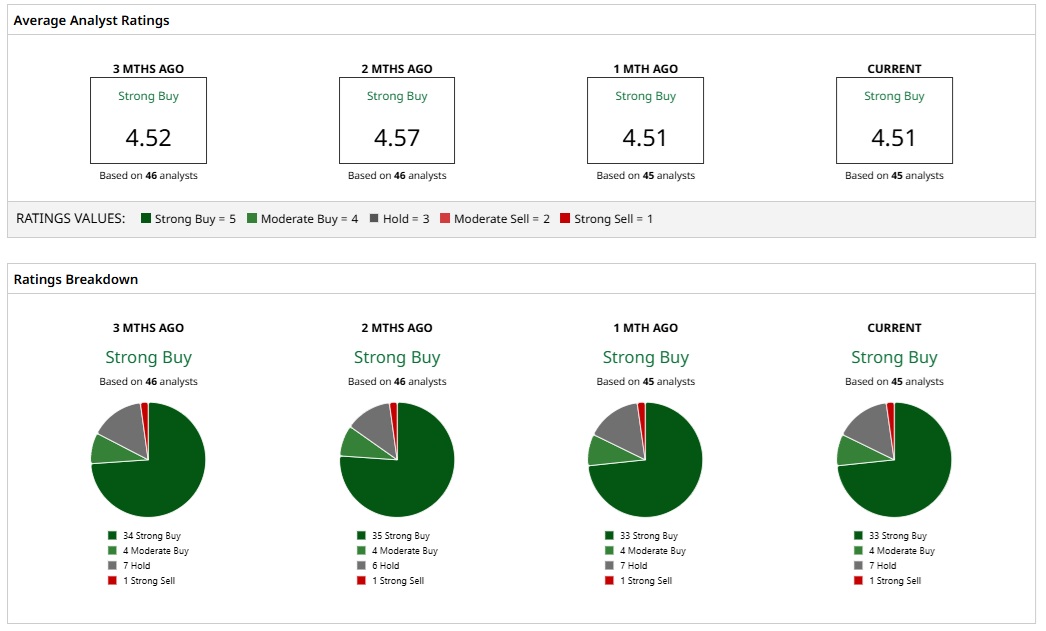
Based on 45 analysts with coverage, UBER stock has a consensus “Strong Buy” rating. While 33 analysts have a “Strong Buy” rating for the stock, four have a “Moderate Buy,” seven have a “Hold,” and one analyst has a “Strong Sell” rating.
The mean price target of $100.57 represents potential upside of 41.3% from current levels. Further, the most bullish price target of $150 suggests that UBER stock could climb as much as 110.8% from here.
On the date of publication, Faisal Humayun Khan did not directly have a position in any of the securities mentioned in this article. All information and data in this article is solely for informational purposes. For more information please view the Barchart Disclosure Policy here.