
The smart driving plan “got on the bus” and the stock price rebounded by more than 30%. Is Yushi Technology (01511) looking forward to a revaluation?
The global autonomous driving industry is entering a critical stage of shifting from technology verification to large-scale commercialization. Autonomous driving supplier Yushi Technology (01511), which focuses on L4 unmanned solutions, is undergoing a round of market repricing.
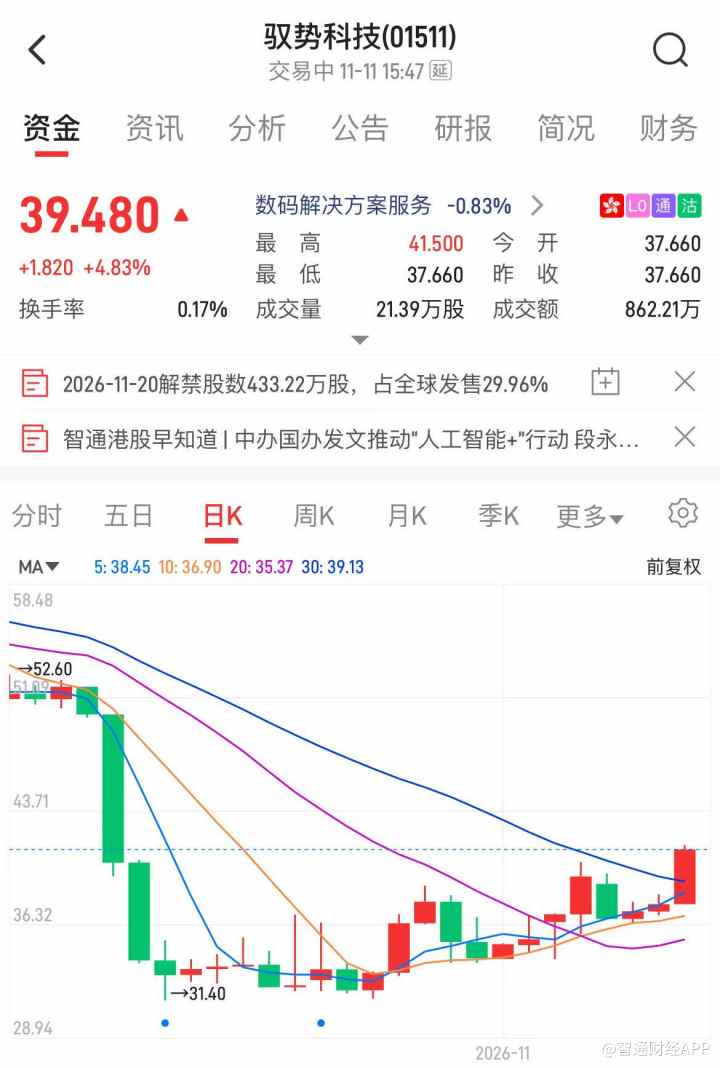
The Zhitong Finance App noticed that since the June high, Yushi Technology's stock price once dropped to HK$31.4 on October 13. Recently, with the gradual restoration of market trading sentiment, the company's stock price rose to HK$41.5 intraday on November 11, with a range increase of more than 32% since the previous low. This round of price correction occurred in an environment where the industry generally lowered its long-term expectations. What was behind it was a shift in capital evaluation standards, moving away from simply a racetrack narrative to re-evaluating the value of the target against the company's operating results.
Market source: Zhitong Finance App
The L4 track is expected to be digested, and the pricing anchor is shifting to successful operation
In recent years, the capital market's criteria for judging the autonomous driving industry have changed rapidly. In the early stages of the development of the industry, the market placed more value on the technical iteration ability, algorithm reserves and number of pilot projects of enterprises, and was willing to pay a high premium for long-term growth space. As the industry enters a commercial fulfillment period, replicable implementation scenarios, stable orders, and standardized delivery capabilities have become a yardstick for the market to evaluate the investment value of enterprises, and the valuation premium brought about by pure technical narratives continues to shrink.
Yushi Technology landed on the Hong Kong Stock Exchange in May 2026. Backed by a booming closed-scenario autonomous driving circuit, it received a high market premium at the beginning of its listing. According to a research report released by Guoyuan International Securities in May, Yushi Technology finally determined the issuance price of HK$60.3 per share, corresponding to the company's market sales rate (PS) of 26 times in 2025, and is at a relatively high level in the industry. The high distribution valuation is essentially the market's early pricing of the long-term growth space for the L4 autonomous driving circuit in a closed scenario.
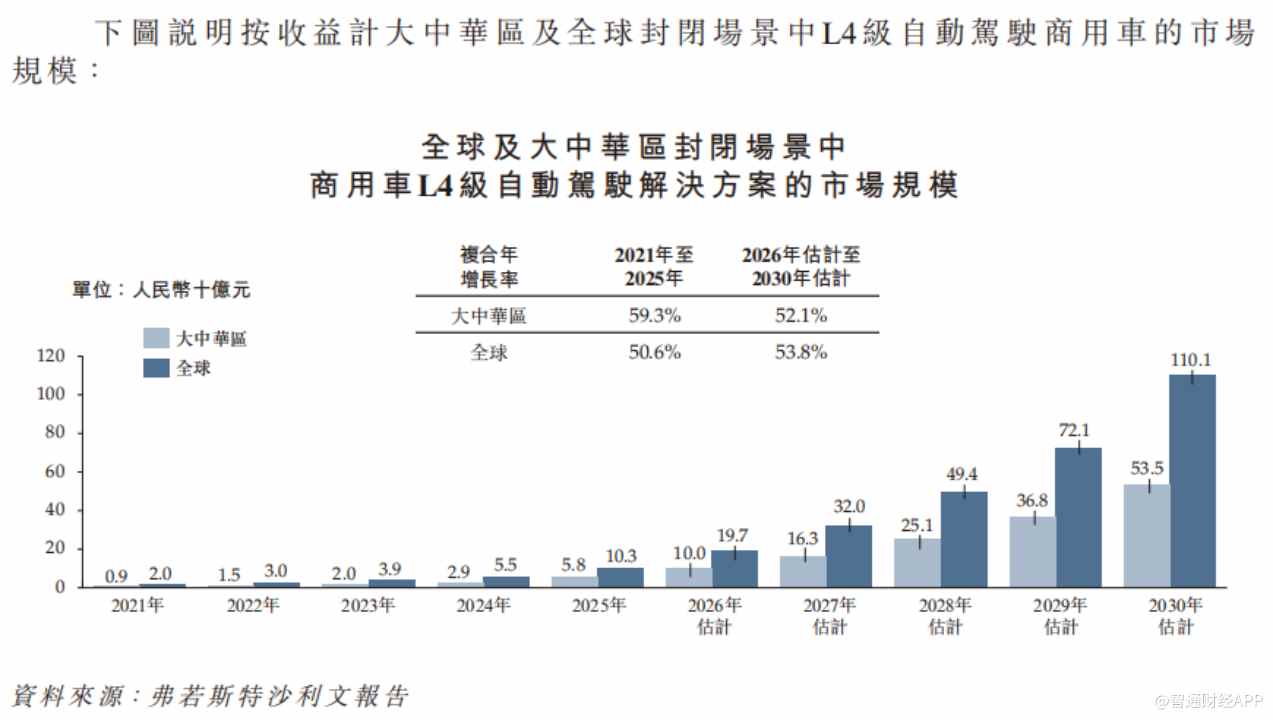
According to Frost & Sullivan's estimates, the global market size for commercial L4 autonomous vehicles in closed scenarios has grown from 2 billion yuan in 2021 to 10.3 billion yuan in 2025; it is expected to reach 19.7 billion yuan in 2026, and rise to 110.1 billion yuan in 2030, with a compound growth rate of 53.8%. Focusing on Greater China, the track's growth rate is more prominent. The market size expanded from 900 million yuan in 2021 to 5.8 billion yuan in 2025. The compound growth rate will maintain a compound growth rate of 52.1% from 2026 to 2030, and is expected to reach 53.5 billion yuan in 2030.
Strong industry expectations supported the company's valuation level in the early stages of listing. As transactions progressed, the forward premiums included in the listing phase were gradually digested. Subsequent market repairs indicate that after the premium was fully exchanged, part of the capital began to re-examine the company's business fulfillment potential, and the valuation focus gradually fell on the ability to implement the business and realize revenue
Differentiated scenario layout, outstanding commercialization capabilities
As an autonomous driving solution service provider focusing on L4 unmanned technology in Greater China, Yushi Technology focuses on closed and semi-enclosed commercial vehicle scenarios such as airports, industrial plants, and port mining areas, while building a general autonomous driving technology system covering all levels of L2 to L4. The solutions can be adapted to various scenarios of logistics, operation, and civilian vehicles.
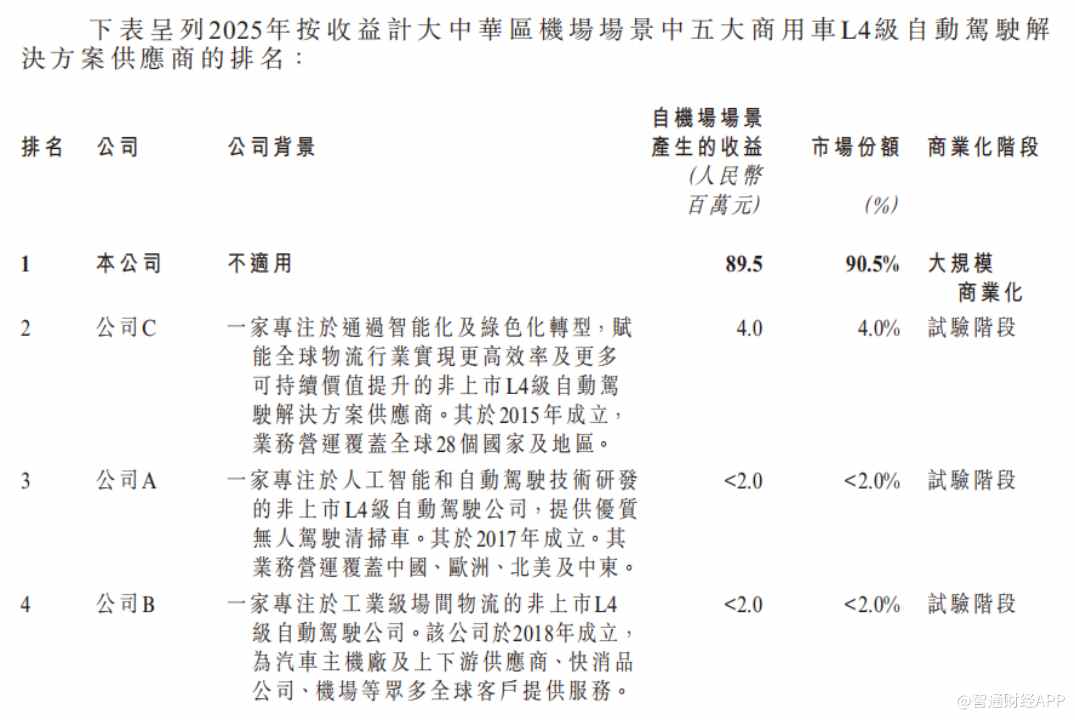
According to Frost & Sullivan data, based on revenue in 2025, Yushi Technology is the top L4 autonomous driving solution provider for commercial vehicles in the Greater China airport scene and factory scene, with market shares of 90.5% and 31.7% respectively. Among them, the airport scenario has significant advantages, which has established a very defensive business foundation for it.
According to Yushi Technology's prospectus, as of May 3, 2026, the company has cooperated with 17 Chinese airports and 3 overseas airports, and has been exploring cooperation opportunities with 4 airports in China and the world. By the first half of the year, the company had achieved unmanned operation of more than 100 vehicles for airport customers in mainland China, and officially launched unmanned operation at Changi Airport in Singapore.
The company stated in its 2026 interim results announcement that in the second half of the year, it is expected to benefit from strong project reserves at Hong Kong International Airport and various airports in mainland China. In addition, the company will actively participate in the certification of relevant civil aviation standards, promote the upgrading of existing models, and explore new business models such as financial leasing and AI driver subscription services to further enhance market penetration.
The pace of order execution has been reflected in the progress of the project. In July 2026, the company won the purchase order for unmanned vehicles from the Xinjiang Airport Group. With the implementation of the new order, the total number of unmanned vehicles operated by Urumqi Tianshan International Airport exceeded 70, making it the largest driverless driverless fleet on the mainland. The fleet has completed 1 million kilometers of commercial operation. The company pointed out that by winning the bid, the company will continue to consolidate its leading position in the smart civil aviation circuit industry and fully open up room for growth in the global civil aviation market.
Yushi Technology's steady increase in order volume confirms the unique advantages of closed scenario routes: compared to the various restrictions faced by autonomous driving on open roads, the boundaries of closed scenarios are clear, the operating rules are stable, the customer is mainly large institutions, the willingness to pay and order stability is stronger, and it is easier to form a closed commercial loop from actual customer needs to normalized operation to continuous repurchases.
Technology reuse and performance realization opens up space for long-term value repair
It is worth noting that the technical characteristic of Yushi Technology is that it has built a full-stack autonomous driving platform that can be reused across scenarios, models, and power forms. This technology system, which has been iterated over a long period of time in closed scenarios, can also be extended to the field of advanced intelligent passenger car driving to explore diversified business growth curves.
In October 2026, the company ushered in mass production, providing intelligent driving assistance software solutions for the fuel version and PHEV smart hybrid version of Buick's new LaCrosse and Cadillac XT5, covering mainstream urban commuting and high-speed long-distance vehicle scenarios. It can enter the supply chain of mainstream joint ventures, and relies on the company's perfect compliance and quality system. Currently, the company has obtained ISO 26262 ASIL-D functional safety certification and Automotive SPICE (ASPICE) Capability Level 3 assessment certification to meet the mass production entry standards of mainstream car companies around the world.
This mass production delivery has verified the reuse value of the company's technology. The same technology platform can be used for different models of cars and SUVs, and is compatible with fuel and hybrid power systems, which not only reduces the cost of model adaptation for car companies, but also allows Yushi's R&D investment to be distributed across multiple business lines to improve technology investment efficiency.
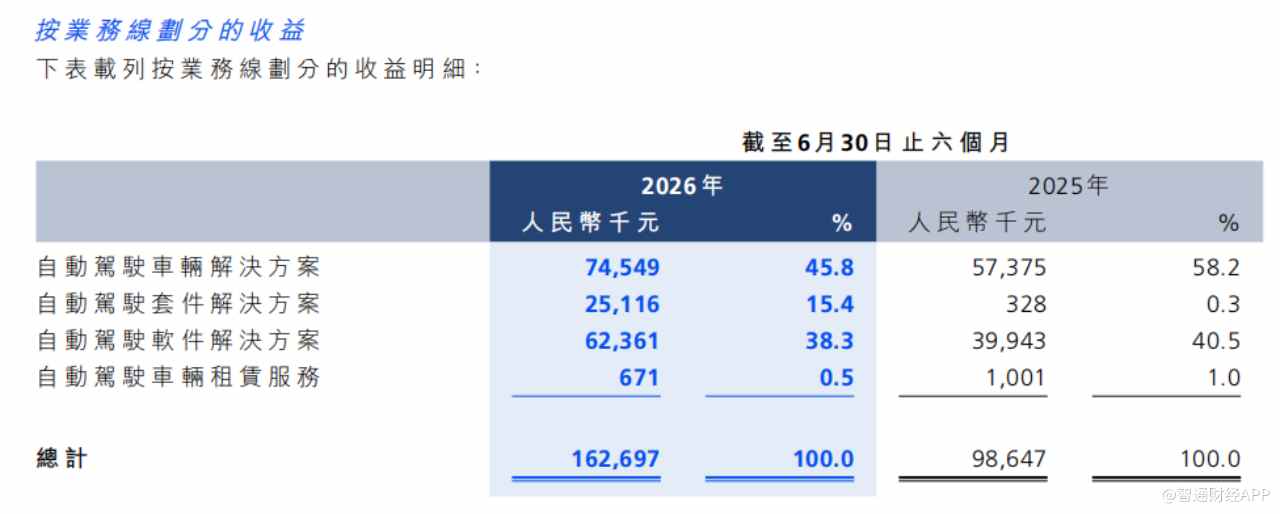
The results of technology implementation are simultaneously reflected in financial reports. In the first half of 2026, the company achieved revenue of 163 million yuan, an increase of 64.9% over the previous year, and the revenue continued to grow. The business structure continued to be optimized, and the autonomous vehicle solution achieved revenue of 75 million yuan, an increase of 30% over the previous year; the autonomous driving kit solution business revenue reached 25 million yuan, accounting for an increase of 15.1 percentage points to 15.4%; and the autonomous driving software solution business revenue reached 62 million yuan, an increase of 56% year on year.
In terms of profitability, the company's overall gross margin remained at 52.9% in the first half of the year, which is at a high level among autonomous driving technology companies that have not yet made a profit, reflecting the pricing space and technology premium of B-side solutions. Thanks to the Hong Kong stock IPO fundraising in May 2026, the company's cash reserves were greatly increased. Liquidity can support technology iteration, expansion of domestic and international scenarios, and promotion of new projects, providing a stable guarantee for subsequent business expansion.
Looking at the current development pattern of the industry, the valuation of autonomous driving racetracks on pure concept targets continues to converge, and market capital tendencies are verifiable, revenue can be quantified, and models can be replicated. With a stable commercial chassis in closed scenarios, new incremental space brought by smart passenger car driving, and a reusable full-stack technology system, Yushi Technology has completed the leap from technical verification to large-scale delivery.
As subsequent orders for domestic and international scenarios continue to be implemented, mass production projects of joint venture car companies are progressing steadily, and the company's operating results are expected to be further consolidated. This round of market recovery, which started from a low point, is a reflection of the market's repricing of its commercial potential. The pricing given by the subsequent market will also continue to be adjusted dynamically according to the pace of business implementation.