
After strong earnings reports, weak AI investment and midterm election risks will overshadow US stock profits next year
The Zhitong Finance App learned that the third quarter earnings season for US stocks is nearing its end. Despite the impressive overall performance, analysts have lowered the S&P 500 index's profit forecast for next year. Concerns surrounding artificial intelligence (AI) spending and the subsequent impact of the US midterm elections are casting a shadow over profit prospects. According to the data, the profit forecast for the S&P 500 index has been lowered for four consecutive weeks. Currently, the market expects profit growth of 20% in 2027, which is lower than the 30% growth rate expected this year.
The decline occurred against the backdrop that earnings per share (EPS) of all sectors of the S&P 500 index exceeded pre-season expectations. Currently, component companies, which account for more than 80% of the market value of the index, have disclosed their results. EPS growth rate reached 33%, slightly higher than 32% in the second quarter, mainly driven by energy and technology giants.
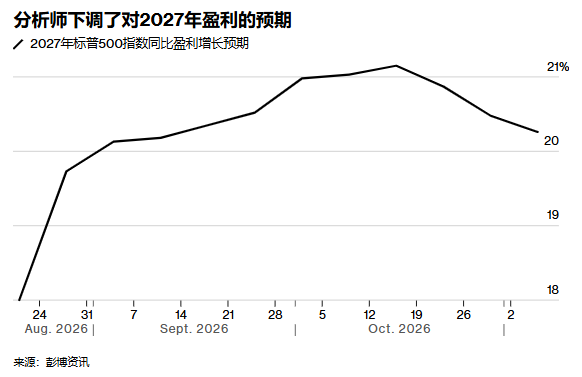
Bank of America strategists Savita Subramanian (Savita Subramanian) and Victoria Roloff (Victoria Roloff) wrote in the report: “The overall guidance trend is encouraging, but the 'blue wave' (Democratic Party's big win in the midterm elections) has increased the risk of delays in AI spending, and AI is the strongest driver of S&P 500 EPS growth over the past three years.”
Questions about the future direction of AI regulation and data center policies have heightened market concerns about AI computing power spending getting out of control, and triggered a sell-off in technology stocks.
The ripple effect of lower AI capital expenditure
Bank of America analyst Vivek Arya (Vivek Arya) said that if policy changes lead to capital spending cuts starting next year, analysts may further lower EPS expectations in the first quarter. Bank of America research shows that if AI capital expenditure is cut by 20%, the S&P 500 EPS could be reduced by as much as 8%.
Citi analyst Atif Malik (Atif Malik) said that delays in approval, local opposition to data center construction, and the market's growing caution about new cloud service companies that provide AI computing power may slow down the pace of development of new projects.
UBS strategist Keith Parker (Keith Parker)'s team wrote that the slowdown in data center construction will affect AI companies themselves, as well as equipment manufacturers and suppliers of electricity, land, and labor. This “weakens the strength of broadening trade (broadening trade).”
The consumer sector faces the test of inflation and interest rates
Outside of AI transactions, the future is uncertain, especially for consumer-oriented companies. Bank of America's Subramanian and Roloff said that since the outbreak of the war in Iran, consumer companies' profit expectations have been “surprisingly strong,” but the boosting effect of tariff refunds has basically subsided, and the margin of revisions to the sector's 2027 profit forecast lags behind the market this season. They said this made inflation and interest rates “swing factors.”
BI analysts Wendy Soong (Wendy Soong) and Christopher Cain (Christopher Cain) said that the results of Walmart (WMT.US) and Target (TGT.US) next week will show how consumers deal with inflation and how the consumer necessities sector can relieve pressure.
Nvidia's performance becomes the next big test for AI trading
Nvidia (NVDA.US), which will also announce results next week, will bring the next test to AI transactions. Citi's Malik said that for the chipmaker, “the key risk is not 2027 demand — this part seems to be largely locked in — but 2028 order visibility and the transformation of backlog orders.”
Furthermore, as the performance test is approaching, the scandal of Nvidia CEO Wong In-hoon is further disrupting market sentiment. Nvidia's board of directors has initiated an independent investigation. The company's stock price has fallen by more than 9% in the past two trading days, and the market value has evaporated by more than 400 billion US dollars. Yorkville Ives analyst Dan Ives said the value of Nvidia as a company and its shares could drop by 25% to 30% if Wong In-hoon were removed from the CEO position. This turmoil has added another layer of governance-level concerns to technology stocks, which are already under pressure due to AI spending prospects and uncertainty in the midterm elections.