
Super Micro Computer: Q1 Earnings Had Plenty to Cheer and Plenty to Worry About
Super Micro Computer (SMCI) reported a strong start to fiscal 2027, giving investors plenty of reasons to cheer about. Revenue nearly quadrupled, earnings beat the company's own forecast, and management lifted the full-year sales target.
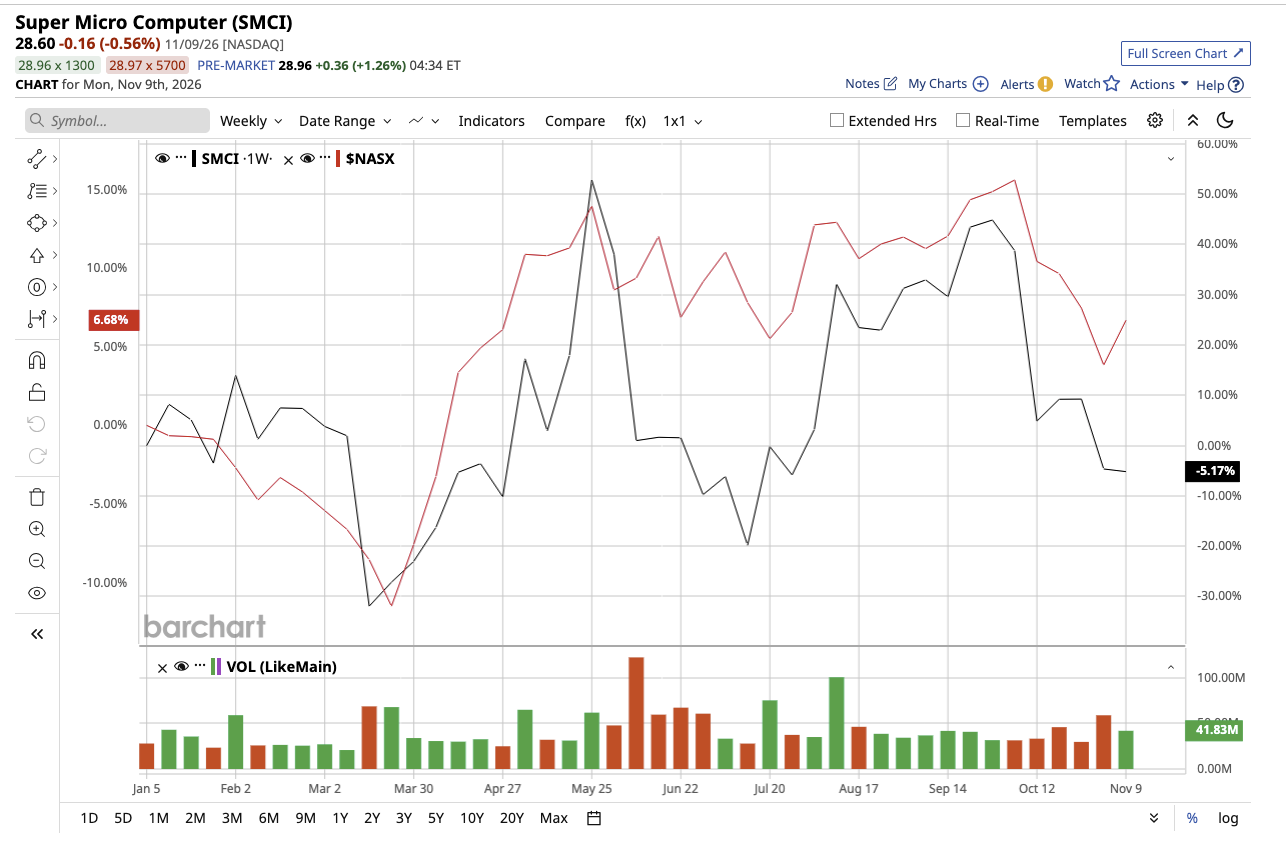
However, the headline growth hides a more complicated picture, which is probably why the market didn’t react much to this enormous quarter. If anything, the stock has fallen 8.3% over the last five days and 7.6% so far this year.
Here are the red flags investors should consider before buying SMCI stock on the dip.
Red Flag No. 1: One Customer Makes Up Nearly Half of Revenue
Super Micro reported $19.9 billion in revenue in its fiscal first quarter, a 298% increase from last year and 79% higher than the previous quarter. This jump includes about $2.3 billion from projects delayed because customers and data centers weren’t ready. Without that catch-up, revenue would have been around $17.6 billion. That’s still a large number but gives investors a clearer picture of the company’s regular pace this quarter.
The red flag here is who is buying these systems. A single, massive data center customer made up 44% of quarterly revenue, putting too many eggs in one basket. When so much depends on the unpredictable timing of huge infrastructure projects, that kind of reliance feels risky. At the end of the first quarter, just two customers made up 49% and 17% of accounts receivable. If one of these giants shifts its rollout, slows spending, or delays payment, it could impact revenue, inventory, and cash flow all at once.
Management said the concentration stems from the size of current AI infrastructure projects and expects it to lessen as enterprise and sovereign AI businesses grow. Some factors helped offset this. Notably, deferred revenue rose by $3.1 billion, mostly from customer payments made before delivery, and days sales outstanding dropped from 59 to 36. The company also reported no significant credit losses this quarter. These protections help for now, but the risk of relying on a few very large buyers remains.
Adjusted diluted earnings per share (EPS) jumped to $1.81 from $0.35 a year earlier, comfortably beating management's original forecast of $1.01 to $1.10. Still, both revenue plus earnings got a significant boost from the recognition of about $2.3 billion in deployments delayed from earlier periods.
Red Flag No. 2: The Margin and Cash Story Is Not as Impressive as Sales
Despite the revenue boost, margins continued to trend downward. Adjusted gross margin slipped to 12.8% from 17.6% in Q4, and operating margin followed suit, dropping to 10.9% from 14.3%. Management pointed to the changing revenue mix as the main culprit. AI solutions now make up 71% of revenue, up from 59% last quarter, but these large-scale deployments typically yield slimmer margins than enterprise and channel sales. Going forward, the company predicts full-year gross margin between 11.8% and 12.2%, signaling that margins may thin further in the second half as even more major AI projects roll out.
Another issue is cash generation and the balance sheet condition. SMCI used $434 million in operating cash and had negative free cash flow of $481 million. Accounts receivable rose by $3.6 billion and inventory by $2.5 billion as the company got ready for future shipments. Days payable outstanding dropped from 29 to 13, meaning the company used about $3 billion for supplier payments.
The cash conversion cycle improved sharply, dropping from 149 days to 97, while inventory days fell to 74. Customer prepayments fueled much of the inventory build, easing the pressure on resources. Management expects the cash conversion cycle to hover near Q1 levels next quarter.
By the end of the quarter, the company had $6.9 billion in cash and $8.6 billion in bank borrowings and convertible notes, resulting in net debt of $1.7 billion. With growth racing ahead, the company must keep turning shipments into cash quickly. If not, expansion could require more borrowing and tie up capital, even if earnings on paper look strong.
Green Flag: AI Demand Is Translating Into a Much Bigger Business
The strongest green flag this quarter wasn’t just revenue growth but the sheer scope of its AI opportunity. AI solutions powered a remarkable 71% of total sales. OEM appliance and large data center revenue soared to $14.7 billion, showing a staggering 321% increase from last year, while enterprise and channel revenue climbed to $4.9 billion, up 229% YOY. Although enterprise and channel business dipped 12% from the previous quarter, the explosive 229% YOY growth proves that demand is thriving across a diverse range of customers.
Super Micro is expanding beyond just selling servers. Its Data Center Building Block Solutions bring together rack-scale hardware, liquid cooling, software, and services to help customers set up and manage their entire infrastructure. The company said it expects to build more than 8,000 racks per month by December, with over 4,000 using direct liquid cooling. Super Micro also pointed to partnerships with Cisco (CSCO) , NetApp (NTAP) , and Nutanix (NTNX) , as well as systems built on Nvidia (NVDA), AMD (AMD), Intel (INTC), and Arm (ARM) platforms. These products could help the company build stronger customer relationships and open up new opportunities beyond just selling hardware.
The upbeat outlook fuels the bullish case. Management has boldly raised its fiscal 2027 revenue guidance to $72 billion to $82 billion, with Q2 revenue expected to be between $19.5 billion and $21.5 billion. Notably, the company expects AI-related solutions to drive 70% to 80% of full-year revenue. Importantly, this forecast does not factor in another $2.3 billion catch-up, making the raised target even more significant.
Is SMCI a Buy Now?
Super Micro Computer’s growth opportunity is substantial, and its raised outlook, stronger revenue and earnings growth, and expanding rack-scale portfolio support the bullish case. However, customer concentration, margin pressure, and negative free cash flow make it a higher-risk investment now.
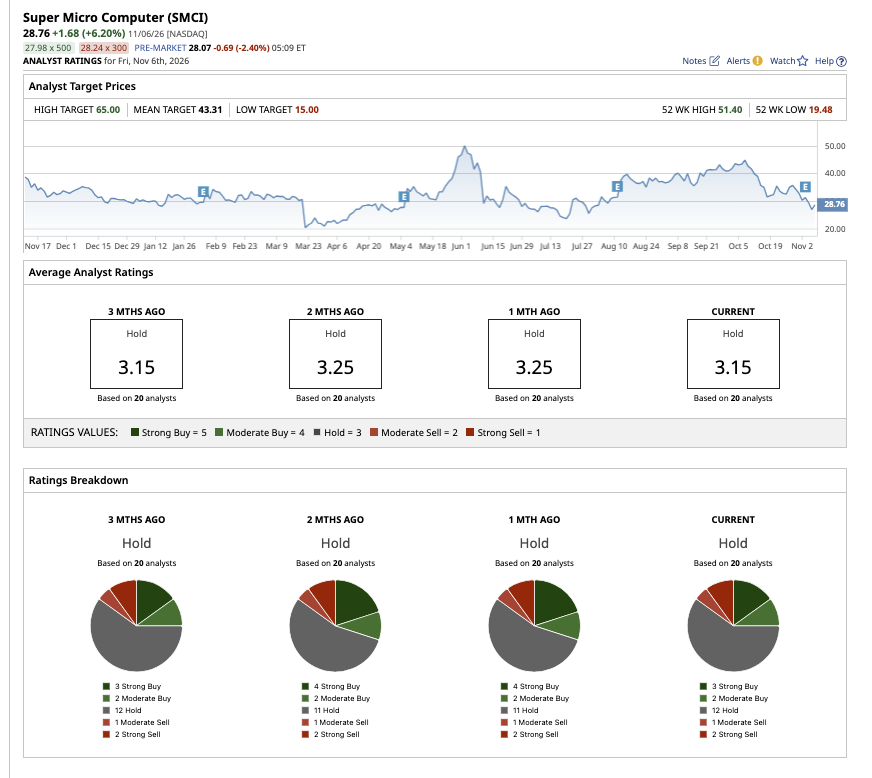
Wall Street currently rates SMCI stock as a “Hold.” Out of 19 analysts, two recommend it as a “Strong Buy,” two as a “Moderate Buy,” 12 as a “Hold,” one as a “Moderate Sell,” and two as a “Strong Sell.” The average price target is $42.44, which is 51.4% higher than the current price. The highest estimate is $65, pointing to a possible 127.3% increase over the next year.
On the date of publication, Sushree Mohanty did not directly have a position in any of the securities mentioned in this article. All information and data in this article is solely for informational purposes. For more information please view the Barchart Disclosure Policy here.