
Consolidated Edison (ED), Why Is Its Latest Update Drawing Attention?
Consolidated Edison (ED) just posted third quarter and nine month earnings, with higher reported sales, revenue, net income, and earnings per share than the same periods a year ago, putting fresh numbers behind the stock’s recent move.
That earnings beat comes amid a strong run for Consolidated Edison, with the share price at $119.28 after a 12.42% one-month share price return and a 19.29% year-to-date share price gain, while the 5-year total shareholder return of 81.10% points to momentum that has built steadily over time.
Scan how Consolidated Edison compares with other regulated utilities showing strong recent moves and solid finances through the curated list of solid balance sheet and fundamentals (24 results)
After a sharp move that has already rewarded existing holders, the real tension for new money into Consolidated Edison is simple: pay up at today’s price, or wait and risk the train pulling further away as the valuation case gets unpacked next.
Most Popular Narrative: 11% Overvalued
On the analyst consensus Narrative on Simply Wall St, Consolidated Edison screens on the expensive side, with a fair value estimate of $107.44 against the latest close at $119.28, so the current quote bakes in a premium to that model.
Planned infrastructure investment of about US$38b over the next five years and US$72b over the next decade at CECONY is expected to expand Consolidated Edison’s regulated asset base, which can support future revenue and earnings tied to that growing rate base. Customer requests for electric capacity that are roughly 20 to 25% above historical levels, with about two thirds of new large projects choosing all electric solutions, point to future load growth that can increase Consolidated Edison’s regulated revenues as those projects come online.
See why 3 investors see Consolidated Edison as 11% overvalued.
The Narrative ties that valuation back to a 7.24% discount rate, modest revenue growth assumptions and a target P/E multiple that sits below the current US Integrated Utilities average. Together these point to a view that Consolidated Edison is broadly fairly valued on earnings power but trading at a richer level than the modelled fair value. With analysts clustering around that $107.44 figure and the stock almost $12 above it, anyone considering the shares has to judge whether the grid investment and demand story justifies paying beyond what that forecast set implies.
Result: Fair Value of $107.44 (OVERVALUED)
Still, the story can break if New York tightens earnings sharing caps or if extreme heat forces higher reliability spending that squeezes Consolidated Edison’s returns.
Find out about the key risks to this Consolidated Edison narrative.
Another View on Consolidated Edison’s Valuation
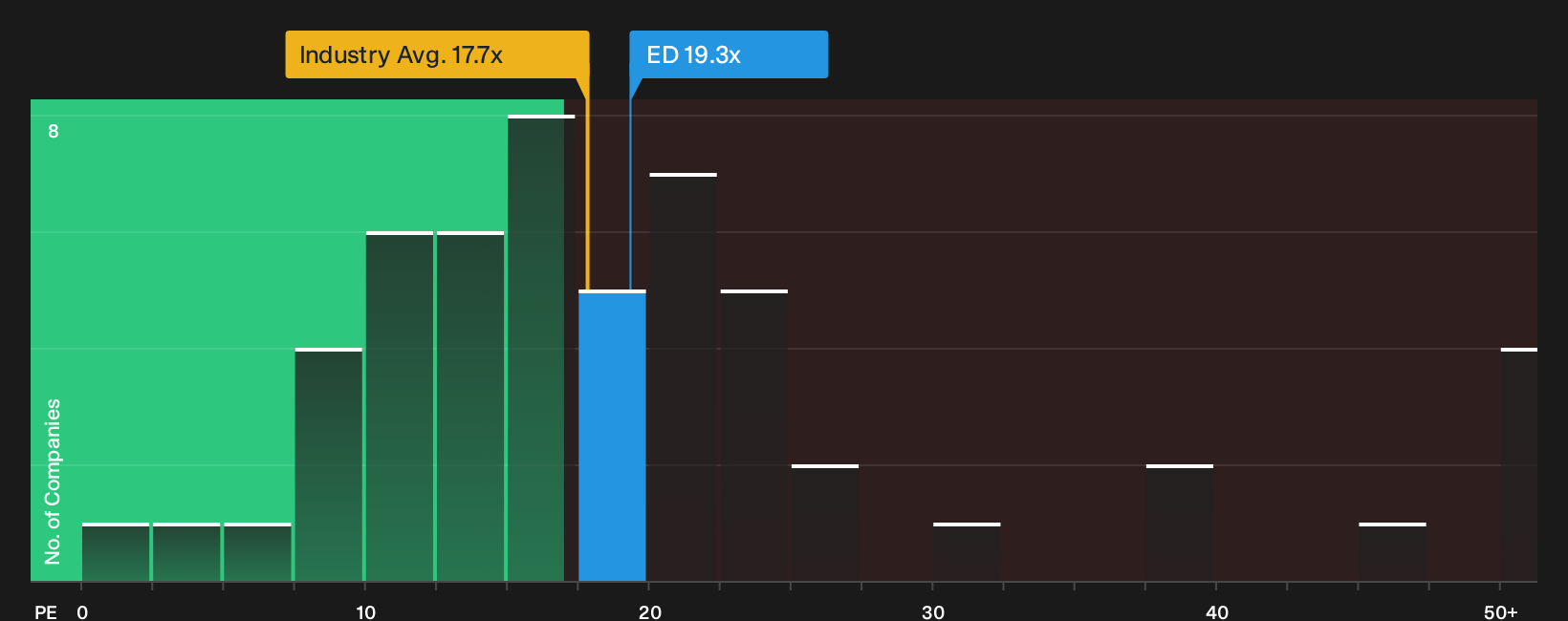
On simple P/E math, Consolidated Edison does not look as stretched as the $107.44 fair value implies. The stock trades on 19.3x earnings, below the estimated fair ratio of 21.5x and under the peer average of 21.2x, yet above the global integrated utilities group at 17.7x. That mix of slight premium globally but discount versus closer peers may leave investors weighing whether the risk now is paying too much or missing a market that moves toward that higher fair ratio.
For a closer look at how that ratio gap could close or widen over time, including what it might mean for future entry points, See what the numbers say about this price — find out in our valuation breakdown.
Next Steps
If the mix of earnings strength and valuation debate around Consolidated Edison feels finely balanced, that is the point. Weigh the upside and the weak spots for yourself by reviewing the 3 key rewards and 2 important warning signs.
Looking for more investment ideas beyond Consolidated Edison?
After weighing Consolidated Edison, you might consider broadening your opportunity set with a few focused stock lists that highlight different types of potential returns and risk profiles.
- Target companies with resilient balance sheets and steady fundamentals by scanning the curated list of solid balance sheet and fundamentals (24 results).
- Look for quality at a discount by reviewing the 35 high quality undervalued stocks that may align better with your price discipline.
- Prioritise income and durability by checking companies in the 5 dividend fortresses.
Have feedback on this article? Concerned about the content? Get in touch with us directly. Alternatively, email editorial-team@simplywallst.com