
UPS vs. FedEx: One has a Bigger Dividend. But Which Delivery Stock Has the Better Future?
Buying something from halfway around the world takes just a few clicks, but getting it to your doorstep is a whole different story.
Unlike 20 years ago, you can now buy items from almost anywhere in the world that was once hard to reach. Today, businesses sell products across borders, and consumers can buy anything from virtually anywhere. But the challenge is: how will that item move from Point A to Point B quickly, safely, and cheaply?
That is where logistics giants United Parcel Service (UPS) and FedEx (FDX) come in. These two companies fill that freight gap.
But for investors, it’s not just about meeting those demands. It’s about which company offers better long-term value.
UPS Stock: The Delivery Giant Behind the Brown Trucks
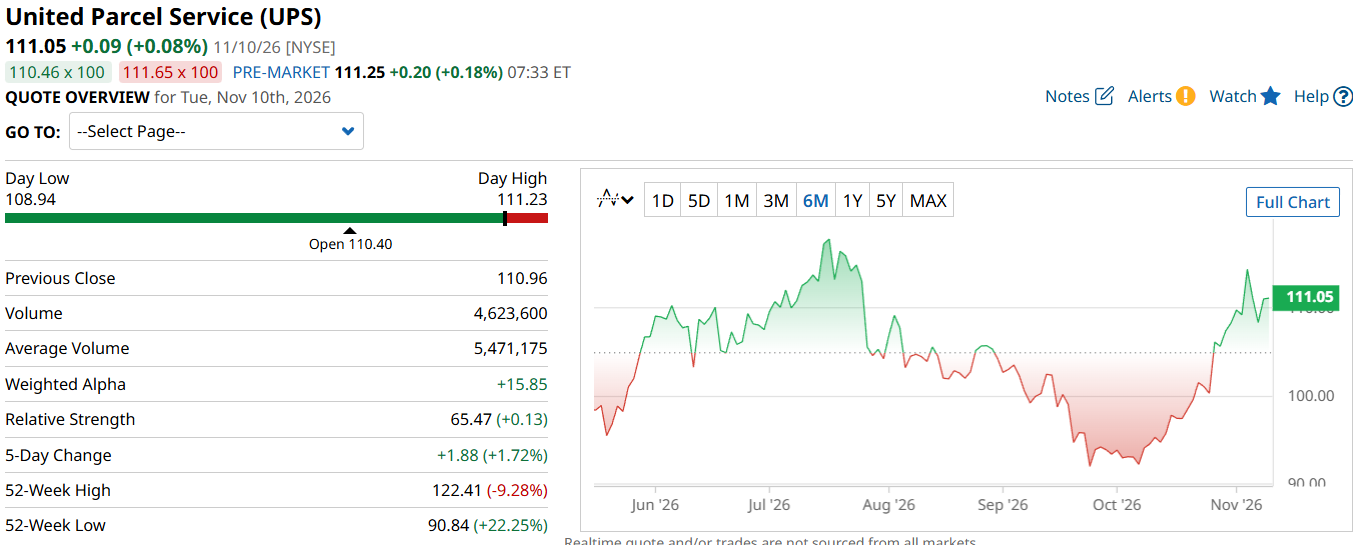
UPS is one of the world's largest logistics companies. You've probably seen its familiar brown trucks in your neighborhood, delivering almost any kind of package, from online purchases to important documents. That parcel on your doorstep is part of the company’s massive system, which includes cargo planes and sorting facilities.
The company’s network is expanding further with new logistics hubs around the world that connect more global trade lanes. Think of it as adding another interchange to a highway system, giving packages more efficient routes.
FedEx Stock: Delivering More Than Just Packages
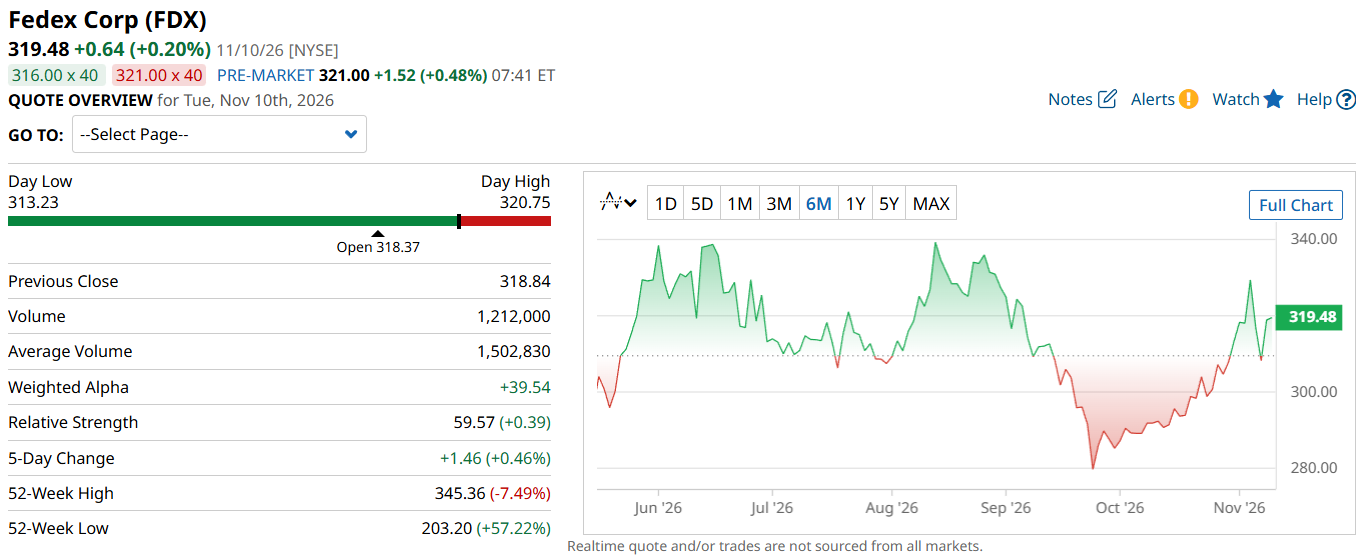
Of course, you've probably also seen FedEx's white trucks with their familiar purple-and-orange logo. Like UPS, FedEx is also a logistics titan that handles online orders and time-sensitive shipments. The company also runs a massive global air and ground network, making it UPS' fiercest competitor.
But FedEx is making behind-the-scenes changes, using robotics and predictive technology to streamline operations. For a company that handles millions of items, saving even a millisecond per package creates a massive difference.
UPS has traditionally been stronger in U.S. ground deliveries, while FedEx is better known for express and international shipping. But both are increasingly stepping into each other's territory. Let's see how that competition shows up in their financials.
UPS vs. FedEx: Which Stock Offers Better Value?
I used Barchart’s Stock Comparison Tool to see how these two stack up:
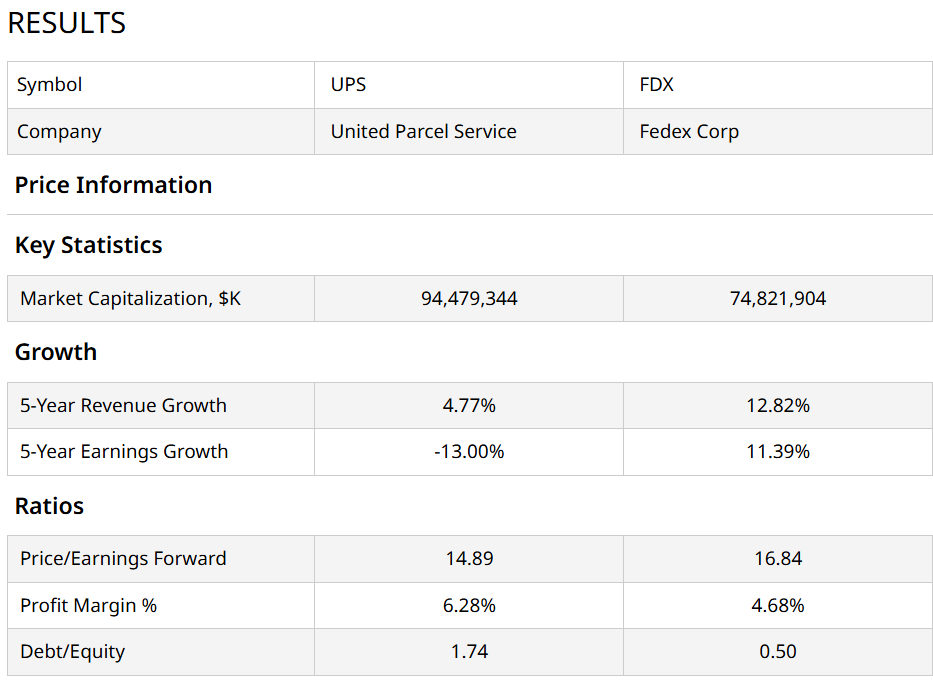
Starting with size, UPS leads with a market cap of about $94 billion, compared with FedEx’s $75 billion. However, size alone doesn’t mean it’s growing faster.
Over the past five years, FedEx’s revenue grew 13%, almost three times UPS’s 5%. The difference is even clearer in earnings: FedEx posted 11% growth, while UPS’s declined 13% over the same period.
One thing worth noting is that FedEx spun off its freight business, so its historical growth figures don’t fully reflect the company investors own today.
That said, UPS reported a higher net profit margin of 6% in 2025, compared with FedEx’s 5% in fiscal 2026, before the Freight spinoff. Put simply, UPS kept around $6 in profit for every $100 in sales, while FedEx kept $5.
FedEx, however, has an advantage in debt. Its debt-to-equity ratio is 0.50, less than a third of UPS’s 1.74, suggesting that the former has far more financial flexibility.
Valuation tips the scales back toward UPS, which trades at 15x forward earnings versus FedEx’s 17x. Both are also well below the S&P 500 Industrials sector’s 23x, making both stocks relatively cheaper than their sector peers.
So far, the scorecard keeps going back and forth like a ping-pong ball. But for income investors, dividends decide the winner.
UPS vs. FedEx: Which Stock Pays the Better Dividend?
Here’s how much value shareholders could expect from UPS and FedEx.
UPS pays investors $6.56 annually, translating to a yield of around 6%. But, its forward dividend payout ratio is 81%, suggesting most of its expected earnings would go to shareholder dividends.
FedEx takes a different approach. It pays a forward annual dividend of $4.88, which translates to a yield of around 1.6%. While its yield is modest, its estimated forward payout ratio is much lower at approximately 23%, leaving a lot more room for reinvestment and future dividend growth.
UPS vs. FedEx: Analyst Ratings and Upside Potential
Here’s Wall Street’s take
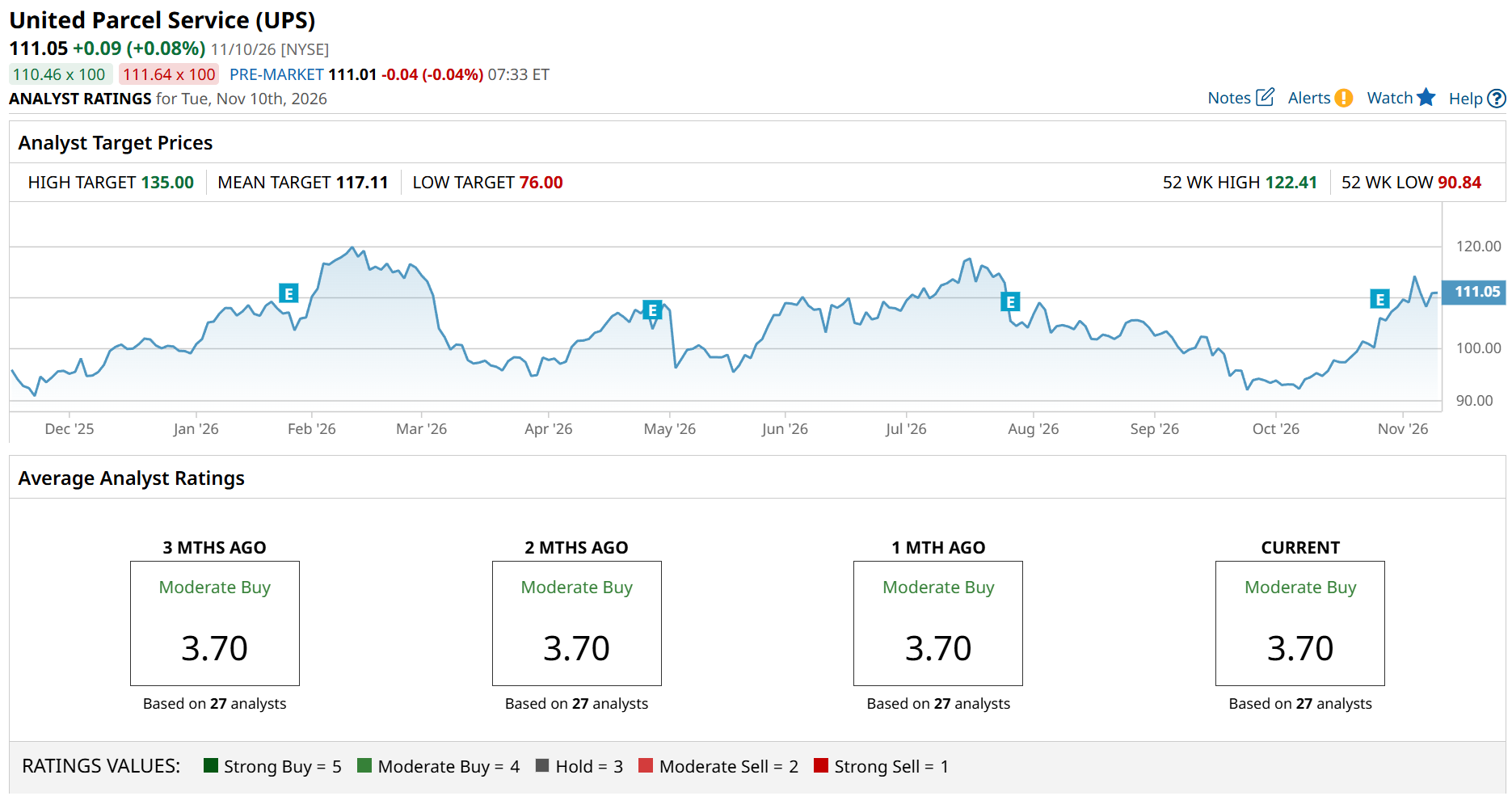
A consensus among 27 analysts rates UPS stock a “Moderate Buy”. Its high target prices suggest upside of ~22% over the next year.
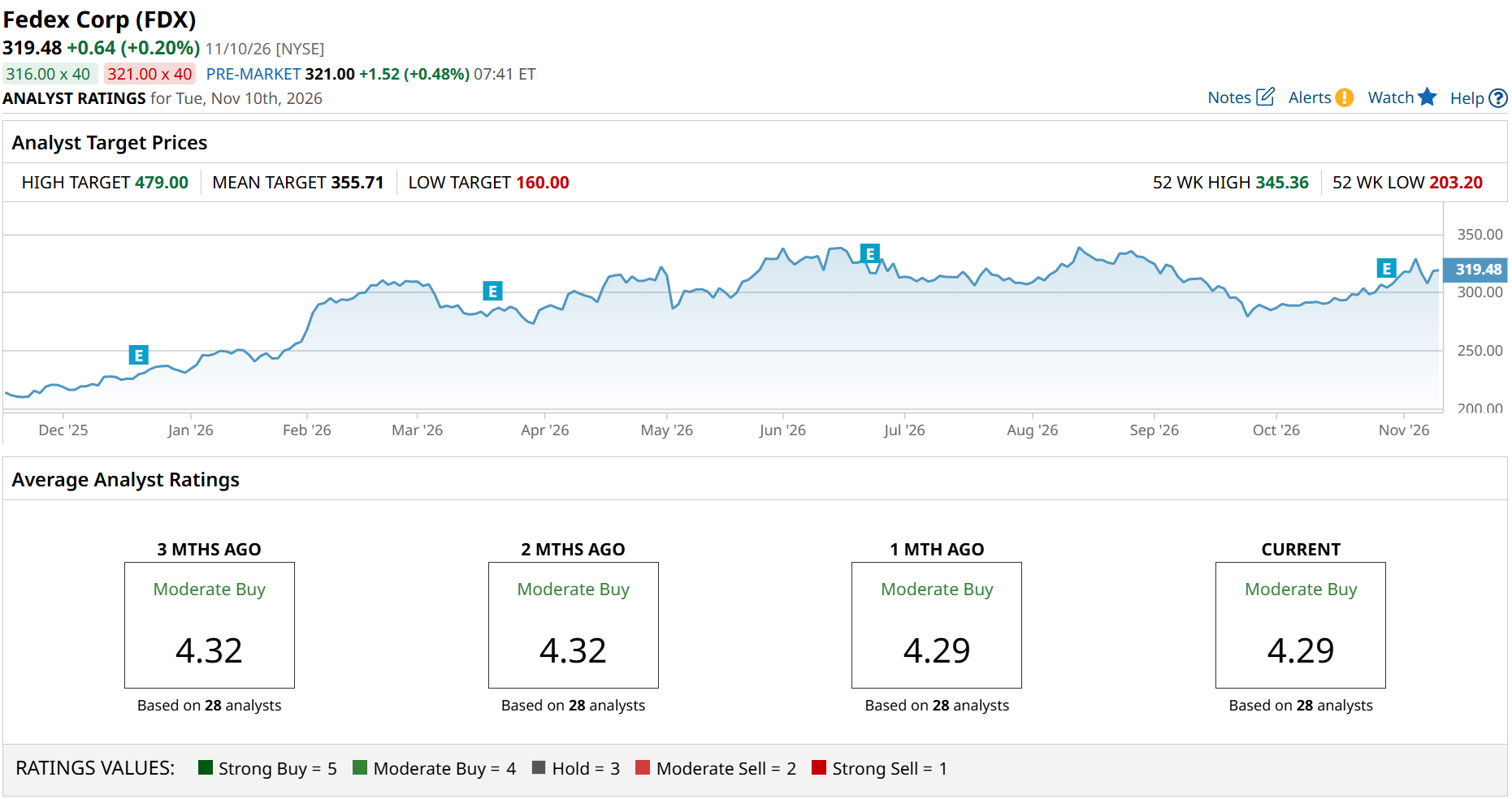
Meanwhile, a consensus from 28 analysts also rated FDX stock a “Moderate Buy”, but higher in terms of points, suggesting a more bullish stance. It has higher upside of 50% when high target prices are hit.
UPS or FedEx: Which Stock Offers Better Long-Term Value?
Online shopping, business shipments, and non-contact transactions will keep increasing, especially as we move toward more convenient personal and professional methods. That creates a strong opportunity for UPS and FedEx, which already have massive networks and initiatives to streamline operations.
But if I had to pick one today, I'd relax and buy FedEx. It is not just its stronger historical growth that gets me, but its dividends. Ironically, while it is modest compared to UPS, FedEx's payout ratio is more sustainable and has room to grow, unlike UPS, which raises long-term sustainability concerns.
On the date of publication, Rick Orford did not directly have a position in any of the securities mentioned in this article. All information and data in this article is solely for informational purposes. For more information please view the Barchart Disclosure Policy here.