
When Wall Street's “big rotation” was underway: AI trading declined, technology stocks “fell out of favor”, and capital migration flocked to the defensive sector
The Zhitong Finance App learned that analysts pointed out that the market is in a “state of alert” as investors shift from riskier technology sector bets to defensive stocks.
Technology stocks — a key force driving the stock market's rise in recent years — showed marked fluctuations in 2026. Concerns about artificial intelligence (AI), particularly in terms of capital expenditure, cash flow, debt, and revolving finance, have caused market turmoil several times this year.
Last week, the Democratic Party swept through Congress in the US midterm elections, further increasing pressure on the sector.
By the close of November 10, the Wall Street Nasdaq Composite Index, which is dominated by technology stocks, had risen about 7.9% since the beginning of the year, but recovered some of the year's gains in October, falling 5.3% in the same month. The index brings together large technology companies such as NVDA.US (NVDA.US), Microsoft (MSFT.US), Alphabet (GOOGL.US), and Apple (AAPL.US). It recently rebounded, but was still declining in November. It has fallen 1.5% so far this month, and once entered a pullback range last week.
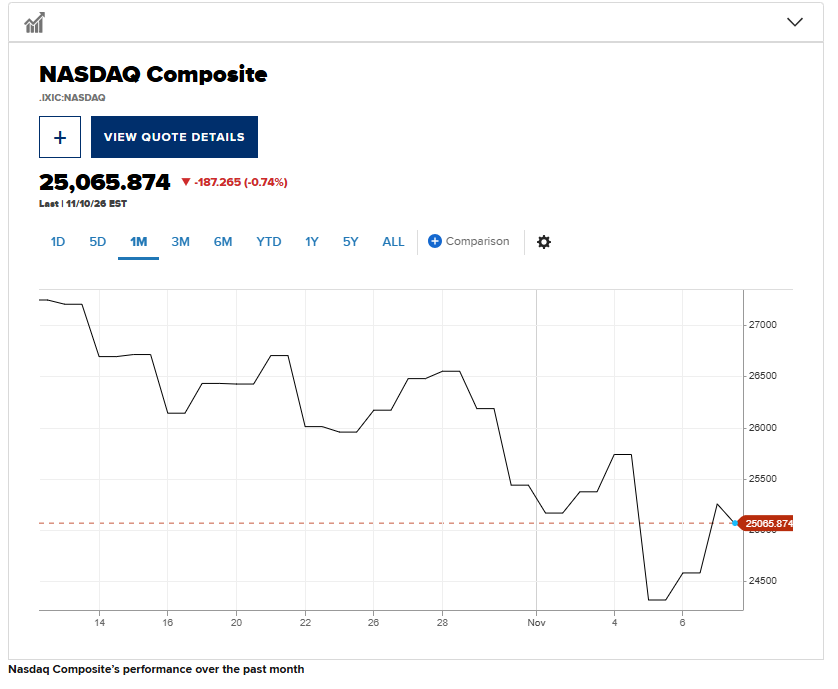
NASDAQ is not the only tech index to experience a sharp drop in the past month. Korea's Kospi Index is highly exposed to the semiconductor sector, falling 16.2% in October and falling more than 6% so far this month.
The MSCI Global Information Technology Index fell 7% in October, and has declined further by about 4% so far this month. The MSCI US Information Technology Index has declined by about 11% since October.
At the same time, individual stocks in the defense sector generally ushered in a rise.
MSCI indices covering the essential consumer goods, healthcare, and utilities sectors — which are widely regarded as stable assets in the stock market during times of market fluctuations or uncertainty — have all risen sharply over the past month.
Alastair Pinder, head of emerging markets and global equity strategy at HSBC, said in a report on Monday that recent stock market trends are “very drastic; in our opinion, they are excessive.”
Referring to the development of the AI industry, he said, “The market has calculated higher implementation risks and capital expenditure deferral expectations. The valuation of the US semiconductor sector has been cut by 45% since June. Currently, the 12-month forward-looking price-earnings ratio is only 13.5 times. How many negative points still need to be digested?”
He added that the overall fundamentals of the sector remain stable.
“The rotation of capital inflows into the defense sector has reached an extreme,” he pointed out. “Walmart (WMT.US)'s forward-looking price-earnings ratio has reached 40 times, approaching an all-time high; while Nvidia is only 13 times, close to an all-time low.”
AJ Bell investment director Russ Molde said that judging from the investor sector's position adjustments, the stock market is in a “state of alert.”
He wrote in Monday's research report: “This kind of sector rotation signal is significant and can provide a reference for stock selectors. As the old saying goes: weak stocks on strong tracks often perform better than good stocks on weak tracks.”
AJ Bell's analysis of the 11 tier 1 industry sectors in the S&P Global 1200 Index shows that since the second half of 2026, the energy sector has benefited from the US-Iran conflict boosting oil prices, leading the performance; the healthcare and essential consumption sectors are closely followed.
According to the data, the IT sector was the strongest performing sector in the first half of the year, with a cumulative increase of 28.4%; after moving into the second half of the year, it fell by more than 11%, making it the sector with the lowest performance.
Molde commented, “The IT sector fell from heaven to hell, from the best performing sector to the worst.”
“The energy sector is resilient; the essential consumption and medical sectors are also resisting the decline; the industrial sector is clearly weakening. These trends not only reflect the market's continued concern about next year's economic prospects, but also that investors are worried that the AI bubble is discouraging.”