
What Southwest Airlines (LUV) Revenue Momentum Means For Shareholders
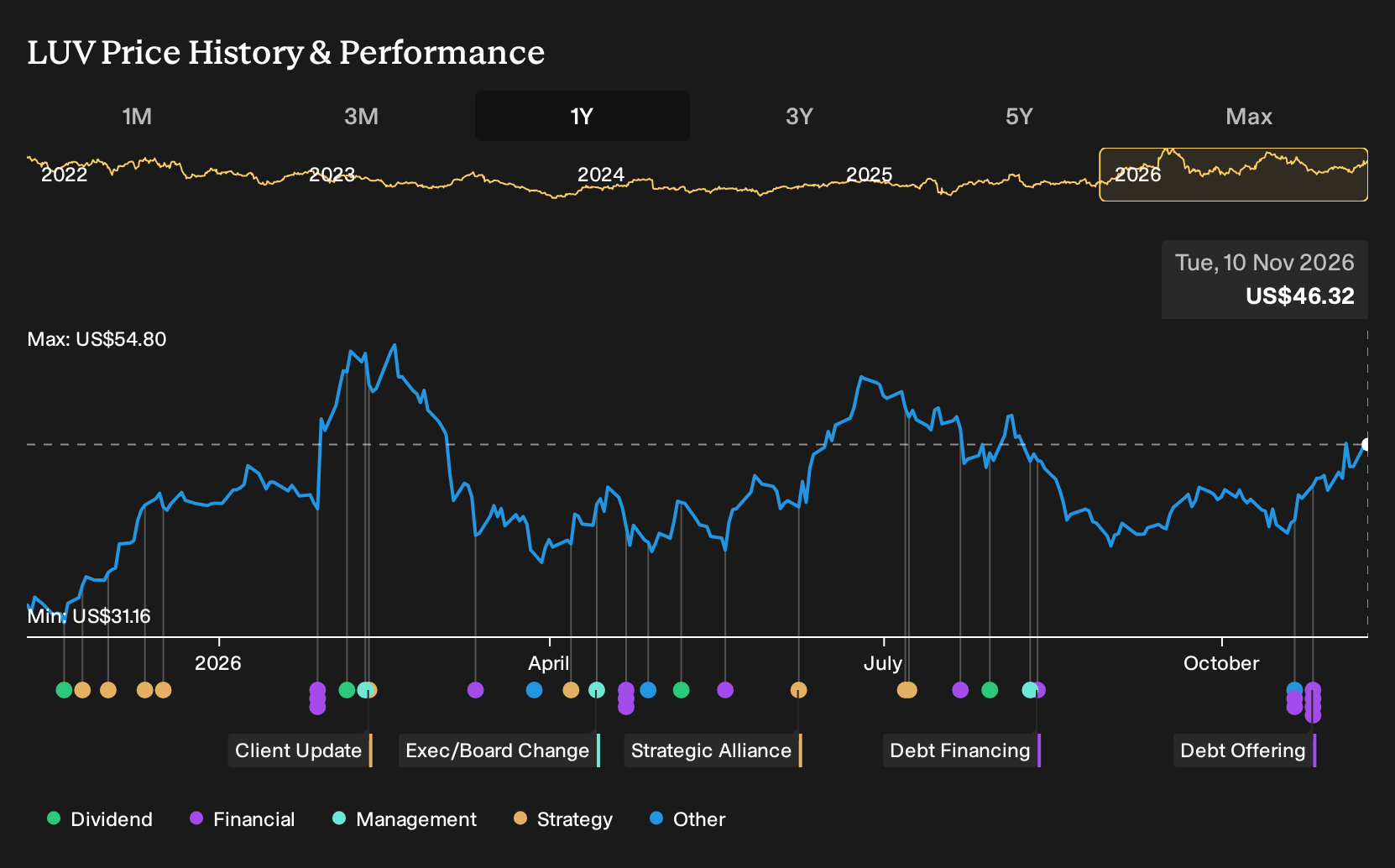
- Southwest Airlines recently saw stronger revenue momentum alongside solid consumer travel demand. This was supported by softer oil prices that eased some pressure on fuel expenses, while operational and labor costs remained elevated.
- The key tension for Southwest Airlines is that healthier top line trends and cheaper fuel are emerging at the same time that higher operating expenses and potential jet fuel volatility keep pressure on margins and execution discipline.
- We will now explore how Southwest Airlines' firmer revenue momentum, set against persistent cost pressures, could influence its broader investment narrative.
Scan for other travel stocks that may show similar demand strength and cost pressure dynamics by reviewing our curated list of list of solid balance sheet and fundamentals (24 results)
Southwest Airlines Investment Narrative Recap
To own Southwest Airlines, an investor needs to believe the carrier can keep solid leisure and business travel demand while holding unit costs in check. The most important short term swing factor is how fuel and non fuel expenses interact with this revenue momentum. The latest share price move on stronger sales and softer oil mainly reinforces that near term story.
The biggest current risk is clear. Higher jet fuel, already linked to geopolitical volatility, together with elevated labor and operational spending, could squeeze margins if fares or ancillary revenue do not offset them. If fuel costs stay unstable, the analyst consensus Narrative on Simply Wall St suggests cost discipline and product segmentation matter even more.
Recent focus on Southwest Airlines has centered on revenue strength against a backdrop of fluctuating fuel costs. That lines up closely with earlier commentary about cost pressure being a key swing factor for earnings. The move in the share price following the revenue momentum news shows how sensitive sentiment can be to any sign that higher demand might improve unit economics.
Those earlier catalysts, including new distribution through Expedia, product segmentation, and loyalty driven economics, still frame the operational story. The fuel related risks outlined by analysts now interact directly with these levers. Execution on cost savings, fleet efficiency and product mix has become the practical test of whether the recent revenue traction can translate into more resilient profitability.
Southwest Airlines' current analyst story points to revenues of $35.8b and earnings of $2.6b by 2029. That path assumes revenue grows at about 6.0% a year and that profits increase by roughly $1.8b from earnings of $837.0m today.
Explore how Southwest Airlines' fair value suggests a 7% potential upside to its current price before the market closes that gap.
Exploring Other Perspectives
Some of the most optimistic analysts frame the recent 4.61% move in Southwest Airlines around a single big swing factor. They see commercial execution as the real catalyst, not just cheaper fuel, and were already penciling in revenue of about $38.6b and earnings of $3.7b by 2029. Those projections were set before this news, so you may want to compare them with the more cautious consensus and decide which version of Southwest’s future feels more realistic to you.
Explore 4 other Southwest Airlines fair value estimates, including one that suggests as much as 114% potential upside from the current price.
Reach Your Own Conclusion
Disagree with existing narratives? Extraordinary investment returns rarely come from following the herd, so go with your instincts.
- A great starting point for your Southwest Airlines research is our analysis highlighting 3 key rewards and 1 important warning sign that could impact your investment decision.
- See our latest analysis for Southwest Airlines. The report includes a comprehensive fundamental analysis summarized in a single visual, the Snowflake, making it easy to evaluate Southwest Airlines' overall financial health at a glance.
Looking For More Investment Ideas Beyond Southwest Airlines?
If the Southwest Airlines story has sharpened your thinking about risk, return and balance sheets, it can be useful to compare it with other opportunities before making any decisions. The Simply Wall St Screener helps you scan the market for different profiles so you can build a watchlist that fits your own tolerance for volatility, income needs, and time horizon.
- If you are hunting for potential value opportunities with solid fundamentals, start with our curated set of 36 high quality undervalued stocks that may trade below what their underlying quality suggests.
- If resilience matters more to you than excitement, focus on companies with steadier financial profiles by filtering for 30 resilient stocks with low risk scores and stress testing how they might hold up through tougher conditions.
- If you are willing to take on more volatility in search of outsized moves, narrow your search to 9 elite penny stocks with strong financials that already show stronger balance sheets and healthier financial traits than the typical micro-cap.
Have feedback on this article? Concerned about the content? Get in touch with us directly. Alternatively, email editorial-team@simplywallst.com