
Enterprise Products Partners (EPD) Stock Looks Like A Bargain After Strong Earnings
Enterprise Products Partners has delivered a powerful run over the past few years, which naturally raises a simple question for investors who focus on the numbers: Is the current share price around its recent level asking too much of the partnership's earnings power or not enough?
- Over the last 5 years the stock has returned 128.1%. Anyone looking at Enterprise Products Partners today is effectively judging whether that kind of long stretch of gains is already fully reflected in what its earnings can support.
- Recent earnings results, record natural gas processing volumes and strong distributable cash flow all feed into expectations about how durable Enterprise Products Partners' profit base may be and how much income the partnership can keep funding without stretching its balance sheet.
- There is a second opinion on Enterprise Products Partners worth weighing. See what analysts think Enterprise Products Partners's shares could be worth.
The issue now is whether Enterprise Products Partners' current market price is adequately supported by the earnings it is generating today and is expected to produce over time.
If you want more context around whether Enterprise Products Partners' earnings profile and income track record fit your style, a focused stock screen is a clean next step. You can start with 5 dividend fortresses.
Does Enterprise Products Partners Look Undervalued on Earnings?
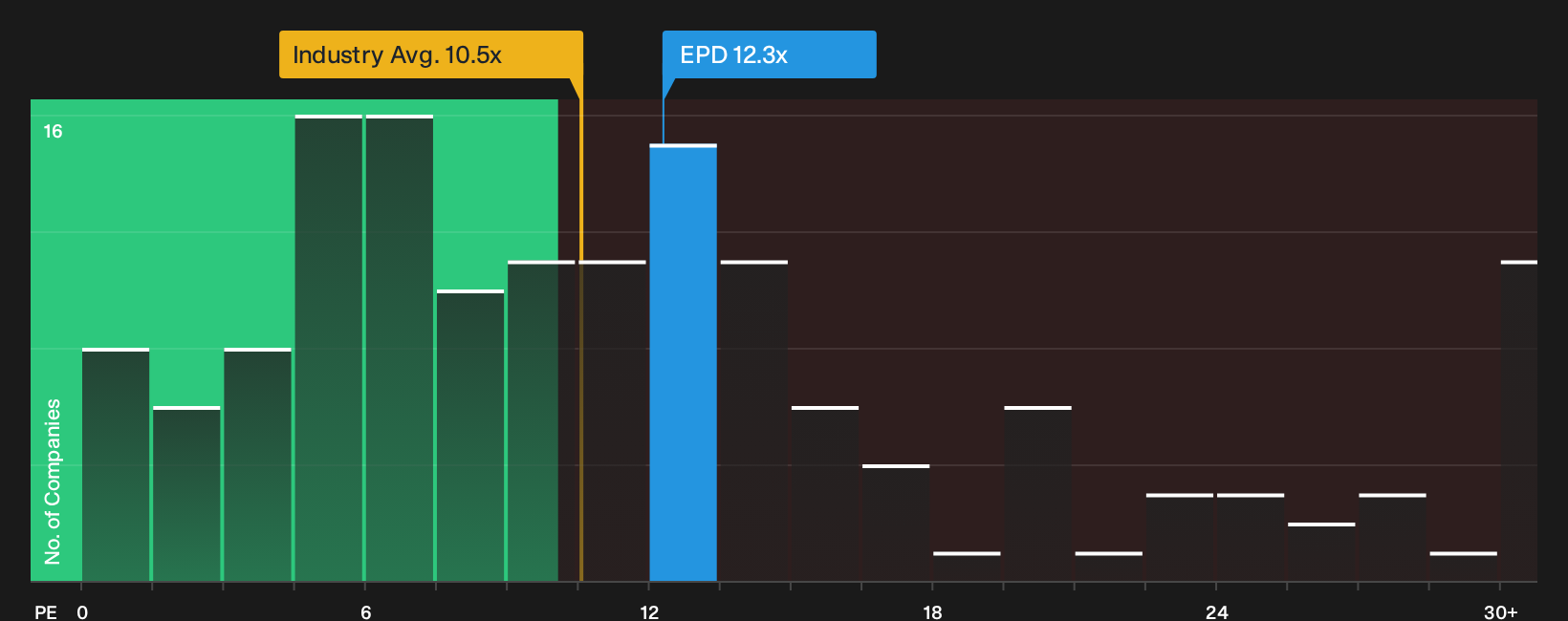
The P/E ratio suits Enterprise Products Partners because earnings remain a core anchor for how investors assess its partnership structure and cash generation. On this measure, the stock trades on a P/E of 12.3x, which is above the Oil and Gas sector average of 10.5x yet below the peer group at 21.1x. That mix suggests the market is giving the partnership some credit versus the wider industry, but not valuing it in line with higher-rated peers.
The latest quarterly report showed solid earnings and strong distributable cash flow coverage. Within that context, a tailored valuation framework points to a higher P/E as a reasonable reference, and the current 12.3x sits below that implied level. The gap indicates investors are still applying a discount to Enterprise Products Partners relative to what its earnings profile and risk mix might support over time. To judge whether that discount is appealing, you would need to weigh the stability of fee based volumes, exposure to the Permian and NGL infrastructure, and how consistently those factors can support cash flows through a full cycle. Explore the numbers behind Enterprise Products Partners's P/E valuation.
The Enterprise Products Partners Narrative: What Would Justify Today's Price?
Simply Wall St Narratives pick up where Enterprise Products Partners' P/E puzzle leaves off by spelling out which growth, margin and earnings paths would need to hold for the units to be worth materially more or less than today's quote. Each scenario links a fair value estimate to a clear story about Enterprise Products Partners' potential catalysts and key risks so you can track over time which version of events appears to be unfolding on the Community page.
One of the top narratives on Enterprise Products Partners: 10% undervalued
This Narrative is the analyst consensus Narrative on Simply Wall St, which compiles analysts' consensus price target and revenue and earnings forecasts, not one person's view.
"The main thing that has to go right is that higher growth capex in the Permian and related NGL infrastructure converts into sustained, high-utilization volumes..."
Discover why this Narrative puts Enterprise Products Partners at 10% undervalued.
Enterprise Products Partners valuation leaves one crucial issue unresolved
Enterprise Products Partners may look compelling on earnings and income, yet Simply Wall St's broader checks have highlighted specific risk signals that deserve a closer look before you decide how to treat the units. Take a closer look at 2 warning signs before settling on a valuation.
Have feedback on this article? Concerned about the content? Get in touch with us directly. Alternatively, email editorial-team@simplywallst.com