
At a time when technology stocks fluctuate sharply, hedge fund bosses warn that crowded “decentralized transactions” may become an “amplifier” of market fluctuations
The Zhitong Finance App learned that at a time when global technology stocks are shaking sharply, a popular Wall Street transaction that relies on individual stock differentiation to profit is facing the risk of the market resynchronizing fluctuations. Will Bartlett, CEO of Parallax Volatility Advisers, warned that Equity Dispersion Trade (Equity Dispersion Trade) has become a “time bomb.”
“Decentralized trading is a time bomb that is counting down,” Will Bartlett, CEO of Parallax Volatility Advisers, said during a panel discussion at the Bloomberg Volatility Forum in New York. “It's only a matter of time before it really explodes.” The top Wall Street hedge fund manager said investors who are enjoying the golden age of decentralized stock trading should be prepared to deal with possible losses in the event of a sudden shift in the market.
The traditional bet of decentralized trading is that a basket of stocks or indices such as the S&P 500 will remain stable, while individual stocks within the index fluctuate more amplitude and direction. This year, as the correlation between stocks declined, this strategy was favored by portfolio managers under multi-strategy investment firms.
Technology stocks alternated between sharp declines and rebounds. The popular strategy of relying on individual stock trends to differentiate profits is revealing sensitivity to simultaneous market fluctuations. The reason why Bartlett described decentralized trading as a “time bomb” is mainly because such strategies usually buy individual stocks and fluctuate sales indices, benefiting from a low-correlation environment where the rise and fall of different stocks offset each other; once the Fed's interest rate is revalued, AI bull investment expectations change, or concentrated deleveraging drive stocks to fall simultaneously, and index fluctuations rise rapidly, the losses of bears on the index side may exceed the long-term gains of individual stocks.
What is more noteworthy is that crowded positions and similar risk control rules may turn initial strategic losses into mutually reinforcing pressure to close positions: some teams take the lead in exiting, changing the relative price of options, and then triggering other teams to reduce their positions. These potentially negative dynamics mean that in addition to the index rebound and volatility falling back, the market also needs to test whether low correlation performance continues and whether liquidity is acceptable during centralized exits; once these two supports weaken at the same time, transactions that originally relied on differentiation for profit may become an amplifier for a new round of market shocks.
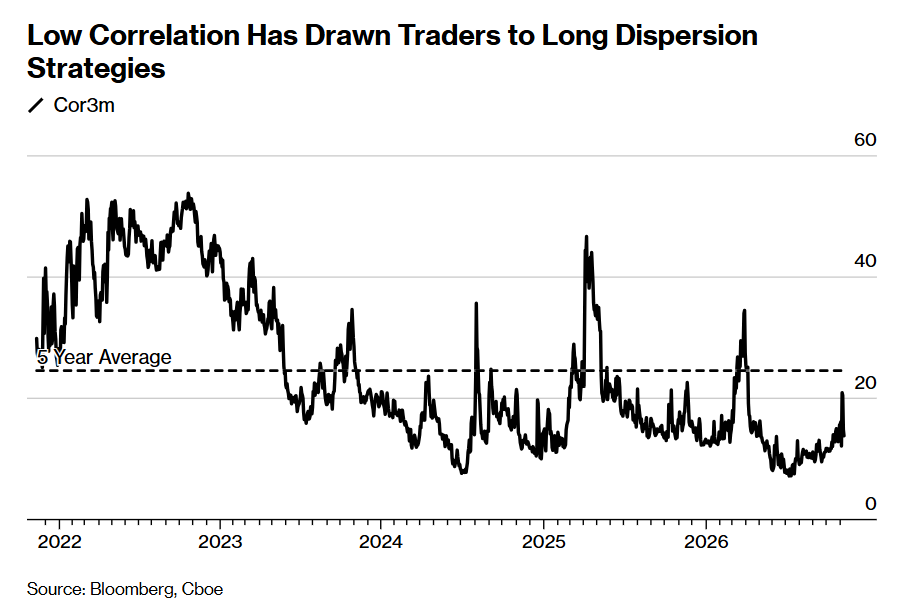
As shown in the chart above, low correlation attracts traders to use diversification strategies that go long.
“Many people who are participating in this deal have never experienced the situation when it was reversed,” Bartlett said. He compared the current market environment to the eve of the Eurozone debt crisis in 2011.
“I saw this situation in 2011, after the financial crisis. At the time, decentralized trading became extremely popular, and some people we call volatility trading 'tourists' entered the market and shorted the correlation in various inappropriate ways. In the end, this deal crashed extremely violently.”
The correlation between individual stocks bottomed out in the middle of this year, and although it has rebounded since then, it is still far below average. Since individual stock trends cancel each other out, this helped to reduce exponential volatility.
A study published earlier this year by hedge fund Adapt Investment Managers explores the issue of transaction congestion. The company envisioned a scenario where multiple multi-strategy investment teams held the same deal, and one of the smaller teams cleared the position, triggering a domino effect affecting the larger team and intensifying market shock during the deal cancellation process.
“Yes, the correlation has always been extremely low, and it still is. But if correlation does rise significantly, I think decentralized trading will suffer significant losses,” Bartlett said.
Tech stocks have plummeted and surged, and Wall Street's “low correlation dividend” is being tested
Will Bartlett, CEO of Parallax Volatility Advisers, focuses on two points: long-term low correlation between individual stocks has attracted large amounts of capital, and crowded positions and similar stop-loss mechanisms may magnify strategic losses into chain liquidation when correlation suddenly rises.
Recent market conditions have revealed a rapid shift between individual stock differentiation and common shocks. On November 5, the Nasdaq 100 index fell sharply by 6.36%, the biggest one-day decline since March 2020. The total market value of constituent stocks evaporated about 2.3 trillion US dollars, and the Philadelphia Semiconductor Index fell 12.25%; on November 9, the two major indices rebounded by 3.40% and 6.85%, respectively. The market tends to focus on the policy and return pressures faced by trading AI investments first, and then re-evaluate previous pessimistic expectations.
However, the general rebound did not eliminate individual stock differentiation: on November 9, AMD rose about 13.3%, Broadcom rose about 8.8%, and Nvidia fell by about 4.3% due to company-specific investigation news. This kind of fluctuation in different directions is the trading environment that decentralized strategies focus on.
However, the subsequent inflation data presented a common risk — the core CPI rose 0.3% month-on-month in October, exceeding expectations of 0.2%, the market began to take into account the possibility of a 50 basis point rate hike in December, and increased aggressive bets on a cumulative total of three 25 basis point rate hikes up to mid-2027. Judging from the transmission mechanism, if interest rate revaluation continues to depress the valuations of different companies, the market, which was originally dominated by financial reports, orders, and corporate events, may shift to a more simultaneous rise and fall.
Fluctuations in buying individual stocks and fluctuating sales indices: how can the same shock break through fragmented transactions
A typical diversification strategy is the volatility represented by buying component stock options and selling index options at the same time. When individual stocks rise and fall sharply and the direction offsets each other, the index can remain relatively stable; the strategy thus obtains relative profit opportunities between individual stock fluctuations and index fluctuations.
Common structures listed on Cboe's official platform are buying countervailing cross-modal options for constituent stocks and selling peer-valued cross-modal options on the S&P 500 index. This type of combination usually bears exposure related to shorting, and the final profit and loss also depends on the opening price, weight of both ends, and subsequent fluctuations.
The risk behind it is that even if the fluctuation of individual stocks themselves does not increase significantly, as soon as they begin to rise and fall more synchronously, index fluctuations may rise significantly. When macro shocks link different stocks, sold index options may rapidly appreciate in value, and losses exceed the compensation provided by individual stock options held. Bartlett mentioned his experience before the European debt crisis in 2011, and emphasized this correlation change: investors who have relied on diversification to profit for a long time may underestimate the rate of loss when the market suddenly shifts to simultaneous fluctuations.
Overcrowded positions will further amplify the impact. ADAPT Investment Managers envisioned in the study that price changes caused by multiple independent investment teams holding similar transactions and small teams taking the lead in clearing positions may trigger risk limits for larger teams, leading to continuous withdrawals. This mechanism is applied to decentralized transactions. Closing positions usually involves buying back short index volatility and selling multiple stocks. These transactions may further worsen the valuation of other similar combinations and drive the “loss - position reduction - price shock - more loss” cycle. Its first impact is the relative pricing and liquidity of options, which cannot be directly equivalent to all participants selling stock in stock at the same time.
For stock investors, the key takeaway is that holding positions across different companies does not mean avoiding common interest rates, financing, and AI capital expenditure risks. As of November 10, VIX has fallen back to 19.46, but it measures the expected fluctuations in the S&P 500 index, and does not directly measure individual stock correlation or crowding. To determine whether such risks have been mitigated, it is necessary to simultaneously observe the degree of simultaneous stock fluctuations, the relative pricing of indices and individual stock options, and the market's ability to bear when closing positions. What Bartlett issued is still a risk warning, and the available information is not enough to conclude that the recent decline in technology stocks has been dominated by scattered trading bursts.