
RHÖN-KLINIKUM (XTRA:RHK) The Latest Update Leaves An Interesting Question
RHÖN-KLINIKUM (XTRA:RHK) just posted nine month 2026 earnings that showed higher sales, revenue and net income than a year earlier, putting fresh financial results in focus for shareholders.
Against that earnings backdrop, RHÖN-KLINIKUM’s share price has climbed year to date with a 12.4% gain, and the current €14.50 level comes after a period where the 1 year total shareholder return of 22.8% contrasts with a softer 3 month share price performance that hints at some cooling momentum.
Spot other hospital and healthcare stocks that show a similar mix of earnings momentum and market hesitation by scanning our curated list of solid balance sheet and fundamentals (194 results).RHÖN-KLINIKUM now trades a little above the average analyst target, yet only slightly above one estimate of fair value. Is the recent caution in the share price overdone or exactly the point?
Price-to-Earnings of 23.1x: Is it justified?
RHÖN-KLINIKUM now carries a P/E of 23.1x, and at a last close of €14.50 that valuation looks richer than both peers and one fair value estimate.
The P/E ratio compares the current share price with earnings per share and gives a snapshot of how much investors are paying for each euro of profit. For a hospital operator like RHÖN-KLINIKUM, that matters because earnings often move with capacity utilisation, case mix and reimbursement structures rather than sharp cyclical swings.
Here, the market is putting a higher tag on those profits. RHK is described as expensive versus its estimated fair P/E of 18.6x, a level the share price could gravitate toward if sentiment cools. The same pattern appears when set against the European Healthcare sector on 18x and a peer average of 18.5x, which means investors are currently paying a clear premium for the company’s earnings.
Explore the SWS fair ratio for RHÖN-KLINIKUM.
Result: Price-to-Earnings of 23.1x (OVERVALUED)
Still, RHÖN-KLINIKUM’s richer P/E and its recent softer 3 month share move leave the narrative exposed if earnings momentum stalls or if regulatory pressures on reimbursement build.
Find out about the key risks to this RHÖN-KLINIKUM narrative.
Another View: What Our DCF Model Says About RHÖN-KLINIKUM
The P/E ratio presents RHÖN-KLINIKUM as expensive. Our DCF model offers a different perspective. At €14.50, the share price sits about 2.6% below an estimated future cash flow value of €14.89, which points to mild undervaluation instead of a clear premium. So which lens do you trust more?
Look into how the SWS DCF model arrives at its fair value.
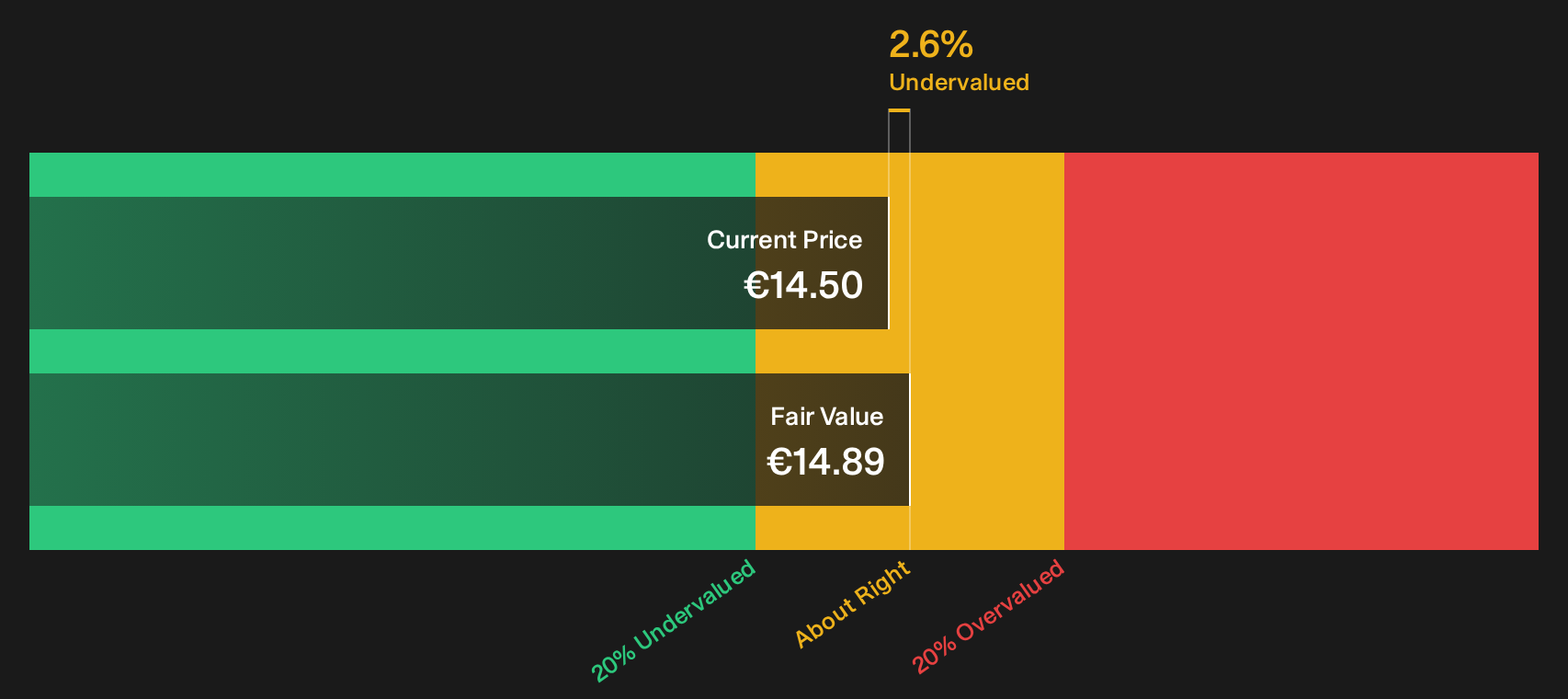
Simply Wall St performs a discounted cash flow (DCF) on every stock in the world every day (check out RHÖN-KLINIKUM for example). We show the entire calculation in full. You can track the result in your watchlist or portfolio and be alerted when this changes, or use our stock screener to discover 200 high quality undervalued stocks. If you save a screener we even alert you when new companies match - so you never miss a potential opportunity.
Next Steps
Mixed messages on RHÖN-KLINIKUM so far, or a clear signal hiding in plain sight. If you want to move quickly and test the story against the underlying data, take a few minutes to review the 3 key rewards.
Looking for more investment ideas beyond RHÖN-KLINIKUM?
Do not let your research stop with a single hospital operator when a wider watchlist could reveal more balanced income, value and quality opportunities today.
- Target steadier compounding potential by reviewing companies that screen as lower risk and financially resilient through the 204 resilient stocks with low risk scores.
- Hunt for strong businesses that trade below their assessed worth by scanning the 200 high quality undervalued stocks and comparing valuation against balance sheet strength.
- Build an income focused shortlist by checking which mature businesses land in the 216 dividend fortresses and align with your return and risk preferences.
Have feedback on this article? Concerned about the content? Get in touch with us directly. Alternatively, email editorial-team@simplywallst.com