
Feel the lethality of the “killing line” of inflation: the average price of a new car broke 51,000 US dollars, and the increase in baby food set a record! Fed rate hike forecast extended to 2027
The Zhitong Finance App learned that from a new car with an average price exceeding 51,000 US dollars to baby food and formula, which increased the price of 5.1% in a single month, American consumers are still facing extensive inflationary pressure. This is why the release of CPI inflation data exceeding expectations on Tuesday evening Beijing time has reignited market discussions about the upcoming “50 basis point hike” of the Federal Reserve's “interest rate hike by 50 basis points,” which in turn led to the three major US stock indices closing down on Tuesday after experiencing a short-term rebound.
According to statistics compiled by the agency, the average transaction price of new cars in the US rose to a record high of 51,109 US dollars in October, yet car sales have cooled down, which is enough to show that the ability of high-income consumers to buy high-priced models is still supporting the profits of car companies; the increase in the price of infant food directly squeezes necessary expenses that are difficult for families raising children to cut.
The extreme fragmentation of consumer trends described above and CPI data that exceeded expectations mutually confirmed the market's focus of attention from “whether the Federal Reserve will raise interest rates further in December” to “whether the rate hike will expand to 50 basis points, and whether the tightening of monetary policy will continue until 2027.” The bullish sentiment in US stocks was thwarted as a result. In particular, technology stocks represented by the Nasdaq 100 Index experienced a strong rebound last Friday and Monday, and then came under pressure to revalue interest rates again on Tuesday.
The stickiness of US inflation can be seen simultaneously on car showrooms and family tables: the average transaction price of new cars rose to a record level of 51,109 US dollars in October, but sales have slowed, reflecting that demand for high-priced models can still support car companies' profits; the 5.1% month-on-month increase in the price of baby food and formula further squeezes the necessary expenses that are difficult for families raising children to cut. Against the backdrop of the core CPI rising 0.3% month-on-month for three consecutive months, Federal Reserve Governor Waller included the December interest rate hike by 50 basis points in discussions, and the market also began to increase bets on the Fed's FOMC continuing to push forward interest rate hikes in 2027. 50 basis points are not yet mainstream expectations, but more prolonged austerity has put new pressure on asset pricing.
Tech stock rebound meets inflationary resistance: the market begins to reassess the 2027 interest rate path
Previously, as of the close of trading in the US East on November 5, the Nasdaq 100 index fell sharply by 6.36%, the biggest one-day decline since March 2020. The total market value of constituent stocks evaporated about 2.3 trillion US dollars, setting a single-day loss record; the Philadelphia Semiconductor Index fell 12.25%. The two major indices cumulatively declined by about 4.91% and 12.15%, respectively, last week. After the Democratic Party gained control of both houses of the National Assembly, investors feared that AI regulation, data center approval, and electricity cost sharing requirements would become stricter, which might delay delivery of computing power and the fulfillment of return on investment; this change in expectations met with congested positions, and then expanded through a systematic reduction in positions, leading to a sharp sell-off.
Since then, US technology stocks rebounded on November 6. On November 9, falling oil prices and the easing of pessimistic AI expectations drove a general rebound in technology stocks. The Nasdaq 100 rose 3.40%, and the cost half rose 6.85%. However, after the CPI was announced on Tuesday, the Nasdaq 100 and Fee Half closed down about 0.60% and 0.35%, respectively. It is worth noting that the extent of this decline was clearly moderate. VIX also dropped from 19.92 to 19.46, which largely indicates that the market is re-evaluating the pressure on the Fed's interest rate path and has yet to repeat the panic sell-off of last Thursday.
US prices continued to rise in October. Although the overall CPI increase narrowed, it was still higher than the market's unanimous expectations; the core CPI increase remained at 0.3% for three consecutive months, not falling back to 0.2% as expected by economists, highlighting that the price pressure after excluding food and energy was still sticky, providing a basis for the Federal Reserve to continue to raise interest rates.
The overall US CPI unexpectedly rose 0.4% month-on-month in October, lower than 0.6% in September, but higher than market expectations of 0.3%; core CPI rose 0.3% month-on-month, higher than expected 0.2%, maintaining this growth rate for the third month in a row. Housing, food, electricity and car insurance rose 0.3%, 0.5%, 0.9%, and 0.7%, respectively. Due to the lack of a comparative base due to the government shutdown last year, the government did not release overall and core CPI year-on-year data.
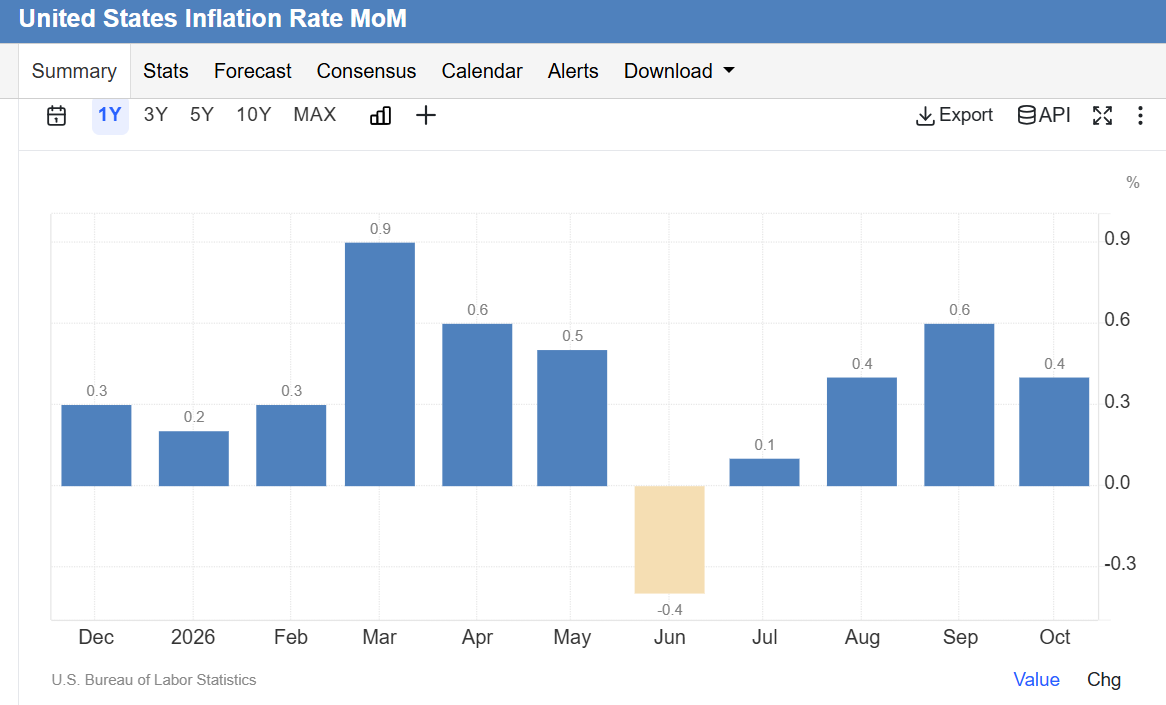
Notably, before the data was released, Federal Reserve Governor Waller said that even if inflation improves, he is inclined to support the December interest rate hike of 25 basis points; if the core CPI still rises by about 0.3% or more, 50 basis points should be considered. The data released later reached the discussion threshold he proposed. CME pricing data quoted by some media closing reports showed that interest rate hikes of at least 25 basis points in December were 100% fully included in the market price by interest rate futures traders. The probability of 50 basis points rose to 11.8%, and there was almost no pricing the day before.
What is more noteworthy is the duration of the austerity. Traders have increased their bets and are expected to implement a total of three 25 basis point rate hikes between now and 2027, more than the two before the data was released. Deutsche Bank also added another rate hike in January next year between the original forecast for December and next March. The target interest rate is expected to rise to 4.50% to 4.75%. Lindsay Rosner, a senior strategist at Goldman Sachs Asset Management, believes that stubborn inflation means further interest rate hikes cannot be ruled out in 2027; Seema Shah of Xin'an Asset Management believes that the current evidence is not enough to make 50 basis points the preferred solution.
From car showrooms to baby tables, stubborn inflation continues to sweep the US
In October, the price of new cars surpassed the overall level of inflation, and the average price rose to a record $51,109, indicating that automakers are still willing to sacrifice sales to increase profit margins.
Industry research firm Cox Automotive said on Tuesday that despite the slowdown in new car sales in the US last month, the average transaction price still rose 2.1% year over year. Automakers have raised sales prices, while consumers continue to buy more expensive, high-margin models such as full-size pickups and SUVs.
Cox quoted data from the Kelly Blue Book as saying that the average recommended retail price for new cars announced by automakers rose 2.4% year over year to $52,933.
According to the latest inflation data released on Tuesday, the overall increase in consumer prices last month exceeded expectations, triggering market concerns that the Federal Reserve will raise interest rates to control prices and drive down stock and bond prices.
Apart from wealthy consumers, affordability issues continue to plague most consumers. This is also one of the factors that enabled the Democratic Party to win a significant majority of seats in the US Senate and House of Representatives in the midterm elections last week.
However, many financially well-off buyers show little sign of putting off their next car purchase. This helps car manufacturers and dealers maintain profits in the face of slowing sales and avoid offering big promotional offers.
Elin Keating, senior Cox analyst, said in a webcast: “The decline in retail sales has indeed made it difficult to operate, but profits are still there. “Consumers keep coming to buy more expensive models.”
New car sales in the US fell to an annual rate of 15.5 million units last month, down from 16 million units in September, indicating that some consumers are beginning to be discouraged by excessive prices. Increased sales to car rental companies and corporate fleets also supported car sales in October.
Cox chief economist Jeremy Rob said, “This sales rate is significantly lower than previous levels, and lower than our forecasts.” He said that “there has been a considerable increase in fleet sales”, offsetting the weakness in the car retail market.
Also last month, the price of baby food and formula recorded the biggest increase on record, further increasing the financial burden on families with young children.
According to data released by the US Bureau of Labor Statistics on Tuesday, the price of baby food and formula in the US rose 5.1% in October. Prices for other necessities and services such as groceries, car insurance, daycare services, rent, and electricity also rose during the month.
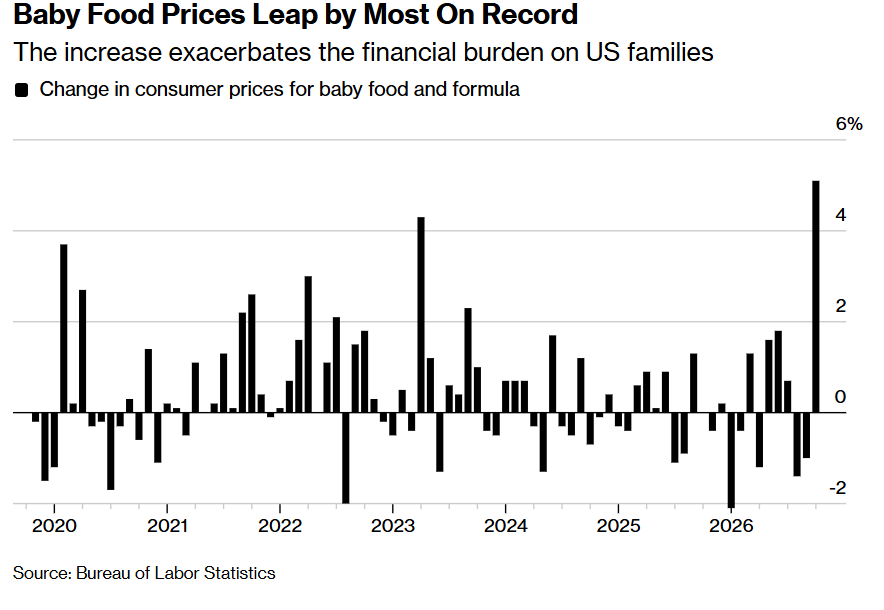
As shown in the chart above, the price of baby food hit the biggest increase on record — an increase that further increased the financial burden on American households. Source: US Bureau of Labor Statistics.
Darren Sever, vice president of research and insight in the field of home, family and infants at Nielsen IQ, said that the rise in formula prices may be driven by a combination of factors, including rising raw material costs, rising transportation prices, and a shrinking birth population. The US Bureau of Labor Statistics declined to further explain what factors might have contributed to the price increase shown in its data.
As the industry faces product contamination and cost issues, infant formula manufacturers are always looking for ways to divest this part of the business.
Abbott, which sells Similac brand formula, said in October that it would split its nutrition business. In 2022, an Abbott plant in Michigan caused a nationwide shortage of formula due to inadequate hygiene conditions. Meanwhile, Perrigo said it plans to sell its infant formula business to a company formed by ByHeart executives. ByHeart is a manufacturer of infant formula whose products caused babies to develop botulism last year.
Baby foods have also been scrutinized for their high levels of heavy metals. However, the “Consumer Report”, which tests various products and services, said that recent tests showed that companies have made progress in reducing these levels.
Sever said, “Infant formula is a category where families don't buy less just because of rising prices. They'll consider which brand to buy. Can you buy a smaller package and still be able to handle it?”
How is the fragmentation of US consumption dragging down the process of cooling inflation step by step?
The automobile market shows a differentiation between price and sales volume. The average transaction price in October was 51,109 US dollars, up 2.1% year on year and 1.3% month on month; the average manufacturer's recommended retail price reached 52,933 US dollars, up 2.4% year on year. Meanwhile, the equivalent annual rate of new car sales fell from 16 million units in September to 15.5 million units, and fleet purchases also offset some of the weak retail demand.
The sales resilience of high-priced SUVs and pickups enables car companies to maintain product portfolios and profits without immediately having to compete for sales through drastic price cuts. According to Cox data, the share of promotional offers in the average transaction price only increased slightly from 6.7% to 6.8%, which is still below the long-term average.
Here, it is necessary to understand the average transaction price in relation to changes in the price of similar products: the increase in the share of sales of high-priced models will itself drive up the average price; the new car price index measured by BLS rose 0.2% month-on-month in October, not 1.3%. Therefore, a sign of more investment significance is that some car companies can still rely on high-profit models to maintain profits, but the ability of low- and middle-income consumers to buy cars is already constrained by both car prices and loan interest rates.
Baby food and formula reflect another kind of price resilience: it is difficult for families to cope with price increases by stopping purchases; they can usually only adjust brands, packaging specifications, or other expenses. Rising costs of raw materials and transportation, and industry quality and operational issues may jointly affect supply and pricing. The category rose 5.1% month-on-month in October. Although its weight in the overall CPI was only about 0.05%, the impact on the budget of families raising children was very concentrated. What the Federal Reserve is actually facing is the continuation of these cost of living pressures combined with housing and service prices.
For AI computing power and semiconductor markets, which have recently been on a strong counterattack, the key transmission mechanism is how higher and more lasting interest rates affect valuations and project returns. Waller paid special attention to price increases for high-tech products related to AI construction, as well as the transmission of energy costs to other products and services. Currently, employment is stable and demand is still resilient, making the Federal Reserve more in a position to keep inflation under control.
After the release of the latest higher-than-expected inflation data, the two-year US Treasury yield rose to about 4.74%, and the ten-year term is approaching 5% again, which means that technology companies must not only use profit growth to support valuations, but also prove that new projects can cover higher financing and construction costs. Large technology giants (such as Microsoft, Google's parent company Alphabet, and Facebook's parent company Meta) that have formed clear cash flows and order returns, and new cloud power companies that continue to rely on external financing to expand, may face a more obvious pricing differentiation in the equity market.