
Can retail investors also short AI debts? Highly leveraged CDS ETF debuted, but analysts threw cold water
The Zhitong Finance App notes that two investment companies are seeking to launch exchange-traded funds (ETFs) to allow retail investors to bet on concerns about AI companies' potential credit defaults — and at the moment, AI trading is experiencing one of the most intense rounds of sell-off in years.
Tuttle Capital Management and Defiance ETFs have filed separate applications with the US Securities and Exchange Commission (SEC) to launch separate funds linked to CoreWeave Inc. (CRWV.US) and Oracle (ORCL.US) credit default swap (CDS), and Defiance also has a linked Meta Platforms Inc. (META.US).
These derivatives, which are usually used by institutions to hedge against the risk of default, will also be packaged into highly leveraged ETFs to link a series of companies that are deeply exposed to the AI construction boom, including chip makers.
These products are designed to capture growing concerns that companies at the center of the AI borrowing boom are burdened with more debt than they can afford. As the Nasdaq index fell 15% from its October high, the cost of insuring debts issued by companies such as CoreWeave and Oracle soared to a new high, making investors betting on their deteriorating credit situation profiteering.
Todd Thorne, chief ETF strategist at Baird Strategies, said, “There is always an ETF created for a specific moment,” “but this one is quite difficult because CDS is not a common tool, and some people have tried it before.”
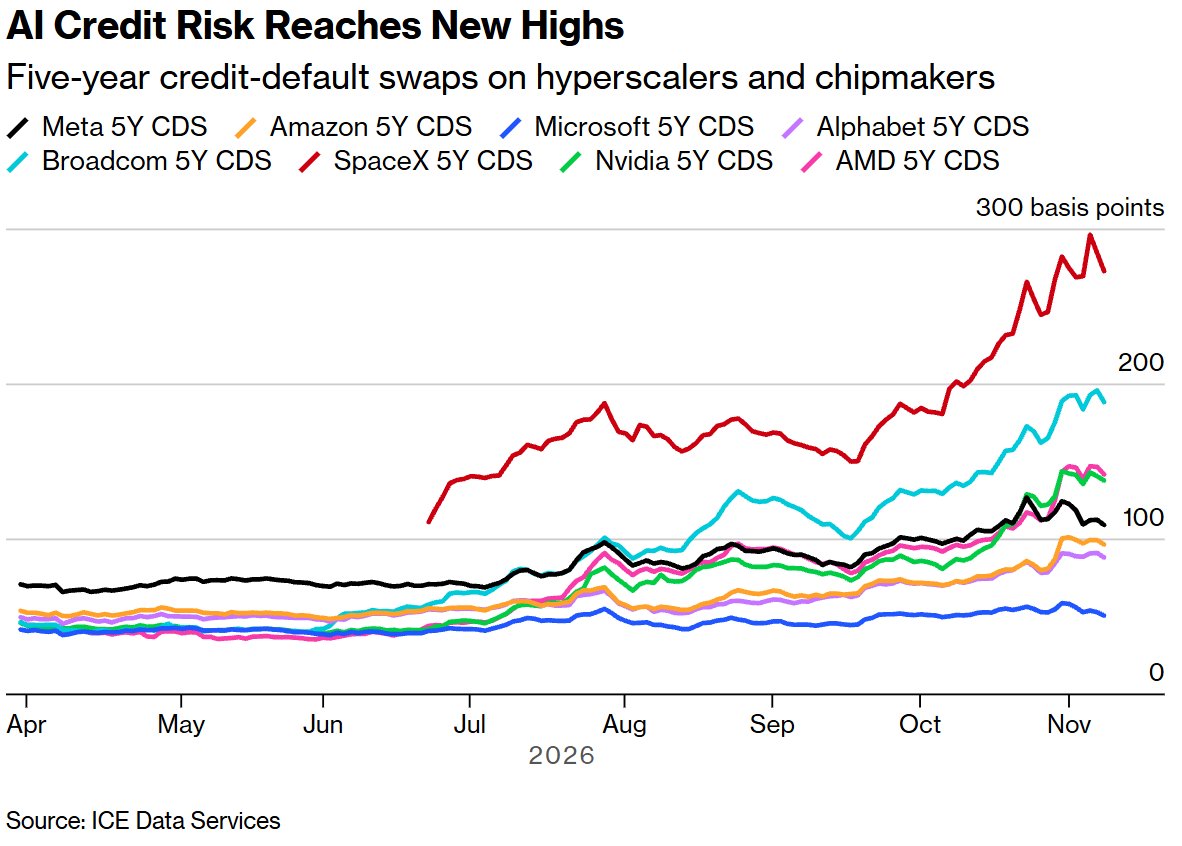
Artificial intelligence credit risk reached a record high
Indeed, this isn't the first time Wall Street has attempted to push credit default swaps to a wider audience. Such derivatives received widespread attention during the 2008 financial crisis, when investors used them to short mortgage-related debts. But when ProShares launched its first batch of CDS ETFs in 2014, the performance of these products struggled and eventually ended in liquidation.
Unlike previous funds that tracked the broader CDS market, the new products target individual companies and an AI boom whose sustainability is being scrutinized more and more severely. These ETFs will compete with shorting and options—retail investors can already use these tools to short stocks.
Tuttle Capital plans to launch five actively managed ETFs, which will actually enable retail investors to purchase leveraged credit protection for AI-related companies. The design logic of each fund is: it rises when the issuer's debt situation worsens and credit spreads widen; conversely, it falls when prospects improve and credit spreads narrow. Defiance plans to launch four ETFs with similar structures.
In some cases, investors may lose money — even if the company's stock price is plummeting — because the ongoing cost of maintaining CDS protection devours the rewards until something bad enough to damage the company's credit actually happens.
Whether it rises or falls, fluctuations can be magnified several times as fund managers plan to use borrowed funds to amplify returns.
AI Panic
In recent weeks, AI deals have collapsed, investors are increasingly concerned that huge investments in AI may take years to pay for themselves, and the Democratic Party's overwhelming victory in Congress has increased the possibility of tightening regulations. Demand for protective tools has pushed CDS prices linked to hyperscale cloud service providers and chip makers to record highs—and a year ago, such tools were almost non-existent.
Oracle has the lowest credit rating among large hyperscale cloud service providers, and is widely regarded as a “barometer” of AI debt risk. Last month, as credit risk soared in the technology sector and the market worried that the post-earnings borrowing frenzy would crush the already overburdened bond market, its five-year CDS hit a historical record. Oracle later revealed that its promise to increase net debt by only $10 billion by FY2030 has eased investors' anxiety to a certain extent.
Meanwhile, CoreWeave has invested in the US high-yield bond and loan market through multi-billion dollar transactions to finance its construction. The contract linked to this “new cloud” company began trading a year ago. It reached a record high last month after the company discussed obtaining a huge pool of capital from insurance companies, which made investors uneasy. Currently, the pricing of these swaps takes into account a probability of over 60% default over the next five years.
The debts issued by Oracle and Meta all have investment-grade credit ratings. CoreWeave is rated B by S&P Global Ratings.
Trading volume reached a record high
The CDS transaction volume linking the ten largest hyperscale cloud service providers and chip makers is at an all-time high, making these swaps one of the most actively traded contracts outside the financial sector in the US market.
According to Barclays credit strategist Gigal Patel's analysis of transaction deposit data, Oracle CDS is the most active single-name contract in the US market so far, reaching a record scale of 47.6 billion US dollars, while the cumulative scale for this year ended October 30 was only 8.7 billion US dollars. CoreWeave's deal size is $4.6 billion, compared to just $145 million previously.
Industry research analyst James Seyfat said that due to the high complexity of the product, these new CDS-linked ETFs may be difficult to win over retail traders, but if AI sell-off deepens, the situation may change.
Sefat said, “Anyone who has read anything related to the global financial crisis will know what these are. But will they actually buy an ETF based on this? Maybe, but I'm skeptical.” “Despite this, no matter how niche, a product that appears in the right place and at the right time can have a snowball effect.”