
AI's biggest IPO is here! Anthropic (ANT.US) plans to raise up to US$90.4 billion, with a valuation sprint of US$1.4 trillion
The Zhitong Finance App learned that Anthropic PBC (ANT.US) is seeking a fully diluted valuation of approximately $1.4 trillion in its initial public offering to become the first cutting-edge artificial intelligence laboratory to go public. The Claude chatbot developer and some of its investors plan to raise up to $90.4 billion in total through an IPO and a private placement.
According to a filing with the US Securities and Exchange Commission (SEC) on Tuesday, the underlying offering raised up to $64.4 billion, with a pricing range of $70 to $78 per share. Of these, the company issued 801.4 million shares and old shareholders sold 23.6 million shares. According to the documents, the offering also included a private placement with a total capital of 26 billion US dollars. The subscribers were AMD (AMD.US), Broadcom (AVGO.US), Google (GOOGL.US), Micron (MU.US), Microsoft (MSFT.US), Nvidia (NVDA.US), and TSM.US (TSM.US).
Valuation caliber
Based on the upper limit of the pricing range and based on the issued foreign share capital as listed in the document, Anthropic's market value is approximately $1 trillion. If employee stock options, restricted stocks, and shares reserved for the company's charitable donation matching program are included, the fully diluted valuation is approximately $1.4 trillion.
Calculations show that if over-allotment rights (green shoes) are included, the total amount of capital raised, including private placement, would be close to US$100 billion. This would surpass SpaceX's $75 billion base issuance scale, and also surpass its $862 billion including the Green Shoe.
This goal contrasts with the sharp sell-off of AI stocks last week: the market expects that politicians advocating stronger data center supervision will drive up costs and limit technological development. Investors are being forced to decide whether the AI sector's valuation is a reasonable path or an overconfidence in a subject that has yet to prove durability.
The business side of the document
The widespread adoption of Claude Code and its competitors among software developers points to the possibility that many professional activities can be transformed: from discovering new drugs, to dealing with complex legal and accounting rules, to operating a factory. Claude made over 90% of contributions to the Anthropic codebase, according to the file.
The company has launched so-called vertical solutions in these fields, with a particular focus on healthcare and life sciences, and Novartis CEO Vas Narasimhan is one of its directors.
According to the terms of the deal, pricing for this IPO is scheduled for November 18 (Wednesday). Goldman Sachs and Morgan Stanley take the lead, with 20 other investment banks participating; the stock is expected to be traded on the NASDAQ Global Select Market under the code ANT.
Sales are surging. Documents show that for the third quarter ending September 30, the company's revenue was close to US$17 billion, compared to US$1.4 billion in the same period last year. On Monday, Anthropic released new versions of the Mythos and Fable models, both faster than previous generations, with Fable being less expensive — at a time when some businesses are cutting back on spending on the technology.
$895 billion commitment and negative operating profit
To maintain a very high level of R&D, revenue growth must be faster than Anthropic's spending on AI infrastructure. The documents show that the company is burdened with $895 billion in promises, most of which is for computing power and chips. Approximately $70 billion must be paid over the year ending September 2027 — a figure that exceeds the individual market value of about two-thirds of the S&P 500 constituent companies.
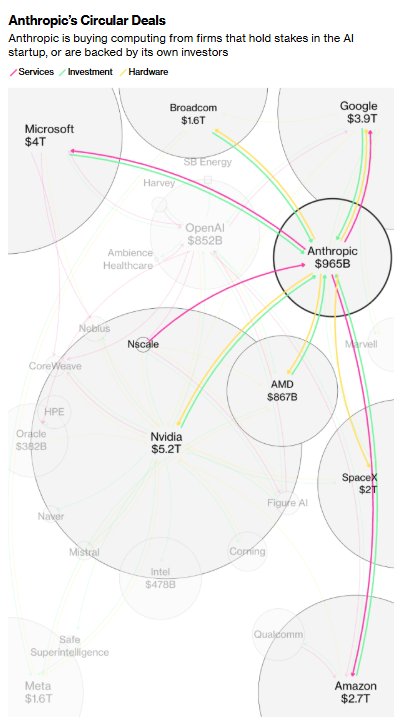
Unlike tech companies that have revenue buffers such as advertising, Anthropic must convince investors that focusing on AI itself can generate profits that far exceed the cost of technology. SpaceX's IPO pitch may also have tied to AI ambitions, but most of its revenue came from other business lines at the time.
Asset management companies, and some of the largest technology companies that invest in the wind industry, are still betting tens of billions of dollars. Prior to the IPO, funds owned by institutions such as Fidelity Investments, Capital Group, BlackRock, and venture capital such as Iconiq, Spark Capital, and Sequoia Capital held shares; Google, Amazon, and Microsoft were both investors, customers, and key computing power suppliers.
The company's total operating expenses jumped to $17.5 billion in the third quarter, up 292% year over year. In the three months ending September 30, operating profit regained negative $567 million from $974 million in the second quarter (the first correction after at least five quarters of losses). The losses were mainly due to $5 billion in short-term promised computing power costs and $2 billion in non-cash expenses associated with charitable donation matching programs.
AI pricing pressure is already impacting revenue. According to the documents, partial price cuts for the new model, combined with contract discounts granted to some customers, reduced third-quarter revenue growth by about $600 million. Anthropic lowered prices in the release of new models, including Opus 5.5 in September, and OpenAI also launched cheaper models in recent months. These giants also face competition for cheaper open source weighting models, including models launched by Chinese developers, which customers can download and fine-tune themselves.
Security narrative and governance structure
The speed of research and development is becoming increasingly controversial. Anthropic CEO Dario Amodei himself called on the head AI lab to “set the pace at the cutting edge” to prioritize safety. Anthropic warned in its prospectus that if the technology is not developed under full guarantees and supervision, it may pose a “disastrous or existential risk” to humans.
Regulators, investors, and even Anthropic employees have pointed out the significant risk that humans will lose control of the technology, and one of them gave a probability of “AI destroying all of humanity in the next ten years” greater than 10%. Bill Gates said AI was powerful enough to drive the events that led to “one billion deaths.”
Competitor OpenAI aims to go public in 2027, and its CEO Sam Altman called 2026 an “unwise time” for an IPO, citing concerns about AI security. According to people familiar with the matter, the company is financing at a valuation of $1.25 trillion.
Anthropic started when a former OpenAI executive left because he wanted to prioritize AI security. Nearly six years after its establishment, it formed itself as a public service company (PBC), which balances shareholders' interests with social interests. Its governance includes a long-term interest trust, which has the power to elect and remove most members of the company's board of directors.
Each of the seven co-founders holds about 1.4%, and even if they fulfill their promise to donate 80% of their individual shares, each is still several times the net worth of one billion US dollars.