
Sally Beauty (NYSE:SBH) reports Q3 CY2026 in line with expectations

Beauty supply retailer Sally Beauty (NYSE:SBH) met Wall Street’s revenue expectations in calendar Q3 2026 (fiscal Q4 2026), but revenue was flat year on year at $952.5 million. The company expects next quarter’s revenue to be around $950 million, close to analysts’ consensus estimates. Its non-GAAP profit of $0.62 per share was 3.3% above analysts’ consensus estimates.
For more on Sally Beauty, read our free full research report.
Sally Beauty (SBH) Q3 CY2026 highlights:
- Revenue $952.5 million vs S&P analyst consensus of $949.6 million (flat year on year, in line)
- Adjusted EPS $0.62 vs S&P analyst consensus of $0.60 (3.3% beat)
- Adjusted EBITDA $126 million vs analysts’ consensus estimates of $120.6 million (13.2% margin, 4.5% beat)
- Revenue guidance $950 million at the midpoint for Q4 CY2026, roughly in line with what analysts were expecting
- Adjusted EPS guidance $2.25 at the midpoint for fiscal 2027, beating analysts’ consensus estimates by 0.7%
- Operating margin 9.7%, up from 8.4% in the same quarter last year
- Free cash flow margin 4.9%, down from 8.2% in the same quarter last year
- Locations 4,390 at quarter end, down from 4,422 in the same quarter last year
- Same-store sales were flat year on year, in line with the same quarter last year
- Market capitalization $1.82 billion
“We finished fiscal 2026 with positive momentum, delivering fourth quarter sales, operating earnings and double-digit adjusted EPS growth,” said Denise Paulonis, president and chief executive officer. “Throughout the year, we strengthened our business through disciplined execution, new customer growth, digital and omnichannel expansion, product innovation, and continued advancement of our long-term growth agenda. We generated $323 million of cash from operations, strengthened our balance sheet, and returned significant capital to shareholders while continuing to invest in our future. As we enter fiscal 2027, we are focused on scaling the capabilities and growth platforms we have built, deepening customer engagement, and generating profitable growth, all in support of driving long-term shareholder value.”
Revenue growth
Reviewing a company’s long-term revenue performance reveals insights into its quality. Even a weak business can perform well for one or two quarters, but a high-quality one grows for years.
With $3.73 billion in revenue over the past 12 months, Sally Beauty is a small retailer, which sometimes brings disadvantages compared to larger competitors benefiting from economies of scale and negotiating leverage with suppliers.
Sally Beauty struggled to increase demand as its $3.73 billion in revenue for the trailing 12 months was close to its revenue three years ago. This was mainly because it didn’t open many new stores.
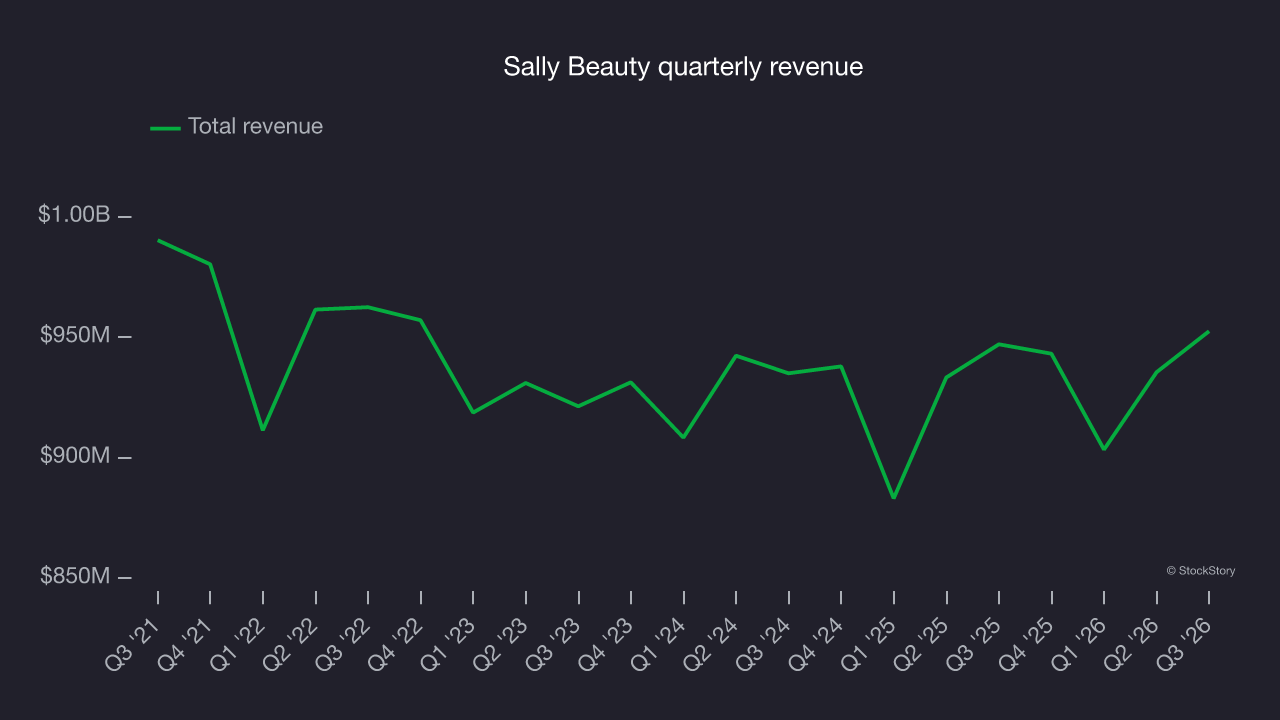
This quarter, Sally Beauty’s $952.5 million in revenue was flat year on year and in line with Wall Street’s consensus estimates. Management is guiding for flat revenue next quarter.
Looking further ahead, sell-side analysts expect revenue to remain flat over the next 12 months, according to S&P. This projection is underwhelming and indicates its newer products will not lead to better top-line performance yet.
Store performance
Number of stores
A retailer’s store count often determines how much revenue it can generate.
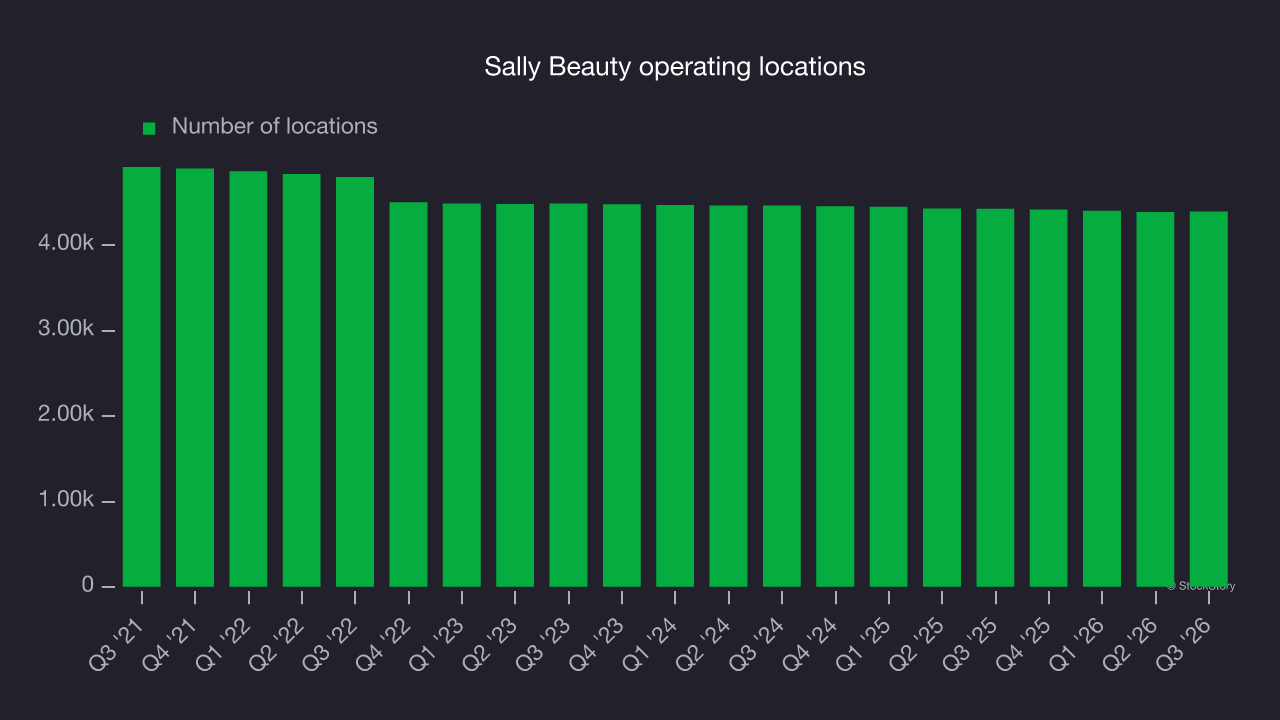
Sally Beauty listed 4,390 locations in the latest quarter and has kept its store count flat over the last two years while other consumer retail businesses have opted for growth.
When a retailer keeps its store footprint steady, it usually means demand is stable and it’s focusing on operational efficiency to increase profitability.
Same-store sales
A company’s store base only paints one part of the picture. When demand is high, it makes sense to open more. But when demand is low, it’s prudent to close some locations and use the money in other ways. Same-store sales offer insight into this topic because they measure organic growth for a retailer’s e-commerce platform and brick-and-mortar shops that have existed for at least a year.
Sally Beauty’s demand within its existing locations has barely increased over the last two years as its same-store sales were flat. This performance isn’t ideal, and any move by Sally Beauty to open new stores to artificially boost revenue growth would warrant skepticism.
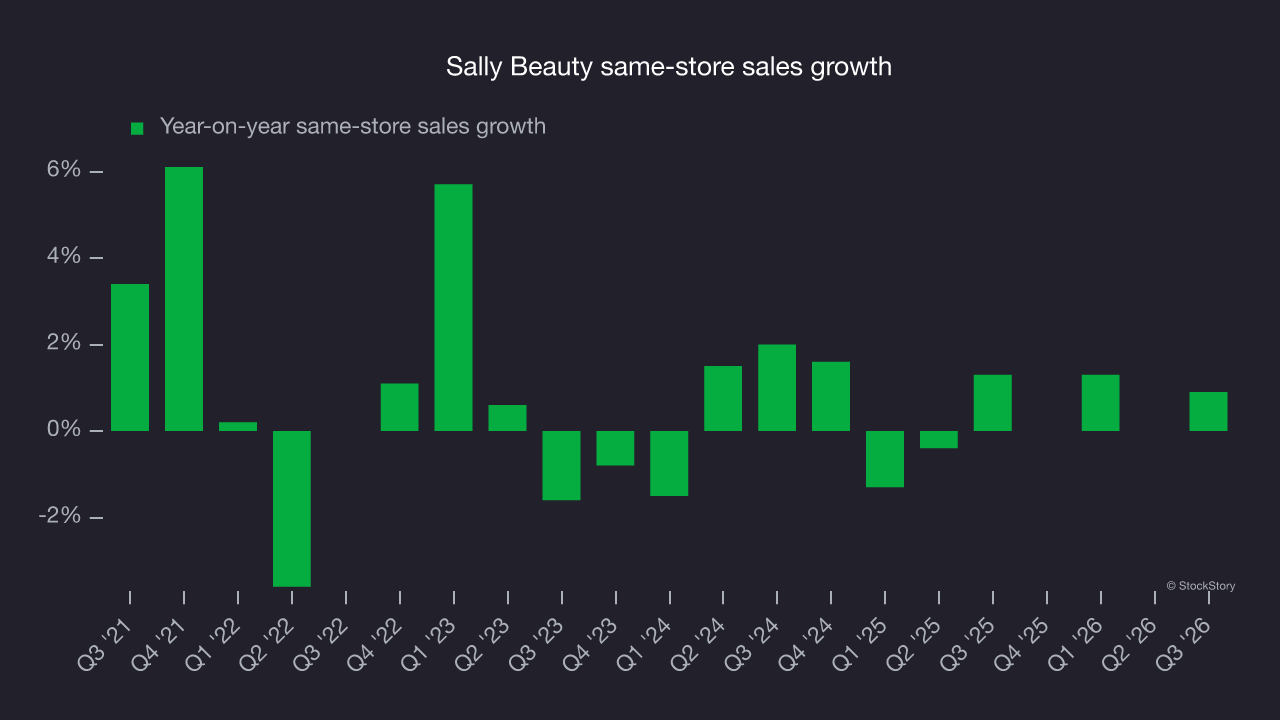
In the latest quarter, Sally Beauty’s year-on-year same-store sales were flat. This performance was more or less in line with its historical levels.
Key takeaways from Sally Beauty’s Q3 results
Sally Beauty’s outlook was split: Full-year EPS guidance slightly exceeded Wall Street’s consensus estimates, but next-quarter EPS guidance missed. EBITDA beat analysts’ consensus expectations, but gross margin fell slightly short of Wall Street’s consensus, making this a softer quarter overall. Shares rose 2.3% to $19.94 immediately after the release.
Evaluating Sally Beauty at its current price requires a broader view. What happened in the latest quarter matters, but not as much as longer-term business quality and valuation when deciding whether to invest in this stock. Read the full research report here (it’s free).